
US Aligns with Canada and Mexico to Modernise North American Air Hubs with Digital Borders

Published
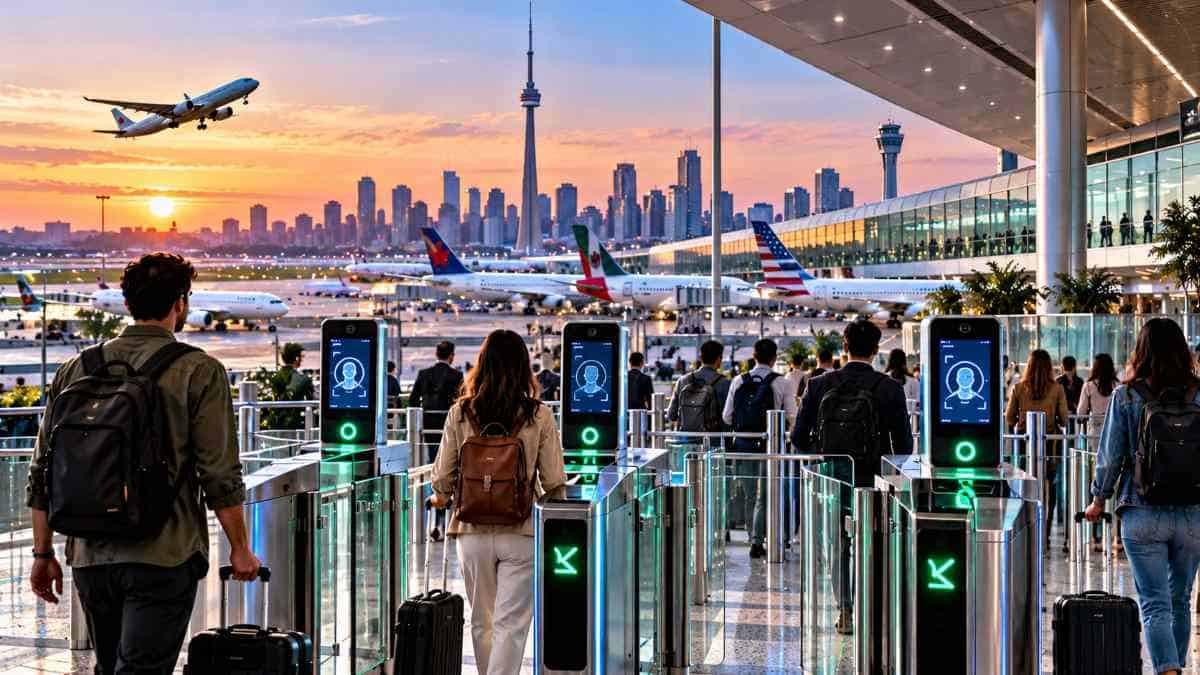
Image generated with Ai
Indeed, the US, Mexico and Canada are now moving towards a new era of international travel involving biometric identification, electronic declaration, trusted traveller programs and pre-clearance procedures, all becoming more common at major ports of entry. Currently, the US, Mexico and Canada do not have a single biometric corridor connecting Toronto, Mexico City, Dallas and Atlanta. Rather, passengers encounter a series of bilateral and national systems that are progressively making international travel increasingly digital. Such a fact is especially important for September 2026 since the FIFA World Cup 2026 has already been held. This international football tournament took place from June 11 to July 19, 2026, in the three countries.
Toronto Strengthens Digital Border Processing
Advertisement
Advertisement
Toronto has emerged as an important part of the new travel infrastructure.
At Toronto Pearson International Airport, eligible travellers can use Advance Declaration to submit customs and immigration information before arriving in Canada. During the World Cup, the Canada Border Services Agency encouraged international passengers and accredited travellers to prepare declarations in advance to help manage higher volumes.
Advertisement
Advertisement
Canada has also expanded the use of systems designed to reduce unnecessary physical border interactions.
In June 2026, the CBSA introduced Free Flow International-to-International Transit at Toronto Pearson Terminal 1, alongside Vancouver and Montréal-Trudeau. Eligible international-to-international connecting passengers can proceed directly towards their next flight rather than completing a traditional customs check-in, while airlines provide travel information to the CBSA.
Advertisement
Advertisement
The development is significant because it changes the airport experience without removing border controls. Passenger information is shared digitally, allowing authorities to maintain oversight while reducing one physical step in the journey.
Toronto Adds Another Pre-Clearance Link
A further development came at Billy Bishop Toronto City Airport, where a new US pre-clearance facility was launched in 2026.
The facility allows US-bound passengers to complete US Customs and Border Protection inspection before departure from Toronto. Once they arrive in the United States, eligible passengers can therefore proceed without repeating the same customs and immigration process.
The Canadian government describes the project as a partnership with US Customs and Border Protection, with the facility intended to support cross-border tourism, aviation connectivity and economic activity.
This is not a new concept for Canada. US pre-clearance has operated at Canadian airports for decades, but the expansion at Billy Bishop adds another Toronto gateway to the network.
Advertisement
Advertisement
Mexico Pushes Digital Processing
Mexico is pursuing a parallel digital approach.
The country has introduced a digital migration form for Mexican citizens travelling abroad. The system allows users to enter travel information electronically before reaching the airport and integrates with Llave MX to reduce repeated data entry.
By March 2026, Mexico’s government reported that more than 1.13 million users had accessed the digital form since its launch in November 2025.
The system was being used particularly at major international airports, including Mexico City, Cancún, Guadalajara, Felipe Ángeles, Monterrey and Morelia.
This development does not constitute a shared US-Mexico-Canada biometric corridor. It does, however, demonstrate how Mexico is digitising parts of the passenger journey independently while North America’s wider border architecture becomes more technology-driven.
Advertisement
Advertisement
Trusted Travellers Already Connect the Region
The strongest existing example of cross-border integration is found in trusted-traveller programmes.
NEXUS is jointly operated by the United States and Canada and provides expedited processing for pre-approved travellers crossing between the two countries by air, land and sea.
The United States also operates SENTRI for pre-approved travellers entering the country from Mexico. Global Entry provides expedited US arrival processing at participating airports, while NEXUS members can use relevant processing technology at US pre-clearance locations in Canada.
These programmes use risk-based screening and, in relevant airport environments, biometric facial comparison or other identity-verification technology.
The result is a network of dedicated lanes and automated processing rather than a single continental system.
Advertisement
Advertisement
The World Cup Accelerated the Need for Capacity
The 2026 FIFA World Cup gave North American border agencies a major operational challenge.
Toronto and Vancouver hosted matches in Canada, while Mexico City, Guadalajara and Monterrey hosted games in Mexico. The United States hosted matches across multiple cities, including Dallas and Atlanta.
The scale was unprecedented for a tournament staged across three countries. Canada alone expected hundreds of thousands of visitors in Toronto, while Mexican authorities prepared for millions of international visitors.
The US Department of Transportation also tracked significant cross-border movement during the tournament period. Data released in September showed passenger and vehicle traffic rising along important corridors serving host cities.
This experience provides a useful reference point for future international events, even though the tournament itself has now ended.
Advertisement
Advertisement
What Comes Next for North American Travel
Travelling in the right direction becomes more evident: border management shifts from using paper documents and rechecking manually to advance declarations, digital identification, automatic gates, and traveller programs. However, the system still works on the basis of national and bilateral arrangements. A traveller passing from Toronto, Mexico City, and Dallas to Atlanta has to meet different conditions at each step.
There is also not yet any biometric profile that enables free passage between the three cities without restrictions. The advantage of this system from the perspective of the passengers is that they will be able to find out beforehand which digital solutions can be used for their respective trips prior to arriving at the airport. On the side of the airports and tourism boards, the greater advantage of this initiative lies in the fact that they can provide the passengers with a more predictable experience, while still being able to enforce their immigration, customs and security protocols. So rather than a single super corridor that would become the future of borders in North America, the development of interconnected systems that will minimise friction at each step of the international trip process seems to be the way to go.
Advertisement
