
Haiti Strengthens Digital Tourism Backbone as Cap-Haïtien and Jacmel Prepare for Future Travel Recovery

Updated
Published
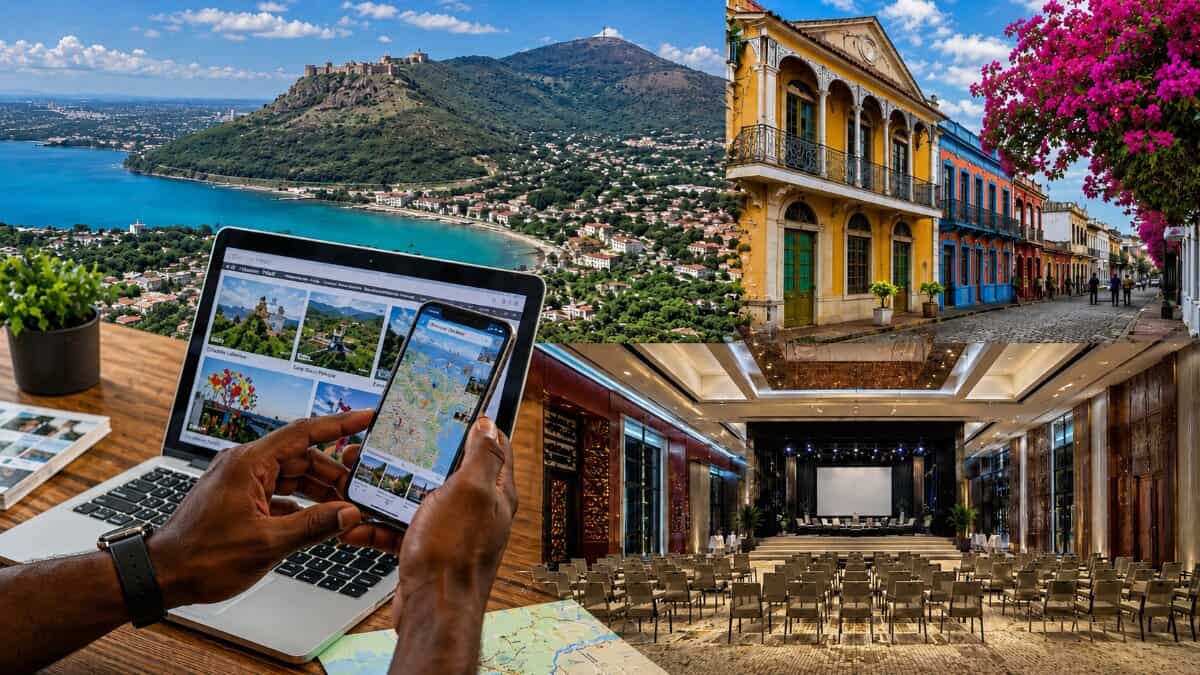
Image generated with Ai
Haiti is quietly developing something potentially more important to its future visitor economy than a conventional tourism website. Government records and the ministry-backed Discover Haiti platform indicate an emerging digital architecture capable of connecting destination maps, heritage information, tourism businesses, trip planning and eventually booking systems. For Cap-Haïtien and Jacmel, where authorities are simultaneously preserving visitor infrastructure, the technology could maintain destination inventory and commercial visibility long before normal international tourism conditions return. The project remains developmental rather than evidence of a tourism reopening.
Haiti’s Bigger Travel-Tech Story Is the Data Layer Behind the Tourism Interface
The significant development for travel-technology companies, destination management organisations, tour operators and travel sellers is the architecture sitting underneath Haiti’s digital tourism programme.
According to Haiti’s Ministry of Tourism, Klike sou Ayiti was presented on 26 February 2026 as the first functional components of a national tourism-indexing infrastructure. The system is intended to organise tourism sites, existing circuits and destination information by geography and category, while creating a national integrated hub capable of connecting databases, content, maps, booking platforms and existing information systems.
That makes the initiative materially different from a conventional destination marketing site.
Advertisement
Advertisement
The ministry describes an eventual orchestration layer distributing Haiti’s tourism ecosystem through a unified digital infrastructure. In travel-technology terms, that points towards a destination data and distribution environment rather than merely a publishing platform. The government has not published an application programming interface specification, connectivity partners, transaction volumes or a production rollout timetable, so it would be premature to describe the system as a fully operational destination management or distribution platform.
The Emerging Haiti Tourism Technology Stack
| Digital component | Confirmed function | B2B travel significance | Status visible in official records |
|---|---|---|---|
| National tourism mapping | Organises sites, circuits, zones and tourism categories | Creates structured destination inventory for search and itinerary construction | Functionally demonstrated |
| Tourism knowledge space | Centralises information for operators, investors, institutions, researchers and diaspora users | Provides a reference layer for destination development and product design | Demonstrated |
| Kwonik Ayiti | Interactive mapping of Haitian heritage and history | Can connect cultural assets with itinerary and heritage-tourism products | Demonstrated |
| Stay-planning application | Intended to support trip planning | Moves the programme from inspiration towards conversion | Listed as under development in February |
| Discover Haiti or Touris platform | Searches hotels, restaurants, attractions, cafés, shops, services and tourism sites | Creates a structured establishment-discovery interface | Public web platform exists |
| Partner workspace | Allows tourism establishments to register and manage their own information | Introduces supplier-managed inventory rather than wholly centralised publishing | Partner authentication area exists |
| Administrative controls | Government administrators can supervise displayed information and data quality | Creates a governance layer around destination records | Confirmed in platform policy |
| Reservation interaction | User data may be shared with selected partners during reservation interactions | Establishes a possible bridge between discovery and transactions | Function acknowledged |
| Integrated national hub | Intended to connect databases, maps, content, booking platforms and information systems | Could become the distribution backbone for future recovery | Prototype vision, not final rollout |
Sources: Haiti Ministry of Tourism and the ministry-backed Discover Haiti platform
Advertisement
Advertisement
Supplier-Controlled Listings Could Become Haiti’s Most Important Digital Asset
A particularly important detail appears on the Discover Haiti platform rather than in the headline government announcement.
The platform identifies Touris App as an initiative of Haiti’s Ministry of Tourism and says participating establishments such as hotels, restaurants and cultural sites can register and manage their own profiles. Administrators can supervise and maintain the quality of information shown to users. The service also provides for interactions between travellers and partners, including reservation-related activity.
That combination is significant for the travel trade.
A destination recovering from prolonged disruption does not merely need advertising. It needs a current record of which accommodation providers, visitor attractions, restaurants, cultural venues and tourism services still exist, where they operate and whether they are capable of receiving customers.
Supplier-controlled records can potentially shorten that rebuilding process because establishments themselves can update information rather than waiting for an entirely new national inventory exercise after conditions improve.
The platform also collects anonymised usage information for the Ministry of Tourism, including navigation behaviour and approximate country-level or city-level visitor origin. If developed at scale, such data could eventually help authorities identify destination interest before physical arrivals recover. No official figures on users, establishments, bookings or conversion rates have yet been published.
Advertisement
Advertisement
Cap-Haïtien Connects the Digital Project With Airport, Market and Heritage Infrastructure
Cap-Haïtien provides the clearest example of why a national tourism-data layer could matter operationally.
According to Haiti’s Ministry of Tourism, work in the north has included rehabilitation of the Northern Tourism Market, modernisation of reception services at Cap-Haïtien International Airport and further development of cultural and heritage circuits. An earlier ministry review also recorded energy improvements at the tourism market and work intended to improve the airport passenger experience.
Cap-Haïtien is especially important because the northern tourism proposition extends beyond the city itself.
UNESCO’s National History Park comprising the Citadel, Sans Souci and Ramiers has been on the World Heritage List since 1982. UNESCO records continuing conservation and management requirements for the site, including visitor-management considerations. The World Heritage Committee’s 2025 decision also noted continuing work relating to conservation and public use.
The travel-tech opportunity is therefore not simply putting Cap-Haïtien on a digital map. A properly governed tourism database could eventually connect airport arrival information, hotels, heritage circuits, guides, attractions and local commercial services into a structured itinerary environment.
That would be particularly valuable for tour operators attempting to rebuild northern Haiti programmes after a prolonged period of uncertainty.
Advertisement
Advertisement
Jacmel Gives the Platform a Heritage and Future MICE Dimension
Jacmel represents the second important test case.
According to the Ministry of Tourism, the Jacmel Convention Centre has been rehabilitated, while a programme initiated in December 2025 installed several hundred lights in tourism areas to improve visitor reception and circulation. These are physical destination-management investments rather than digital projects, but they increase the value of having a reliable digital record of local tourism infrastructure.
Jacmel also has unusually strong heritage credentials.
UNESCO lists the Historic Centre of Jacmel on Haiti’s World Heritage Tentative List and recognises Jacmel within its Creative Cities Network. Its cultural-tourism strategy is centred on safeguarding the historic centre while supporting art, craft traditions and carnival-related creative industries.
For the travel trade, this creates two potential digital product layers.
The first is heritage tourism, where mapped historic properties, cultural experiences, events and creative businesses can be organised into bookable circuits.
Advertisement
Advertisement
The second is future meetings and events business. A functioning convention facility gains far greater commercial utility when it can be digitally linked to accommodation, restaurants, transfers, cultural programmes and local suppliers. Haiti has not announced that the Jacmel Convention Centre itself is integrated into an online MICE booking engine, so this remains a future commercial opportunity rather than a current capability.
Haiti Is Linking New Digital Architecture With Older Destination Investment
The digital strategy also builds on a much longer history of destination-development investment.
The Inter-American Development Bank approved a US$2.43 million project in 2010 aimed at developing Haiti’s Northern Department as a tourism destination through public-private destination management and culturally based tourism products. In 2014, the IDB approved a Sustainable Coastal Tourism Program in southern Haiti with a total project cost of US$48 million and an original US$36 million grant allocation.
| Tourism development layer | Northern Haiti / Cap-Haïtien sphere | Southern Haiti / Jacmel sphere |
| Long-term destination strategy | Northern destination-management and tourism-product development | Sustainable coastal and cultural tourism investment |
| Heritage anchor | UNESCO National History Park | Historic Centre of Jacmel and Creative City identity |
| Current physical works | Tourism market, airport reception, cultural circuits | Convention centre rehabilitation, tourism-area lighting |
| Digital opportunity | Connect arrival gateways, accommodation, guides and heritage circuits | Connect cultural businesses, events, venues, accommodation and experiences |
| Strategic value | Faster rebuilding of structured northern itineraries | Preservation of cultural-tourism and potential MICE inventory |
The new element in 2026 is therefore not tourism development itself. It is the attempt to create a common digital layer through which fragmented tourism assets could eventually be discovered, managed and distributed.
Why This Matters Even While International Tourism Remains Severely Constrained
This development must not be interpreted as a conventional destination reopening.
The UK Foreign, Commonwealth and Development Office continues to advise against all travel to Haiti. The United States maintained Haiti at Level 4 Do Not Travel in its 10 July 2026 advisory because of crime, kidnapping, unrest, terrorism risks and limited healthcare capacity. The US advisory also notes continuing restrictions affecting government personnel and commercial aviation involving Port-au-Prince.
Advertisement
Advertisement
The United Nations’ 2026 humanitarian framework similarly describes continuing insecurity and displacement, while identifying the Grand North and Grand South as relatively more stable areas receiving displaced populations compared with the areas experiencing the most acute violence.
That distinction explains why digital preservation matters.
Tourism systems can be developed even when international demand cannot safely be activated. Mapping attractions, maintaining supplier records, digitising cultural assets and establishing partner accounts preserve institutional knowledge that might otherwise become fragmented during a prolonged crisis.
The Information-Gain Angle for Global Travel Technology
Haiti may effectively be attempting something uncommon in destination recovery: constructing digital commercial readiness before physical tourism normalisation.
Most destination digitalisation projects are designed to improve an already functioning visitor economy. Haiti faces the reverse problem. Its challenge is preserving tourism discoverability, supplier identity, heritage information and commercial relationships while mobility remains severely disrupted.
If the architecture progresses from prototype to production, its value will depend less on the consumer interface than on five technical issues: the completeness of supplier records, frequency of updates, verification standards, connectivity with third-party booking systems and the ability to maintain accurate operational information during disruption.
Advertisement
Advertisement
The government has not yet released public metrics covering those points.
That absence is important for B2B readers. As of 26 August 2026, Klike sou Ayiti should be regarded as emerging destination infrastructure, not a mature distribution system. Its strategic significance is substantial, but measurable commercial performance remains unproven.
What Travel Agents and Tour Operators Should Do Now
- Do not interpret digital tourism development as a safety clearance. Continue following official government travel advisories and insurance requirements.
- Treat online listings as leads rather than automatic operational confirmation. Verify hotels, transport providers, attractions and guides directly before contracting.
- Monitor the transition from prototype to production. A final national launch, partner count, inventory volume, booking integration or API documentation would materially change the platform’s B2B relevance.
- Watch Cap-Haïtien separately from Port-au-Prince. Airport reception improvements and northern heritage investment make it an important future gateway, but current connectivity and security must be checked independently.
- Track Jacmel’s event and cultural infrastructure. The rehabilitated convention centre and heritage ecosystem could support future group, cultural and MICE programmes once operating conditions permit.
- Preserve flexible contracting. Cancellation, force-majeure, ground-handling and emergency-support provisions remain essential in any future Haiti programme.
- Use official data wherever possible. Haiti’s developing government-controlled tourism inventory could eventually provide a stronger verification layer than fragmented destination information, but that capability is not yet proven at scale.
Haiti’s Travel-Tech Experiment Could Shape How Crisis-Affected Destinations Prepare for Recovery
The long-term importance of Haiti’s initiative lies in sequencing. Cap-Haïtien and Jacmel are receiving physical tourism-preservation work while the national government simultaneously develops maps, heritage databases, trip-planning capability, supplier management and potential booking connectivity.
If those systems mature, Haiti would not need to rebuild its tourism information architecture from zero when travel conditions improve. Destination assets could already be digitally identified, suppliers could already have management access, heritage could already be structured for discovery, and booking distribution could potentially be connected to a prepared national data layer.
That is a more consequential travel-technology story than the launch of a new tourism website. For the global travel industry, Haiti is becoming a test of whether digital destination readiness can be built before demand recovery itself. Cap-Haïtien and Jacmel will be two of the clearest places to watch whether that strategy eventually translates from preserved tourism inventory into functioning, distributable and commercially viable travel products.
Advertisement
