
Barcelona Travel Hit by Catalonia Floods as Deadly Torrential Rain Disrupts Spain’s Transport Network

Published
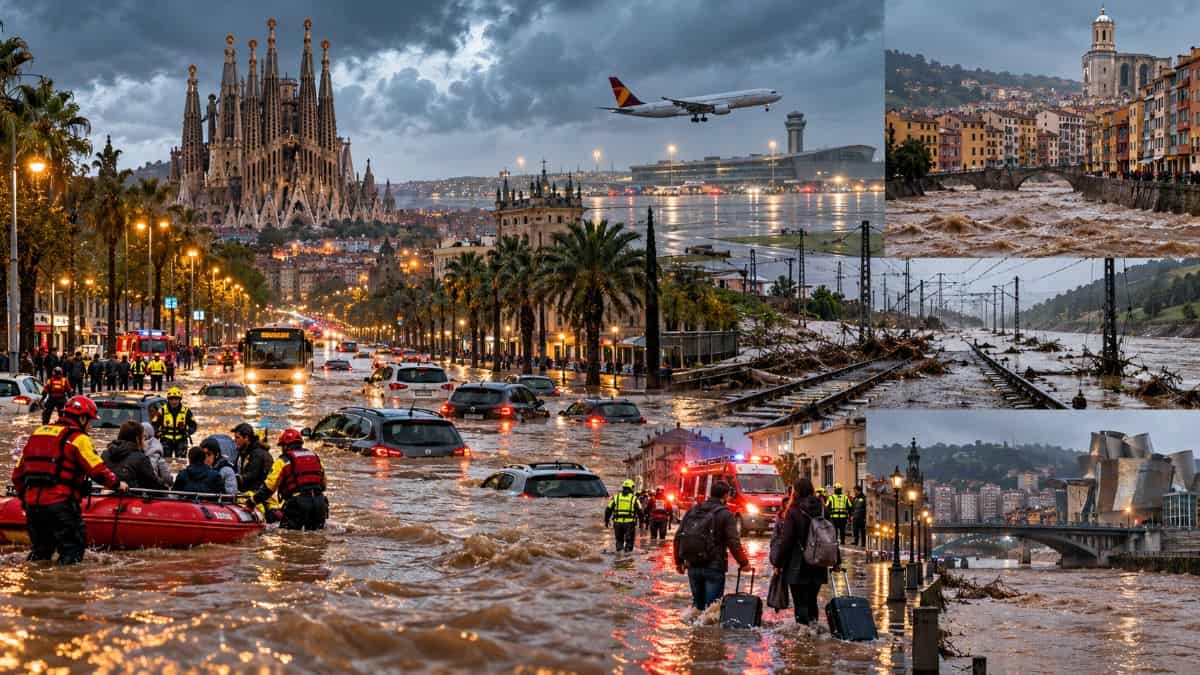
Image generated with Ai
Spain’s latest weather emergency has widened beyond Catalonia, with three confirmed deaths, one person missing and extensive flooding reported across several regions. Two people died in Catalonia after torrential rain overwhelmed communities around Barcelona, while a 102-year-old woman died earlier in Madrigueras, Albacete.
The emergency has also become a significant travel disruption across northeastern Spain. Barcelona-El Prat experienced flight cancellations, while flooding halted or restricted rail services, roads and local transport. Meanwhile, Girona remained vulnerable as swollen rivers and saturated ground created fresh risks for travellers.
The Flood Emergency Has Spread Beyond Barcelona
The latest picture shows a broader Spanish weather emergency rather than an isolated Barcelona incident. Spain’s Civil Protection authorities had already warned of intense and persistent storms across the eastern and northeastern peninsula, including Catalonia, the Valencian Community and the Balearic Islands.
The official warning highlighted the risk of sudden flooding in low-lying areas, streams and drainage channels. Authorities also warned that repeated rainfall could increase danger where substantial accumulations had already occurred.
Advertisement
Advertisement
By Monday, Catalonia had begun lifting some mobility restrictions. However, authorities continued to warn of localised heavy rain across the coast, pre-coastal areas and northeastern parts of the region.
The human cost is already significant. Two deaths occurred in the Barcelona province, while another person remained missing after being seen falling into a watercourse at Pineda de Mar.
Advertisement
Advertisement
| Location | Reported impact | Traveller significance |
|---|---|---|
| Tordera, Barcelona province | One death after a wall collapsed | Local roads and outdoor sites affected |
| Montornès del Vallès | One death in flooding | Urban travel and road disruption |
| Pineda de Mar | One person missing | Coastal mobility and watercourse risk |
| Barcelona metropolitan area | Flooding, transport disruption | Flights, trains and roads affected |
| Girona and Empordà | Flood and river risks | Restrictions affected regional travel |
| Madrigueras, Albacete | One death and about 90 rescues | Severe local flooding and recovery |
| Biscay | Extensive rain-related incidents | Roads and urban areas affected |
| Balearic Islands | Rain and storm alerts | Potential ferry and flight disruption |
Barcelona Bears the Brunt of the Travel Disruption
For international visitors, Barcelona has emerged as the most important transport concern. The city combines a major international airport with an extensive commuter rail network and high-volume tourism infrastructure.
Barcelona-El Prat handled 57.5 million passengers in 2025, according to airport operator Aena. It also recorded around 361,000 aircraft movements and 379 routes during that year.
Advertisement
Advertisement
That scale explains why severe weather around Barcelona quickly creates consequences beyond the immediate flood zone. Disruption can affect inbound passengers, outbound travellers, connecting passengers and airline crews.
Reports on the weekend disruption said flights were cancelled or delayed at Barcelona airport. Separate reporting based on Civil Protection figures put weekend cancellations at 385 flights, comprising 220 on Saturday and 165 on Sunday.
Travellers should therefore avoid treating airport operations as the only measure of normality. A flight may operate while road access, metro services or rail connections remain disrupted.
Aena’s official Barcelona airport information remains the appropriate source for current airport arrangements.
Advertisement
Advertisement
Rail Recovery Remains A Major Challenge
Rail travel faces a different problem because flooding can damage tracks, bridges, signalling equipment and surrounding infrastructure. Even after rainfall weakens, operators must inspect affected sections before reopening them.
Rodalies de Catalunya reported continued disruption on Monday, October 5. Several sections required alternative road transport, while other lines had resumed train operations.
The Girona–Sant Andreu and Portbou–Maçanet-Massanes sections, for example, required alternative road services. The Arenys de Mar–Maçanet-Massanes section also faced a road replacement service.
The distinction matters for visitors planning day trips. A destination may technically remain open while its principal rail connection operates only partially.
| Transport mode | Current issue | Practical traveller response |
|---|---|---|
| Air travel | Weather-related cancellations and delays reported | Check airline and airport status before departure |
| Regional rail | Multiple sections affected | Confirm the exact route, not just the destination |
| Roads | Flooding and infrastructure damage | Avoid low-lying routes during warnings |
| Metro and buses | Local disruption reported | Allow additional transfer time |
| Taxis and transfers | Road conditions can change rapidly | Confirm pickup access before travelling |
| Car hire | Flooded roads present safety risks | Do not drive through standing or moving water |
Albacete Reveals the Wider Human Cost
The second major incident unfolded away from Catalonia in Madrigueras, Albacete, where flooding caused one fatality and triggered a large rescue operation.
Regional authorities reported more than 140 litres of rainfall per square metre during the event. They also described water arriving from surrounding drainage channels and neighbouring areas, worsening conditions in the town.
Advertisement
Advertisement
A 102-year-old woman died after becoming trapped at her home. Emergency services rescued around 90 people, while vehicles, homes and public buildings suffered extensive flooding.
Castilla-La Mancha subsequently maintained its emergency plan at operational level 1 while recovery teams worked in the affected area. The regional government also announced plans to seek special disaster-area recognition for Madrigueras.
This incident is particularly relevant for tourism because it demonstrates how quickly rainfall can become dangerous outside Spain’s most visible coastal destinations.
Biscay Also Reports Serious Flood Incidents
Northern Spain was also affected as heavy rain moved through Biscay and Bilbao. Regional emergency services recorded 150 rain-related incidents in Biscay by Saturday evening, with 137 occurring in Bilbao, according to reporting citing emergency authorities.
Floodwater entered streets, businesses and garages across parts of Bilbao. Traffic restrictions also affected the La Avanzada tunnels in Leioa, while other municipalities reported water-related incidents.
No additional fatality from this Biscay episode was identified in the official material reviewed for this report. That distinction is important because the weather emergency has produced multiple serious incidents without every affected region recording deaths.
Advertisement
Advertisement
For visitors, however, the absence of fatalities does not mean the area is automatically safe for unrestricted movement.
Mediterranean Regions Face Continuing Exposure
The wider weather pattern had already prompted warnings across eastern Spain. Civil Protection identified Catalonia, the Valencian Community and the Balearic Islands among the areas exposed to intense and persistent storms.
The Balearic Islands activated orange-level warnings for rain and thunderstorms in Ibiza and Formentera. Mallorca also remained under an orange rainfall alert, while Menorca faced yellow-level warnings for rain and storms.
AEMET’s warning system provides region-specific alerts because weather impacts can differ sharply between neighbouring areas. Its system covers Spain’s autonomous communities, provinces and island territories, allowing travellers to check warnings at a much more local level.
This matters particularly for island tourism. Travellers may have a clear sky at their hotel while ferry routes, airport operations or roads elsewhere on the island face severe weather.
Why This Weather Pattern Matters
The current episode has developed from an unstable Mediterranean weather pattern capable of producing intense rainfall over short periods. Civil Protection attributed the instability to cold air at middle and upper levels combined with substantial Mediterranean moisture.
Advertisement
Advertisement
That combination creates a difficult travel environment because rainfall intensity can matter more than the daily total. Water can accumulate faster than drainage systems, streams and urban channels can handle.
The danger also persists after the heaviest rain ends. Saturated ground, damaged roads, unstable structures and swollen rivers can continue creating hazards.
Barcelona illustrates this lag effect particularly well. The immediate rainfall emergency may ease, yet railway infrastructure still requires inspection before normal operations can resume.
What Travellers Should Check Before Departure
Visitors heading towards Barcelona, Girona or other affected Spanish destinations should treat transport status and weather warnings as separate checks. A normal flight schedule does not guarantee normal onward transport.
Travellers should first check the latest AEMET warning for their destination. They should then check the airport, airline and relevant rail operator before leaving their accommodation.
Visitors should also avoid travelling into flooded areas simply to reach an attraction or photograph conditions. Moving floodwater can conceal damaged roads, open drains and unstable surfaces.
Advertisement
Advertisement
For rail journeys, passengers should verify the exact departure and arrival stations. Replacement buses can operate on some sections while trains continue normally on others. Rodalies specifically advises passengers to consult its latest service information as infrastructure recovery progresses.
The safest approach is therefore to build flexibility into Spanish itineraries during an active weather emergency. Travellers with tight connections should consider allowing several hours of additional margin.
A Warning for Autumn Travel Planning
The latest emergency also highlights a wider issue for Spain’s autumn tourism calendar. October remains an important month for city breaks, cultural travel, coastal holidays and business events.
Barcelona’s transport system is particularly important because the city functions as both a leisure destination and an international aviation gateway. Aena recorded more than 57 million passengers at Barcelona-El Prat during 2025, demonstrating the scale of potential disruption when extreme weather affects the metropolitan area.
The current episode also shows why travellers should look beyond national weather forecasts. Conditions can vary dramatically between Barcelona, Girona, Albacete, Bilbao and the Balearic Islands.
Spain’s official warning architecture is designed around that geographic variation. AEMET maintains warning information across individual autonomous communities and smaller geographical zones, while regional emergency authorities issue local mobility instructions.
Advertisement
Advertisement
For tourism businesses, the episode reinforces the value of flexible booking policies, rapid passenger communication and contingency transport arrangements. Hotels, tour operators and destination managers can also help visitors interpret local restrictions when transport systems change rapidly.
Spain’s Travel Picture Remains Fluid
The latest official Catalan assessment indicates that the worst immediate river-overflow risk has eased. However, recovery remains underway, and some transport infrastructure continues to operate under restrictions or alternative arrangements.
Catalonia’s emergency response has been substantial. Authorities reported 8,151 emergency calls, while firefighters carried out 2,440 operations, including 226 rescues, during the wider weekend episode.
The figures underline the scale of the disruption beyond the headline death toll. Roads, railways, homes, public facilities and tourism-related movement have all faced pressure.
The broader Spanish picture also remains important. Three deaths have now been linked to the flooding episode, with two in Barcelona province and one in Albacete, while emergency teams continue recovery and infrastructure checks.
For travellers, the message is straightforward. Barcelona and affected parts of Catalonia should not automatically be avoided, but journeys require real-time checks, route flexibility and strict compliance with official warnings.
Advertisement
