

China Travel Gains Momentum as Hong Kong MTR Settles High-Speed Rail Delay Dispute

Published
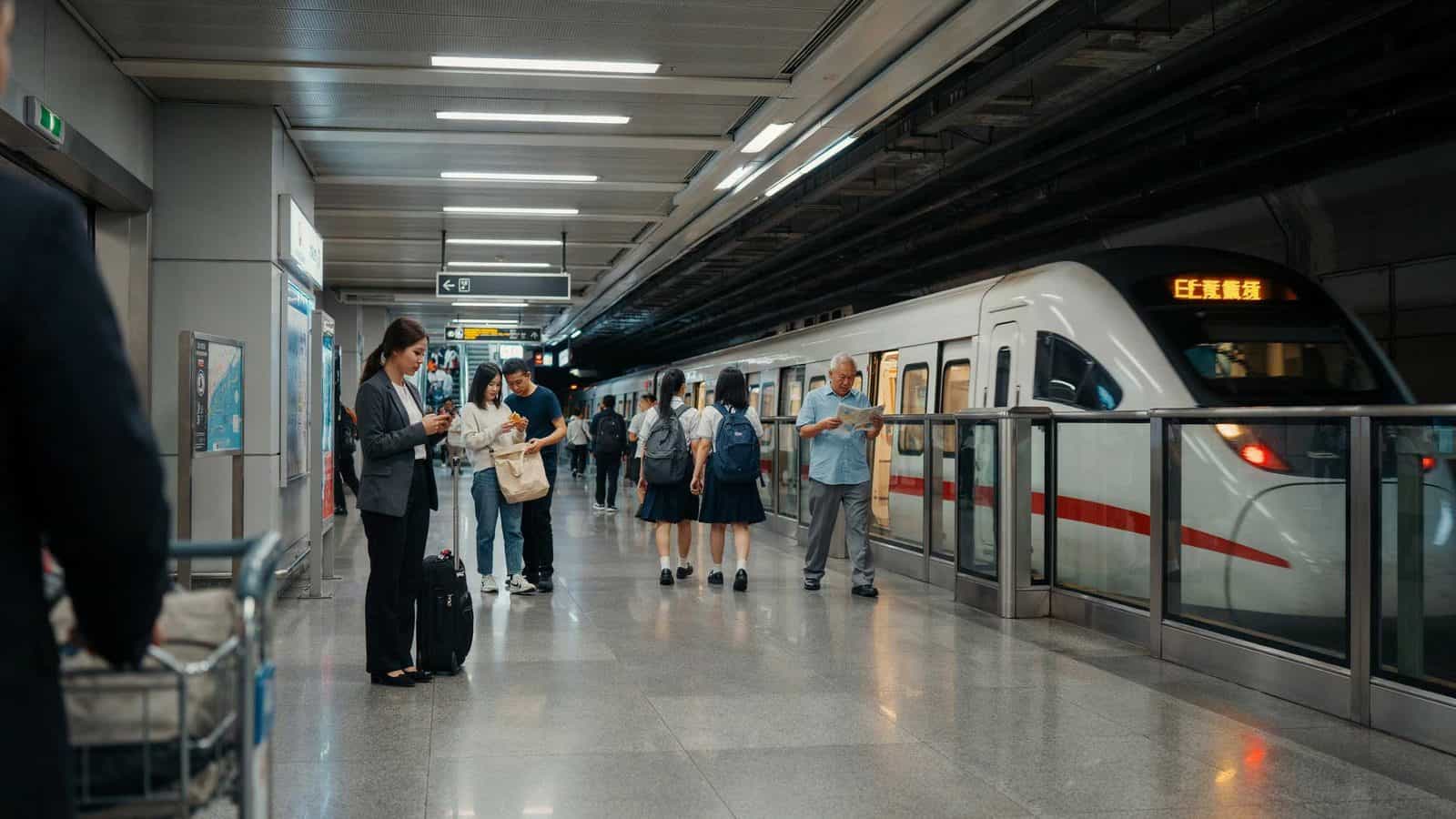
However, it looks like there is something else behind this agreement in resolving the disagreement between the rail network in Hong Kong and the MTR company. This agreement has managed to settle some current disputes that arose because of the projects of high-speed trains and Shatin to Central Link. The real importance of this agreement will come after that. The following step for the city of Hong Kong will be the development of its rail system where new stations and new rail lines will arise along with the growing number of passengers.
Hong Kong Is Turning an Old Rail Problem Into a New Accountability Model
The High Speed Rail and Shatin to Central Link were transformative projects, but neither followed the original development path.
Construction of the Hong Kong section of the Express Rail Link began in 2010 and was originally expected to be completed for passenger operation in August 2015. Following delays and cost overruns, the completion target moved to the third quarter of 2018.
The estimated cost to complete also rose sharply, increasing from HK$65 billion to HK$84.42 billion. The railway eventually entered service in September 2018.
Advertisement
Advertisement
The Shatin to Central Link followed another difficult construction trajectory.
Work began in 2012. Parts of the project had originally been expected to open between 2018 and 2020, but the completed Tuen Ma Line was not fully commissioned until June 2021, while the East Rail Line cross-harbour extension entered operation in May 2022.
Advertisement
Advertisement
Its estimated cost to complete increased from HK$79.82 billion to HK$90.73 billion. MTR also absorbed about HK$2.8 billion in additional project-management costs and expenses associated with the Hung Hom Station Extension quality incident.
These figures explain why the settlement has significance well beyond corporate accounting.
Hong Kong is now trying to make sure the same pattern is not repeated.
What Has Changed for Hong Kong’s New Railway Projects?
This is where the new angle becomes much stronger.
The Hong Kong Government says it and MTR reviewed the experiences of the two delayed projects and introduced enhanced railway governance, monitoring and cost-management mechanisms.
These enhanced arrangements are already being applied to projects including:
Advertisement
Advertisement
- Kwu Tung Station
- Tung Chung Line Extension
- Oyster Bay Station
- Tuen Mun South Extension
- Hung Shui Kiu Station
- Northern Link
More significantly, the Government says MTR is required under project agreements for these newer schemes to bear construction and operational risks, including the risk of cost overruns.
That represents a critical change in the story.
The public debate is therefore no longer simply about compensation for yesterday’s delays.
Attention now shifts towards whether the revised model can create stronger incentives to finish future railway projects on time and within budget.
Why This Matters for China Travel
The travel implications are substantial because Hong Kong’s High Speed Rail has become increasingly important to cross-boundary passenger movement.
When the line opened in 2018, West Kowloon directly served 44 Mainland destinations.
Advertisement
Advertisement
By January 2026, that number had climbed to 110. The Government said the number of destinations had almost doubled from the 58 served before the pandemic.
The expansion has included both short-haul and long-haul markets.
Newer direct links have included services serving destinations such as Chengdu, Zhangjiajie, Zhanjiang, Xi’an, Nanjing, Wuxi and Hefei.
For travellers, that changes the role of Hong Kong.
West Kowloon is increasingly functioning not simply as a terminal for journeys into nearby Guangdong but as an entry point into China’s much larger national high-speed rail system.
Passenger Growth Makes Better Project Governance More Urgent
Passenger volumes show why the issue deserves attention now.
Advertisement
Advertisement
The Hong Kong section of the High Speed Rail carried more than 30 million passenger journeys during 2025.
By that point, cumulative patronage since opening had already exceeded 100 million journeys.
Demand accelerated further during 2026.
Average daily patronage exceeded 90,000 journeys during the first four months of the year, compared with around 80,000 per day in 2025.
Peak demand has been considerably higher.
Passenger traffic reached about 145,800 journeys on 19 February 2026 and climbed to approximately 148,700 journeys on 4 April. Both figures represented new records at the time.
Advertisement
Advertisement
During weekends and festive periods, average daily traffic generally exceeds 100,000 passenger trips.
This is not a marginal transport corridor.
It is increasingly central to Hong Kong-Mainland travel.
That makes the successful delivery of future railway capacity more important to tourism, business mobility and regional economic integration.
Long-Distance China Rail Travel Is Also Growing
One of the most revealing trends is the growth of long-haul rail travel from Hong Kong.
Average daily patronage on short-haul services increased from around 47,000 journeys in 2023 to 60,000 in 2024 and 70,000 in 2025.
Advertisement
Advertisement
Long-haul daily patronage also increased, rising from about 10,000 journeys in 2023 to 13,000 in 2024 and 15,000 in 2025.
That indicates that High Speed Rail is increasingly competing not merely with road travel but with longer-distance travel options.
Some newly introduced destinations are already attracting considerable traffic.
The Government identified Quanzhounan, Quanzhoudong, Zhanjiangxi, Chengdudong, Zhangjiajiexi, Meizhouxi, Hangzhouxi, Xingningnan, Kaipingnan and Hefeinan among the newer long-haul stations recording the strongest passenger volumes. Together, those destinations were generating around 67,000 passenger journeys a month.
For the tourism sector, this creates a powerful network effect.
Every additional direct destination makes Hong Kong easier to combine with another Chinese city.
Advertisement
Advertisement
Hong Kong Residents and Visitors Are Both Driving the Network
The network is also serving a relatively balanced mixture of Hong Kong residents and visitors.
Official passenger statistics show that visitors represented 55% of West Kowloon passenger traffic in 2023, compared with 45% for Hong Kong residents.
In 2024 and 2025, visitors accounted for 53% of passenger traffic, while Hong Kong residents represented 47%.
That data gives the railway a stronger tourism dimension.
The system is not simply transporting Hong Kong residents to the Mainland.
It is also bringing large numbers of visitors through a major cross-boundary gateway.
Advertisement
Advertisement
This means reliability, capacity and station experience have a direct impact on Hong Kong’s tourism competitiveness.
West Kowloon Is Becoming a Larger Travel Gateway
The growth of passenger traffic has already created pressure on West Kowloon Station.
Official government information shows that the waiting hall contained around 1,400 seats by May 2026, including approximately 200 additional seats compared with 2023.
The Government and MTR have also been examining additional food, beverage and retail facilities to improve the passenger experience.
That may appear to be a minor operational issue compared with billion-dollar construction disputes.
It is not.
Advertisement
Advertisement
When traffic regularly crosses 100,000 passenger journeys on peak days, station capacity becomes part of destination management.
Crowding, waiting facilities, boarding arrangements, retail services and passenger information all affect how travellers perceive a cross-border rail journey.
The success of Hong Kong’s next railway expansion will therefore depend on more than laying tracks.
The passenger experience will matter too.
Comparison: Hong Kong’s Old Rail Model Versus Its Emerging Approach
| Area | Earlier XRL and SCL Experience | New Direction |
|---|---|---|
| Project delivery | Major delays affected both programmes | Stronger monitoring mechanisms |
| Cost control | XRL and SCL costs increased substantially | Tighter cost-management framework |
| Dispute outcome | Years of unresolved claims | Settlement reached in October 2026 |
| MTR financial exposure | Negotiated after project problems | Greater construction and operational risk under newer agreements |
| Passenger role | Network still developing | HSR now carries more than 90,000 journeys daily on average during early 2026 |
| Mainland connectivity | 44 direct destinations at HSR launch | 110 direct destinations by January 2026 |
| Strategic focus | Individual railway construction | Wider Greater Bay Area and Northern Metropolis integration |
Source: Hong Kong SAR Government and official railway information.
Northern Metropolis Makes the Governance Question Even Bigger
The new railway programme also fits within Hong Kong’s broader development strategy.
Advertisement
Advertisement
The Government’s 2026-2030 development plan identifies the Northern Metropolis as a major platform for Hong Kong’s deeper participation in the Guangdong-Hong Kong-Macao Greater Bay Area.
The plan is designed around new communities, innovation and technology, education, industry and closer integration with surrounding economic centres.
Rail infrastructure will be essential to that model.
The Northern Link is therefore not simply another commuter railway.
It will help connect emerging development areas with the existing transport network and support a much wider transformation of northern Hong Kong.
This makes project discipline critical.
Advertisement
Advertisement
Delays to a railway serving an established urban district are disruptive.
Delays to infrastructure around which entire new development areas are being planned can have much wider consequences.
What Others Are Missing About the MTR Settlement
Most coverage naturally focuses on the HK$2.25 billion payment.
But the more consequential change may be hidden inside the Government’s explanation of what happens next.
Hong Kong says enhanced governance and cost-control mechanisms have already been embedded into ongoing railway projects.
It also says MTR must bear construction and operational risks, including cost-overrun risk, for the newer projects covered by the relevant agreements.
Advertisement
Advertisement
That makes the settlement a dividing line.
Before it lies an era characterised by transformative railway projects that also generated years of arguments over delays, responsibility and additional expenditure.
After it comes an era in which Hong Kong is attempting to build major infrastructure under a tighter accountability framework.
Whether that new model works will determine the real significance of the 2026 settlement.
Travel Analytics: The Numbers Point Towards Greater Rail Dependence
The passenger numbers already provide a useful indication of where Hong Kong travel is heading.
High Speed Rail patronage exceeded 30 million journeys in 2025.
Advertisement
Advertisement
Average daily traffic moved beyond 90,000 in early 2026.
Long-distance rail use has climbed steadily.
Visitor traffic represents more than half of West Kowloon passenger movements.
The number of directly connected Mainland destinations has more than doubled compared with the railway’s launch network.
Together, these indicators suggest that cross-boundary rail is becoming structurally more important to Hong Kong tourism.
Air connectivity will remain crucial, particularly for international visitors.
Advertisement
Advertisement
But railway connectivity increasingly determines how efficiently travellers can combine Hong Kong with Mainland destinations.
That can influence hotel stays, multi-city itineraries, shopping activity, attractions and business travel.
Conclusion: Hong Kong’s Next Rail Test Has Already Started
Whereas this partnership represents the completion stage of a difficult process for both parties, the future challenges are yet to come. As the construction of the railway in Hong Kong is carried out, and there is an increasing number of passengers using the fast railway, the only thing which can prevent such an experience is having good systems for managing risks and controlling the project. The success of the projects will bring benefits not only in terms of reduced travel time, but also better relations between Hong Kong and Shenzhen.
Advertisement
