
Ethiopia Advances Bale Mountains Tourism Through Robe and Goba Amid Rising Geoheritage Focus

Published
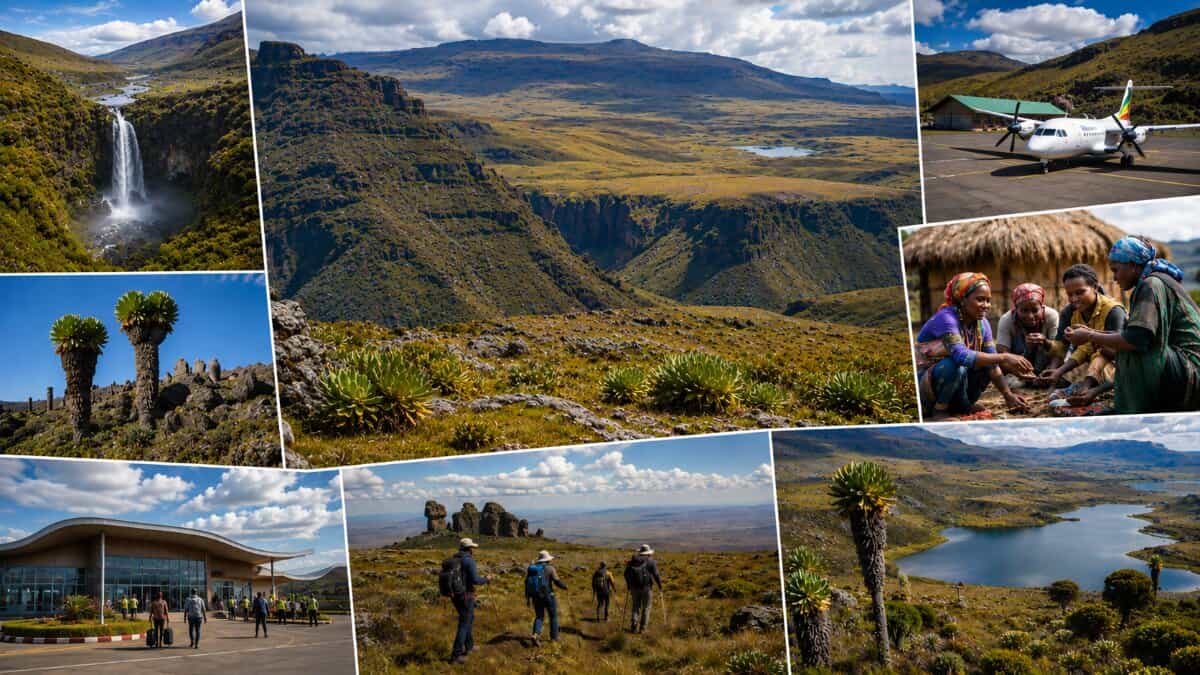
Image generated with Ai
Ethiopia’s geotourism strategy has moved into a live UNESCO evaluation, but Bale Mountains is not the site currently seeking Global Geopark designation. The nominee is Central Ethiopia Rift Valley. The stronger travel-industry story is that Bale now combines recognised geoheritage with UNESCO World Heritage biodiversity which is an upgraded Robe airport gateway alongside current air access and an all-weather Robe–Goba road corridor. Together these elements create a credible blueprint for selling southern highland Ethiopia as an interpretation-led geotourism circuit rather than only a wildlife or trekking extension.
Ethiopia’s 2026 Geopark Evaluation Changes the Commercial Context
According to UNESCO’s 2026 Global Geopark application register, Central Ethiopia Rift Valley is among 14 new applications in the official evaluation process. Ethiopia has no UNESCO Global Geopark at present, while UNESCO’s network reached 241 sites across 51 countries after 12 additional geoparks were designated in April 2026. UNESCO’s current list was updated on 24 July 2026.
Advertisement
Advertisement
The process has advanced beyond documentation. Werabe University recorded a visit by the Central Ethiopia Rift Valley Geopark evaluation team on 23 July 2026 as part of the ongoing evaluation mission. UNESCO’s standard procedure places field evaluation before Global Geoparks Council consideration in September. Successful Council recommendations subsequently move to the UNESCO Executive Board for final endorsement during the following spring session.
That makes the 2026 development materially different from Ethiopia’s earlier geopark awareness work. The concept is now being tested against formal requirements covering geological significance, management, community participation, conservation, interpretation, infrastructure, finance and sustainable development.
Advertisement
Advertisement
| 2026 milestone | Verified position at 17 August | Travel-industry meaning |
|---|---|---|
| Global network | 241 UNESCO Global Geoparks in 51 countries | Ethiopia is seeking entry into an established international geoheritage system |
| Ethiopian candidate | Central Ethiopia Rift Valley among 14 applications | Bale Mountains is not the current nominee |
| Field stage | Evaluation activity documented on 23 July | The application has progressed into on-site scrutiny |
| Next stage | Council assessment normally occurs in September | Creates a near-term milestone for destination planners |
| Final stage | Executive Board consideration follows in spring | No designation should currently be marketed as guaranteed |
Bale Mountains Could Benefit Without Being the Nominee
The new travel angle lies in separating UNESCO designation from tourism product development. Bale Mountains does not need to be Ethiopia’s present Global Geopark candidate for the country’s emerging geopark expertise to influence how Bale is interpreted, packaged and sold.
Advertisement
Advertisement
According to the Ethiopian Ministry of Tourism, the Bale and Simien Mountains, Blue Nile Falls, Sof Omar Cave, Danakil Depression, Degu’a Tembien and Selti-Butajira volcano-tectonic zone are among Ethiopian geosites carrying significant scientific, educational, aesthetic, ecological or cultural value. The Ministry also reported intensive UNESCO Global Geopark training for working-group members attached to four geopark projects in Ethiopia, although its publication did not identify Bale as one of those four projects.
For the travel trade, that distinction is important. Geological interpretation can already be incorporated into Bale’s biodiversity, hiking, birding and wildlife programmes without making an incorrect claim that the park possesses UNESCO Global Geopark status.
Bale Holds Unusually Strong Material for Geo-Biodiversity Tourism
According to the UNESCO World Heritage Centre, Bale Mountains National Park covers 215,000 hectares, accompanied by a 235,121-hectare buffer zone. Its landscape bears the imprint of ancient lava outpourings, glaciation and Great Rift Valley processes. Tullu Dimtu reaches 4,377 metres, while the Sanetti Plateau forms part of the largest intact and contiguous Afro-alpine habitat in the world.
UNESCO records 1,660 flowering plant species, including 177 endemic to Ethiopia and 31 restricted to Bale Mountains. It also identifies 79 mammal species, 23 of them endemic, plus 363 documented bird species, including more than 170 migratory species. Those figures allow tour operators to combine geological storytelling with natural-history travel instead of treating Bale as a single-purpose wildlife destination.
| Bale asset | Officially recorded detail | B2B product opportunity |
| World Heritage property | 215,000 hectares | Supports substantial multi-day touring |
| Buffer zone | 235,121 hectares | Creates potential for community-linked experiences |
| Tullu Dimtu | 4,377 metres | Strengthens high-altitude landscape positioning |
| Geological character | Lava, glaciation, escarpments, valleys and glacial lakes | Enables guide-led earth-science interpretation |
| Plant diversity | 1,660 species | Supports specialist botany and educational travel |
| Ethiopian-endemic flora | 177 species | Adds scarcity and conservation value |
| Bale-restricted flora | 31 species | Gives the destination additional differentiation |
| Mammals | 79 species, including 23 endemics | Supports wildlife extensions |
| Birds | 363 species, including 170-plus migratory species | Strengthens specialist birding itineraries |
Robe and Goba Make Geotourism Commercially Usable
The difference between an exceptional remote landscape and a saleable international tourism product is access. Bale’s gateway structure has strengthened considerably.
Advertisement
Advertisement
According to Ethiopian Airlines Group, the new Wako Gutu Airport Terminal at Bale Robe was inaugurated on 5 January 2025. At inauguration, Ethiopian reported operations of up to 14 weekly flights to and from Robe and specifically linked the airport investment with improved access to Bale Mountains National Park.
Ethiopian Airlines’ current booking platform continues to recognise Bale–Goba under airport code GOB, providing a current institutional indication that the destination remains integrated into its domestic network. Travellers and agents should nevertheless verify the actual timetable for their intended dates rather than relying on the frequency announced at the terminal opening.
The government-backed Visit Ethiopia platform already presents a three-day Bale Mountains itinerary using round-trip flights from Addis Ababa to Robe, followed by Dinsho, the Sanetti Plateau and Harenna Forest. That is commercially important because a remote highland destination can potentially be compressed into a short extension around an Addis Ababa stay or incorporated into a longer national circuit.
Goba provides the second gateway function. According to Visit Ethiopia’s official Bale Mountains destination information, an all-weather road runs from Dinsho through Robe and Goba, continues across the Sanetti Plateau and then descends into Harenna Forest. Walking routes starting around Dinsho can extend from two to 11 days, creating both short fly-in and deeper adventure formats.
A Southern Highlands Narrative Could Become Ethiopia’s Next Tourism Product
Ethiopia has traditionally marketed a powerful mixture of cultural heritage, historic sites and natural landscapes. Its developing geotourism programme introduces another way to organise the national tourism story: through tectonic processes, volcanoes, high plateaux, caves, glacial landforms, biodiversity and the communities living around those landscapes.
Advertisement
Advertisement
Bale fits that approach particularly well because its tourism value does not depend on one attraction. A regional itinerary can progress through grasslands, Afro-alpine terrain, volcanic ridges, glacial lakes and forest. Geological interpretation can therefore become the connective narrative rather than a specialist excursion added to a conventional wildlife trip.
For tour operators, this could also change itinerary economics. Interpretation-led travel creates potential expenditure across transfers, professional guiding, trekking logistics, accommodation and locally provided services. UNESCO’s Global Geopark model is specifically designed to connect geological conservation with education, local participation, training, enterprise creation and sustainable economic development.
The strategic benefit is transferable expertise. If the Central Ethiopia Rift Valley process advances successfully, Ethiopian institutions will accumulate practical experience in geopark governance, geological interpretation and international geoheritage positioning. Bale could benefit from that capability while remaining outside the nominated territory. This is the central information gain of the story: the 2026 geopark process may influence another major destination before any Bale-specific geopark designation exists.
Conservation Limits Must Shape Any Bale Tourism Expansion
Growth cannot be separated from ecological pressure. UNESCO’s Bale Mountains documentation identifies threats linked to settlement, livestock grazing and agricultural expansion. It also records that the road crossing vulnerable park habitats can cause direct disturbance and facilitate access to previously remote areas.
That makes carrying capacity, vehicle routing and guide-led interpretation central to any B2B expansion. Geotourism should not become a reason to simply push larger traffic volumes across the Sanetti Plateau. Higher-value guided travel, controlled trekking, longer stays and community-linked services more closely match the conservation principles underpinning World Heritage management and UNESCO’s geopark philosophy.
Advertisement
Advertisement
The park is managed by the Ethiopian Wildlife Conservation Authority. Its management framework covers park operations, tourism management, settlement and grazing management, outreach and ecological management. For tour operators, conservation requirements therefore need to influence itinerary architecture from the beginning rather than being treated as an after-sales compliance issue.
Current Operating Risk Still Requires Live Route Checks
As of 17 August 2026, the UK Foreign, Commonwealth and Development Office continues to advise against travel to some parts of Ethiopia, identifies security concerns affecting parts of Oromia and notes that Ethiopian authorities can introduce travel restrictions at short notice.
Agents should therefore check exact road sectors, domestic flight operations, local conditions and travel-insurance wording immediately before departure. High-altitude itineraries also require realistic scheduling and contingency planning because Bale programmes can cross elevations above 4,000 metres and may include multi-day walking.
Critical Operational Takeaways for Travel Agents and Tour Operators
- Do not describe Bale Mountains as Ethiopia’s 2026 UNESCO Global Geopark applicant. Central Ethiopia Rift Valley is the candidate.
- Position Robe as the air gateway and Goba as the overland highland base when designing Bale itineraries.
- Add geological interpretation to wildlife, birding and trekking programmes to deepen visitor value rather than simply chase volume.
- Reconfirm Ethiopian Airlines schedules before ticketing because the frequency announced at the 2025 terminal inauguration should not be treated as a permanent timetable.
- Check current government travel advisories, road conditions, local operating intelligence and insurance exclusions before every departure.
- Build altitude, weather and road contingencies into programmes covering Sanetti Plateau, Dinsho and Harenna Forest.
- Use qualified local guides and community services where practical to align product development with conservation and local economic participation.
- Avoid implying that UNESCO Global Geopark approval is secured because several formal decision stages remain.
Ethiopia’s Next Tourism Advantage May Be Interpretation Rather Than Another Label
The larger development is not simply one UNESCO application. Ethiopia is building institutional machinery capable of turning geology into a sophisticated tourism product, and that machinery is now undergoing a real international evaluation. Bale Mountains already possesses World Heritage credentials, geological diversity, exceptional endemic biodiversity and a workable Robe–Goba gateway structure.
If the Central Ethiopia Rift Valley process ultimately succeeds, Ethiopia would gain a replicable framework for geoheritage interpretation, community participation, destination governance and specialist tourism marketing. Bale is one of the clearest destinations where those lessons could eventually be commercialised responsibly, helping Ethiopia’s southern highlands secure a stronger place in international itineraries while broadening the country’s visitor proposition beyond its best-known historic tourism circuit.
Advertisement
