

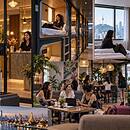
Image generated with Ai
Women-only accommodation in Asia is booming because women are travelling independently. There is an increasing demand for privacy, safety, and comfort. There is an entire range of accommodation, from women-only dorms to women-only floors, boutique stays, retreats and women-only residences. This boom in accommodation is a result of a much larger shift in behaviour, rather than a temporary demand for accommodations. 48% of women in Southeast Asia travel independently, compared to 36% in the previous year. Almost 80% of previous solo travellers planned to travel solo again. Similarly, there is a large number of solo female travellers in India, with 30% of the guests served by Airbnb being women travelling solo in 2023.
For a woman arriving alone in an unfamiliar Asian city, the choice of bed can involve more than price and location. The composition of the dormitory, building access, reception hours, bathroom arrangements and late-night arrival procedures can influence the booking decision.
That has helped create a distinct middle ground between a conventional hotel and a mixed dormitory. Female-only lodging can combine affordability with greater privacy, while retaining the communal atmosphere that attracts independent travellers.
However, the trend needs careful framing. There is no comprehensive Asia-wide government dataset measuring demand specifically for female-only rooms. Instead, several indicators point towards the underlying market opportunity, including stronger solo-travel intentions, expanding accommodation formats and operators adapting facilities for female guests.
Advertisement
Japan provides one of the clearest established examples. The Japan National Tourism Organization notes that capsule accommodation now includes both mixed and female-only facilities. It also highlights segregated floors within some hostels.
The concept, therefore, is no longer confined to a single hostel model. It has become an accommodation design question: how can properties serve travellers who want independence without sacrificing comfort?
South-east Asia offers some of the clearest behavioural evidence behind this evolution. The TripAdvisor survey reported that 48% of women across Singapore, Malaysia, Indonesia and Thailand had travelled alone. That represented a substantial increase from the 36% recorded in the previous year.
The motivations were revealing. Sixty per cent cited freedom as a reason for travelling alone, while 45% valued the independence and challenge. Another 32% said friends or family lacked the time or resources to travel with them.
The destination preference also matters for accommodation operators. Some 77% of surveyed women in South-east Asia who planned solo travel chose Asia as a destination region. Europe followed at 44%, while North America stood at 14%.Travel indicator South-east Asian women Had travelled alone 48% Previous-year comparison 36% Planned another solo trip Nearly 80% Chose Asia for solo travel 77% Cited freedom as a motivation 60% Cited independence and challenge 45%
The figures do not prove that every solo traveller wants female-only lodging. They do, however, identify a sizeable customer base that may value accommodation designed around independent female travel.
That distinction matters for hotel investors and hostel operators. The opportunity lies in matching a growing travel behaviour with a more precise lodging proposition, rather than assuming that gender segmentation alone creates demand.
Japan illustrates how female-oriented lodging can become part of the accommodation architecture itself. Capsule hotels traditionally emerged as compact, economical accommodation, particularly around major urban transport hubs.
The Japan National Tourism Organization says the first capsule hotel opened in Osaka in 1979. Modern properties have subsequently expanded beyond the original business-traveller model, with female-only capsules and segregated accommodation now available.
That evolution is significant because the capsule itself solves one of the central problems facing budget solo travellers: how to secure personal space without paying for a full hotel room.
Tokyo has offered particularly visible examples. JNTO has previously documented women-only properties such as Nadeshiko Hotel Shibuya and Nine Hours Woman Kanda. It has also highlighted properties combining female-only floors with shared social facilities.
The model has also moved beyond the city. At the Mount Fuji trailhead, Fujikyu Unjokaku has 42 capsule rooms, including 20 exclusively for women.
That example is particularly useful for travellers because it demonstrates how female-only accommodation can serve very different journeys. It is not necessarily a city-break product. It can also support hiking, pilgrimage, wellness and nature-based itineraries.
India presents a more complex picture because women-only accommodation already exists outside tourism. Hostels for students and working women have long created a parallel residential ecosystem.
Tourism adds another layer. The country’s official tourism data portal recorded 9.15 million foreign tourist arrivals in 2025, alongside 20.22 million international tourist arrivals when its broader measure is considered. Its latest dashboard also shows women representing 45.02% of foreign tourists.
The broader domestic market is even more important for accommodation businesses. India’s tourism dashboard records 8.287 billion domestic tourist visits, illustrating the enormous scale of movement within the country.
Airbnb’s India data offers another useful indicator. The company reported that 30% of its Indian female guests travelled solo in 2023. It also identified Goa, Bengaluru, Delhi NCR, Pune, Dehradun and Jaipur among preferred domestic destinations for women guests.Market Accommodation opportunity Japan Female capsules and segregated hotel floors India Women-only hostels, guest accommodation and longer stays South Korea Urban guesthouses, hostels and female dormitories Thailand Social hostels and female-only dormitory options Indonesia Backpacker accommodation and female-focused stays Singapore Privacy-led budget accommodation in a high-cost market
India’s opportunity therefore differs from Japan’s. The market can connect tourism accommodation with established women-only residential models, particularly for longer stays, education, business travel and wellness journeys.
In Seoul and other major Asian cities, the proposition increasingly overlaps with the social-hostel economy. Travellers may not want complete isolation. Instead, they may want a private sleeping environment while meeting other travellers in controlled communal areas.
That creates a useful distinction between female-only sleeping space and female-only social space. A property can keep dormitories segregated while operating mixed cafes, lounges or activity areas.
South-east Asia’s backpacker infrastructure makes this model particularly relevant. Thailand and Vietnam have extensive hostel networks, while Bali has developed a powerful combination of backpacking, wellness, digital work and longer-stay travel.
Recent Hostelworld analysis has highlighted the importance of security, organised social activities and attentive staff for solo female travellers in Thailand and Vietnam.
The implication for operators is straightforward. A women-only bed is not enough. The surrounding experience increasingly determines whether the proposition feels genuinely useful.
Privacy has traditionally been treated as a luxury feature in hotels. In the budget accommodation segment, however, it can become a competitive advantage.
A female-only dormitory may cost considerably less than a private hotel room while reducing some of the discomfort associated with mixed accommodation. Capsule hotels go further by providing an enclosed personal sleeping area within a shared property.
The result is a new accommodation spectrum:Format Privacy Typical appeal Mixed dormitory Low Lowest-cost social travel Female-only dormitory Moderate Budget solo travel Female-only floor Moderate-high Hotel-style environment Capsule High sleeping privacy Urban short stays Private room High Comfort and independence Female-only residence High Long-term travel or work
This matters particularly in expensive cities. A traveller may not need a large private room if she spends most of the day exploring. A secure personal sleeping zone can deliver the essential benefit at a lower cost.
Japan’s accommodation landscape demonstrates this principle particularly clearly. JNTO notes that many capsule properties sit close to major railway stations, adding convenience for travellers navigating large cities.
Safety is one of the strongest reasons travellers may consider women-only lodging. Yet travel journalism should avoid claiming that a women-only property is automatically safer.
A female-only dorm can still have weak access controls, poor management or an inconvenient location. Conversely, a well-run mixed hotel may provide excellent security.
Travellers should therefore examine the actual security architecture, rather than relying on the label.Booking question Why it matters Is the entire property women-only? Policies can differ by floor or room Is access controlled? Limits unwanted entry Is reception open overnight? Important for late arrivals Are lockers available? Protects passports and valuables Are bathrooms inside the dorm? Affects privacy and convenience How does late entry work? Crucial after evening flights Is the neighbourhood well connected? Reduces difficult late-night transfers Are recent reviews available? Reveals current operating standards
Japan also provides an important regulatory lesson. JNTO warns travellers to verify that private accommodation is properly licensed or registered under Japanese law.
That principle applies more broadly. The accommodation’s legal status matters as much as its marketing language.
The old image of a women-only hostel customer is too narrow. The potential market now spans first-time solo travellers, professionals, digital workers, students, wellness travellers and older independent tourists.
This is particularly important because accommodation needs change with age and trip purpose. A 22-year-old backpacker may prioritise price and social interaction. A 38-year-old business traveller may care more about quietness, luggage security and transport access.
A longer-stay traveller may prioritise laundry facilities, kitchens and workspace. A wellness traveller may instead value bathing facilities, retreat programming and proximity to nature.
Booking.com’s 2025 Travel Predictions research surveyed more than 27,000 travellers across 33 countries and territories, including India, Japan, South Korea, Thailand, Vietnam and Singapore. The research identified broader movement towards travellers challenging conventional assumptions about how they travel.
That does not specifically measure female-only accommodation. It does reinforce the larger commercial shift towards more personalised travel choices.
The emergence of women-focused accommodation also presents a lesson for conventional hotels. A property does not necessarily need to become entirely women-only to respond to this market.
Female-only floors, private lockers, improved lighting, stronger access controls, dedicated arrival procedures and female-focused concierge services can create a differentiated product.
Japan has already demonstrated how segregated floors can coexist with conventional accommodation. JNTO’s accommodation guidance notes that hostels can offer both co-ed lodging and segregated floors, depending on the property.
The commercial opportunity therefore extends beyond specialist operators. Mainstream hotels can incorporate female-oriented design without completely changing their operating model.
For consumers, the most important development is choice. A traveller no longer has to treat the decision as simply “hotel versus hostel”.
She can compare the precise combination of price, privacy, location, social environment and operating standards.
The most useful question is not whether a property calls itself women-only. It is whether the accommodation actually solves the traveller’s needs.
A late-night arrival, for instance, makes reception and access procedures more important. A hiking trip makes luggage storage and transport more significant. A two-week urban stay makes laundry, workspace and neighbourhood connectivity more valuable.
This is why women-only lodging should be evaluated as a service model, rather than merely a gender category.
This trend in female-only accommodation has the strongest evidence in changes in behaviour rather than in room inventories. Female solo travel is more visible while accommodation providers are forming more specialised approaches to serve independent travellers.
Japan is one of the first countries to develop female-only capsules and segregated floors in its accommodation offerings. South East Asia is a great example of the social-hostel model. In India, there’s an emphasis on long-stay and domestic tourism.
The change gives travellers more options with greater variety without completely removing the need for travellers to do their own research. For accommodation providers, the new options provide a new way to think about how privacy, security, and community can be merged in one room.
We can expect a variety of accommodation options over the next few years rather than a monopoly of a specific hotel type. Instead of a variety of flexible accommodations based on traveller needs, women-only accommodations in Asia will continue to be one of the new, varied accommodations offered in the travel economy.
Advertisement
Advertisement
Advertisement













Sunday, September 6, 2026

Sunday, September 6, 2026

Sunday, September 6, 2026

Sunday, September 6, 2026

Saturday, September 5, 2026

Saturday, September 5, 2026
Sunday, September 6, 2026

Sunday, September 6, 2026



