
Puerto Vallarta Faces Sharp International Tourism Slump as Air Traffic Drops Nearly 20 Percent in 2026

Published
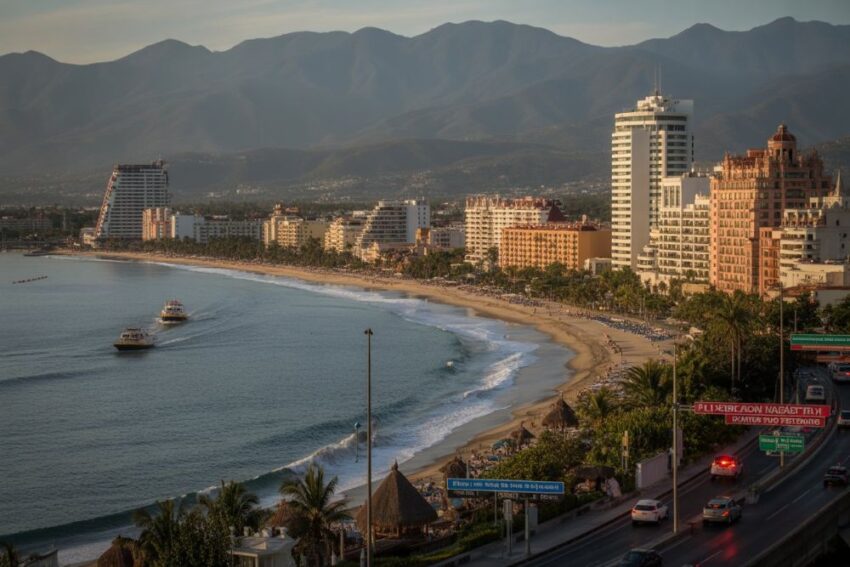
Image generated with Ai
Puerto Vallarta faces a sharp international tourism slump as air traffic drops nearly 20 percent in 2026, with international passenger movements falling 19.7% through August and an even steeper 26.3% decline during August alone, increasing pressure on a destination heavily dependent on fly-in leisure travellers.
Puerto Vallarta is confronting one of its most significant aviation slowdowns of 2026 as international passenger traffic through its airport falls substantially below last year’s levels.
Advertisement
Advertisement
Official figures from Grupo Aeroportuario del Pacífico show that international terminal passenger traffic dropped from 2.71 million during January–August 2025 to 2.18 million during the same period of 2026.
That represents a decline of 19.7%, or approximately 534,000 fewer international passenger movements.
Advertisement
Advertisement
August was considerably weaker.
International traffic plunged 26.3% year on year, creating a serious challenge for a Pacific tourism destination where overseas travellers support hotels, restaurants, villas, excursions, transport operators and other visitor businesses.
Advertisement
Advertisement
Puerto Vallarta International Traffic Plunges 26.3% in August
August delivered the clearest warning.
Puerto Vallarta International Airport processed approximately 119,200 international passengers during August 2026, compared with 161,800 in August 2025.
That represents a decline of 26.3%.
Domestic traffic proved substantially more resilient. Passenger movements fell only 2%, from 314,000 to approximately 307,700.
The sharp international contraction pulled total airport traffic down 10.3%, from 475,800 passengers in August 2025 to 426,900 this August.
| Puerto Vallarta Airport | August 2025 | August 2026 | YoY Change |
| International passengers | 161,800 | 119,200 | -26.3% |
| Domestic passengers | 314,000 | 307,700 | -2.0% |
| Total passengers | 475,800 | 426,900 | -10.3% |
The difference between domestic and international performance is striking. It shows that Puerto Vallarta’s current aviation weakness is concentrated much more heavily in its international market.
Advertisement
Advertisement
January to August Reveals a Much Deeper International Problem
The eight-month numbers confirm that August was not an isolated setback.
International traffic reached approximately 2.18 million passengers from January through August 2026, compared with 2.71 million during the same period of 2025.
That represents a 19.7% decline.
Domestic traffic also fell, but by a much smaller 3%, from approximately 2.12 million to 2.05 million.
Total passenger traffic consequently dropped 12.4%, from 4.83 million to 4.23 million.
| Puerto Vallarta Airport | Jan–Aug 2025 | Jan–Aug 2026 | Change |
| International passengers | 2.713M | 2.178M | -19.7% |
| Domestic passengers | 2.119M | 2.055M | -3.0% |
| Total passengers | 4.832M | 4.233M | -12.4% |
The airport therefore handled roughly 599,000 fewer passenger movements overall during the first eight months of 2026.
Advertisement
Advertisement
More than half a million of that deficit came from the international segment.
International Tourism Is Puerto Vallarta’s Biggest Pressure Point
Puerto Vallarta’s international dependence makes the decline economically important.
The destination has long attracted travellers from the United States and Canada, particularly during the northern winter.
International visitors support a tourism economy extending well beyond conventional hotels.
Their spending can reach:
- Luxury resorts
- Boutique hotels
- Vacation rentals
- Restaurants
- Private transportation
- Yacht and boating companies
- Wellness businesses
- Golf
- Excursions
- Wedding operators
- Retail
- Nightlife
A reduction in fly-in international traffic therefore has the potential to affect numerous businesses simultaneously.
Advertisement
Advertisement
However, airport statistics do not identify the income level of each passenger. It would be inaccurate to conclude from these figures alone that luxury American travellers specifically account for the decline.
Domestic Travellers Provide an Important Buffer
The comparatively modest decline in domestic traffic gives Puerto Vallarta some protection.
August domestic passenger movements fell only 2%, compared with the 26.3% international contraction.
Across January–August, domestic traffic was down just 3%.
That gap suggests Mexican travellers are currently providing a more stable demand base.
Domestic tourism can help hotels, restaurants and attractions offset part of the international slowdown, particularly during holiday periods and weekends.
Advertisement
Advertisement
But replacing international visitors entirely is difficult.
Overseas travellers may stay longer, book different accommodation categories and spend differently from domestic visitors.
The challenge for Puerto Vallarta is therefore not simply filling the same number of seats. It is maintaining the overall economic value generated by its visitor mix.
August Shows Puerto Vallarta Underperforming Other Major GAP Airports
Puerto Vallarta’s August performance also looks weaker when compared with several other airports operated by GAP.
Guadalajara passenger traffic increased 10.5%, while Tijuana grew 1.2%.
Puerto Vallarta declined 10.3% overall.
Advertisement
Advertisement
Los Cabos, another major Mexican Pacific resort market, fell 6.2%.
The international comparison is even more revealing.
Puerto Vallarta’s international traffic dropped 26.3%, compared with a 16.6% decline at Los Cabos.
This indicates that Puerto Vallarta’s weakness is not simply part of an identical pattern across every Mexican Pacific tourism gateway.
The destination is facing particularly heavy international aviation pressure.
Puerto Vallarta Still Retains a Strong Tourism Product
The aviation downturn should not be interpreted as evidence that Puerto Vallarta has suddenly lost its destination appeal.
Advertisement
Advertisement
Official tourism material shows the city continues to receive major industry recognition in 2026.
Its tourism proposition extends across:
- Beaches
- Gastronomy
- Luxury resorts
- LGBTQ+ tourism
- Weddings and honeymoons
- Meetings and events
- Adventure activities
- Cultural tourism
- Wellness
- Romantic travel
- Nearby mountain communities
Puerto Vallarta’s accommodation sector is similarly diverse, ranging from large international resorts to boutique properties.
That breadth matters during a slowdown.
A destination with several tourism segments has more ways to reposition itself than one overwhelmingly dependent on a single visitor profile.
Affordability Could Become More Important in the Next Phase
If international air demand remains weaker, Puerto Vallarta may need to compete more aggressively on value.
Advertisement
Advertisement
That does not mean abandoning luxury tourism.
Premium resorts, villas, restaurants and experiences remain important components of the destination economy.
Instead, the opportunity is to broaden the range of reasons travellers choose Puerto Vallarta.
More accessible experiences could include:
- Shorter city-and-beach breaks
- Food-focused holidays
- Cultural itineraries
- Outdoor experiences
- Wellness trips
- Family travel
- Local neighbourhood experiences
- Domestic packages
- Shoulder-season promotions
Diversification can help the destination reach travellers who may be unwilling to commit to an expensive luxury holiday but still want a Mexican Pacific escape.
Experiential Tourism Gives Puerto Vallarta Another Route to Growth
Puerto Vallarta possesses an advantage that extends beyond resort infrastructure: it functions as a living city.
Advertisement
Advertisement
The Malecón, historic neighbourhoods, restaurants, markets and surrounding Sierra Madre create experiences outside the traditional hotel environment.
That can become particularly valuable when traveller preferences shift towards experiences rather than purely accommodation-led holidays.
Visitors can combine beach time with food, art, outdoor activities, nightlife and nearby towns.
This allows Puerto Vallarta to market itself as more than a fly-in resort destination.
Experiential tourism can also distribute spending into smaller local businesses.
Restaurants, guides, galleries, independent tour operators and neighbourhood businesses can benefit when visitors explore beyond their hotels.
Advertisement
Advertisement
Tourism Promotion Is Being Reinforced in 2026
Puerto Vallarta is not standing still as aviation traffic weakens.
Official Jalisco procurement records show that the city’s Tourism Promotion and Advertising Trust has been commissioning public-relations and tourism-promotion services for domestic and international markets during 2026.
That provides evidence of an active effort to maintain destination visibility.
International promotion becomes particularly important during a period of declining air traffic.
Airlines make capacity decisions based partly on expected demand. Strong destination marketing can support the commercial case for maintaining or restoring routes.
Tour operators and travel agencies can also influence demand by packaging Puerto Vallarta competitively.
Advertisement
Advertisement
The objective is therefore circular: stronger promotion can stimulate demand, and stronger demand can help support future airline capacity.
Puerto Vallarta Needs International Air Traffic to Stabilise Before Winter
The timing of the slowdown matters.
Puerto Vallarta’s high season benefits substantially from travellers escaping colder North American weather.
That means the performance of autumn and winter airline schedules will be critical.
If international traffic begins recovering, the January–August decline could represent a difficult first phase followed by a stronger peak season.
If the contraction continues, hotels and other tourism businesses may face greater pressure to use discounts, promotions and domestic demand to protect occupancy.
Advertisement
Advertisement
August’s 26.3% international decline therefore deserves particular attention.
One weak month does not determine the entire winter season, but it comes on top of an already substantial 19.7% year-to-date international decline.
Puerto Vallarta Tourism Slowdown at a Glance
| Indicator | 2026 Performance |
| August international traffic | 119,200 |
| August international YoY | -26.3% |
| August domestic YoY | -2.0% |
| August total traffic YoY | -10.3% |
| Jan–Aug international traffic | 2.178M |
| Jan–Aug international YoY | -19.7% |
| Jan–Aug domestic traffic | 2.055M |
| Jan–Aug domestic YoY | -3.0% |
| Jan–Aug total traffic | 4.233M |
| Jan–Aug total YoY | -12.4% |
The numbers make the central issue clear: Puerto Vallarta’s current aviation downturn is disproportionately international.
The 20% Decline Is Real but Needs the Right Definition
The original claim that Puerto Vallarta has suffered a roughly 20% international air decline is broadly supported when applied to the January–August period.
The precise official figure is 19.7%.
But August itself was substantially worse at 26.3%.
Advertisement
Advertisement
It is also important to call the figures what they are: international terminal passenger movements at Puerto Vallarta International Airport.
They should not automatically be described as tourist arrivals, American visitors or luxury travellers because GAP’s airport dataset does not make those distinctions.
That precision strengthens rather than weakens the tourism story.
A nearly 20% eight-month international aviation contraction is significant without needing to exaggerate what the data measures.
Conclusion: Puerto Vallarta Faces Sharp International Tourism Slump as Air Traffic Drops Nearly 20 Percent in 2026
Puerto Vallarta faces a sharp international tourism slump as air traffic drops nearly 20 percent in 2026 because international passenger movements through its airport fell 19.7% during January–August and plunged 26.3% in August alone, creating pressure on a visitor economy heavily exposed to fly-in overseas demand.
Domestic traffic has provided some protection, declining only 3% through August. But that resilience has not been enough to offset the loss of more than half a million international passenger movements compared with the same period of 2025.
Advertisement
Advertisement
Puerto Vallarta still possesses considerable strengths. Its beaches, food, resorts, culture, LGBTQ+ tourism, events, wellness and outdoor experiences give it a diversified destination product.
The challenge is converting those strengths into renewed international demand.
That may require a broader mix of premium and value-driven travel, stronger experiential tourism, aggressive promotion and enough airline demand to restore lost capacity.
The official figures do not prove that wealthy American travellers alone are responsible for the downturn. What they do show unmistakably is that Puerto Vallarta’s international fly-in market has contracted sharply in 2026—and rebuilding that market will be central to restoring the destination’s wider tourism momentum.
Advertisement
