
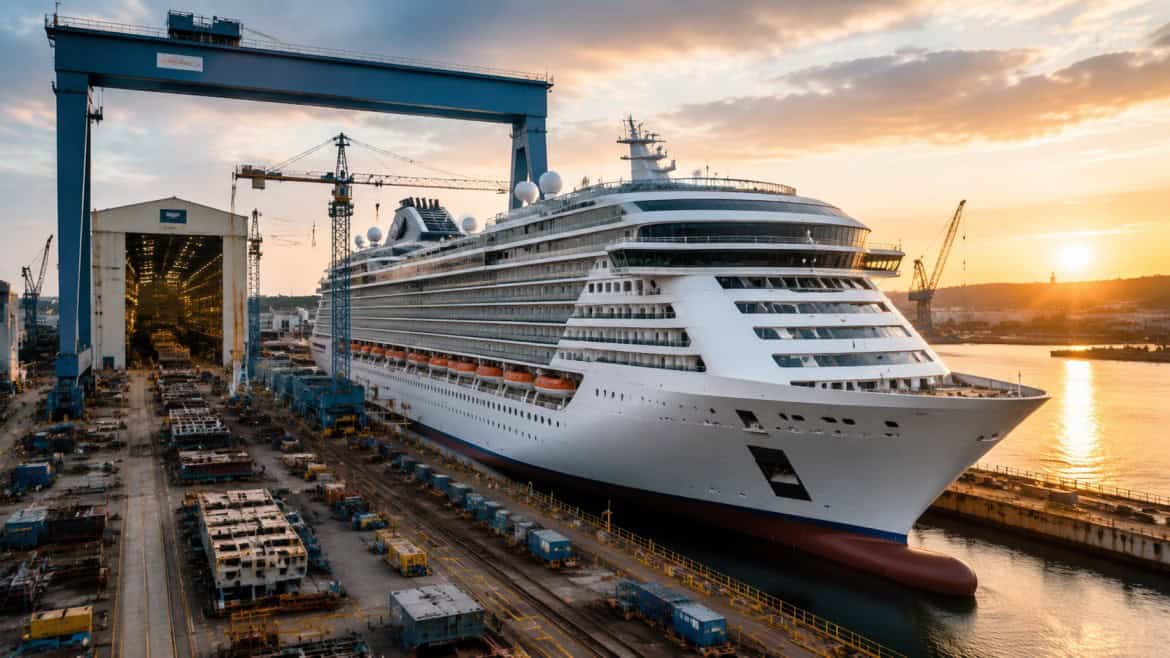
Image generated with Ai
MSC Cruises and MEYER WERFT are in advanced negotiations in Papenburg, Germany to finalise a landmark order for four New Frontier cruise ships. The talks, confirmed on June 28, 2026, signal one of the most significant cruise shipbuilding moves heading into the next decade.
This matters immediately because it locks in production capacity through the early 2030s, shaping global cruise supply at a time when demand is rebounding sharply post-pandemic restructuring. Cruise lines, ports, tourism boards, and investors are directly impacted by how quickly this deal is finalised and how shipyard slots are allocated.
Advertisement
The stakes are high: the cruise industry is entering a long-cycle expansion phase, and this agreement could determine who controls future ocean capacity growth.
The partnership between MSC Cruises and MEYER WERFT has moved beyond early-stage planning into detailed contract negotiation and design finalisation. The shift signals that the New Frontier class is no longer conceptual—it is entering industrial execution.
Advertisement
Advertisement
The agreement builds on a December 2025 letter of intent covering:
What makes this phase critical is the transition from commercial alignment to engineering specification. Shipbuilding contracts of this scale typically require extensive technical validation, regulatory compliance mapping, and supply chain coordination across multiple EU maritime suppliers.
This is not just a contract. It is a decade-defining industrial commitment.
The proposed New Frontier class introduces a new generation of ultra-large cruise vessels designed for long-haul itineraries and high-density passenger optimisation.
Advertisement
Advertisement
At this scale, each ship effectively functions as a floating tourism city. The design aligns with evolving cruise economics where operating efficiency, onboard monetisation, and itinerary flexibility are becoming decisive competitive factors.
The industry is shifting from volume expansion to yield-optimised mega-vessels, and this class reflects that transformation.
What others are missing in this deal is not the ship size—it is the production lock-in effect.
European shipyards, particularly in Germany, France, and Italy, are operating under constrained capacity due to overlapping cruise orders, naval contracts, and offshore energy projects. By securing a four-ship pipeline, MSC effectively anchors MEYER WERFT’s production calendar into the early 2030s.
This creates a structural imbalance in global cruise expansion. Smaller cruise operators may face delayed fleet renewal cycles, while dominant players like MSC gain long-term scheduling advantage.
In simple terms: the cruise race is no longer about demand—it is about who secured shipyard time first.
The implications extend far beyond shipyards. Cruise ports, tourism boards, and destination economies are now recalibrating their long-term infrastructure planning based on anticipated mega-vessel arrivals from 2030 onward.
For destinations, the arrival of 5,400-passenger vessels changes everything—from crowd management to excursion logistics.
Governments and port authorities are increasingly aligning with maritime frameworks under international safety and environmental conventions, ensuring compliance with emissions standards and sustainable port infrastructure planning.
This agreement is not just about MSC expanding its fleet. It represents a structural reordering of cruise industry capacity through 2035.
Three macro trends converge here:
Together, these forces are pushing cruise expansion into tightly scheduled mega-project cycles rather than flexible ordering patterns.
If finalised, the MSC–MEYER WERFT agreement will not just add ships—it will define where and how cruise tourism grows for the next decade. Papenburg becomes a production anchor point for one of the largest cruise expansion programmes in modern maritime history.
For industry stakeholders, the signal is clear: capacity is no longer open-ended. It is pre-booked years in advance.
Cruise operators, tourism boards, and investors now face a narrow strategic window. Those who understand shipyard allocation cycles early will control future market share. Those who delay will compete for what remains.
Advertisement
Advertisement
Advertisement













Saturday, September 5, 2026

Saturday, September 5, 2026

Saturday, September 5, 2026

Saturday, September 5, 2026

Saturday, September 5, 2026
Saturday, September 5, 2026
Saturday, September 5, 2026

Saturday, September 5, 2026



