
IndiGo Lite Fare Explained: New Budget Travel Options for Flyers

Published
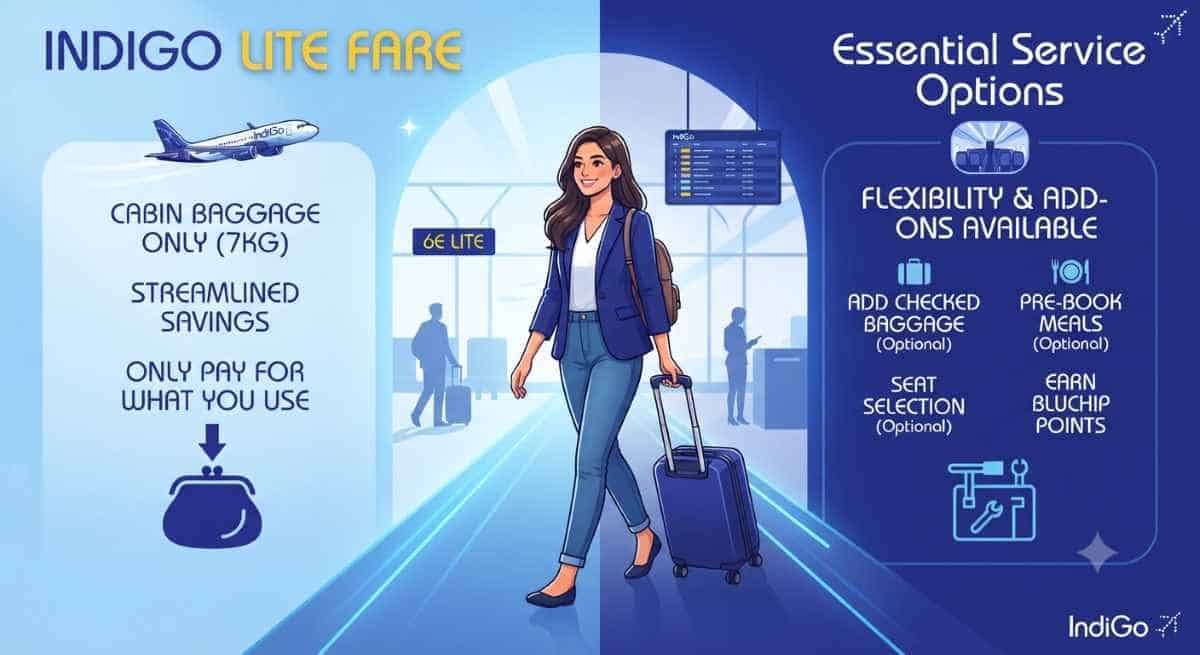
In an era defined by rapid market shifts, the airline industry is seeking innovative ways to remain competitive. Recently, IndiGo, India’s largest airline, introduced a significant addition to its service portfolio called IndiGo Lite. This initiative is positioned as an entry-level fare for budget travel. It is designed specifically for passengers who prefer to travel with only cabin baggage. The announcement on July 1, 2026, marks a pivotal moment in the carrier’s long-term strategy. The airline aims to provide a more tailored air travel experience. By focusing on efficiency and cost-effectiveness, the airline expects to solidify its position in a dynamic market.
The Impact of IndiGo Lite on Budget Travel
The introduction of this fare category will impact frequent flyers and budget-conscious individuals. By decoupling check-in baggage costs from the base ticket price, passengers gain autonomy. They only pay for the services they actually utilize. For those who travel light, this creates immediate cost savings. Savings typically range between Rs 300 and Rs 400 on domestic routes. Proportional benefits are also expected on international sectors.
The passenger experience is characterized by high levels of personalization. While the base fare includes an auto-assigned seat and 7 kg of cabin baggage, travellers retain flexibility. Optional add-ons can be purchased up to one hour before departure:
- Preferred seat selection.
- Additional checked baggage.
- In-flight meals.
- Priority services like Fast Forward.
This system ensures the base price is minimized. However, the ability to tailor the journey remains uncompromised. Even within this lower-fare tier, passengers earn and redeem IndiGo BluChip loyalty points. The benefits of the rewards programme are not sacrificed for affordability.
Advertisement
Advertisement
Industry Insights: Why the Airline Industry is Evolving
From a broader perspective, service unbundling is a necessary response to complex challenges. Global airlines face significant hurdles today. Fluctuations in crude oil prices directly influence aviation turbine fuel (ATF) costs. ATF remains the largest operating expense for the airline industry. Additionally, regional tensions have led to airspace restrictions. The requirement for longer flight routes has placed pressure on traditional, all-inclusive fare models.
The decision to launch IndiGo Lite is indicative of a larger trend. Airlines are adopting sophisticated yield management tools. By separating the seat cost from secondary services, carriers optimize seat load factors. This strategy is a proactive approach to maintaining market dominance. With a substantial domestic market share, the airline sets benchmarks for service-based pricing. It aims to cater to the diverse and price-elastic middle class of India.
Advertisement
Advertisement
Practical Information for IndiGo Lite Travellers
Those considering the IndiGo Lite option should note the following operational guidelines:
- Bookings are facilitated exclusively through direct channels.
- Use the official website, mobile application, or contact centre.
- The fare applies to domestic and international non-stop routes.
- It covers one-way, round-trip, and multi-city journeys.
- Travel under this structure commences on July 15, 2026.
A crucial detail involves cabin baggage. The 7 kg allowance must adhere to specific dimensions (55 x 35 x 25 cm). The bag must fit securely beneath the seat. If a passenger arrives with excess weight, charges will be incurred at the airport. It is recommended that passengers arrive early. Aim for 60 minutes prior to domestic departures. For international departures, 75 minutes is advised. Please note that this fare is not applicable for infants. It does not apply to group bookings or corporate travel. Furthermore, it cannot be upgraded to higher fare classes via digital channels.
Advertisement
Advertisement
Comparison with Previous Policies
In the context of recent market developments, IndiGo Lite reflects a shift across the Indian aviation landscape. Other major carriers, such as Air India, initiated similar moves recently. They introduced basic economy fares that exclude complimentary meals. While the objectives—capturing the price-conscious segment—are similar, the methods of unbundling differ. One carrier focuses on removing the meal component. Conversely, the strategy employed by IndiGo targets the exclusion of checked baggage.
This transition from a traditional pricing structure to a multi-tiered model represents a departure from historical practices. In the past, fare structures were rigid. Services were bundled regardless of actual need. The evolution toward the IndiGo Lite model highlights a movement toward consumer-centric choices. It prioritizes transparency and flexibility. As the market matures, such tiered structures will likely become the norm. This allows airlines to balance profitability with the growing demand for affordable air travel options.
Advertisement
