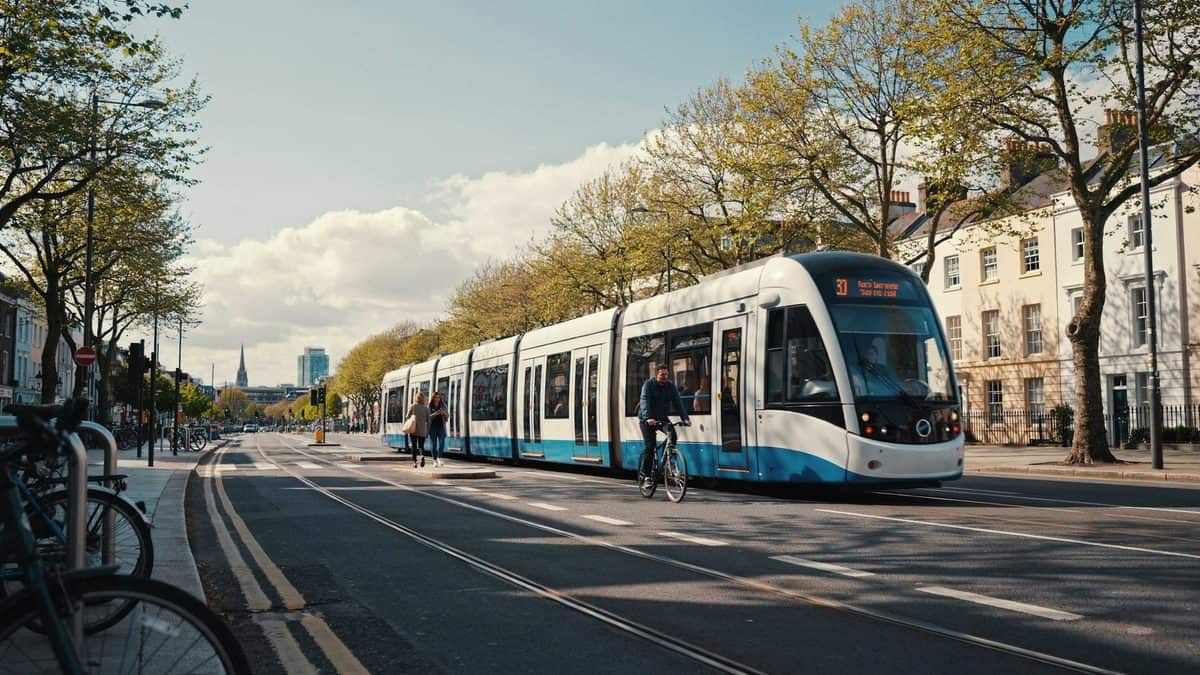
Image generated with Ai
Dublin, Ireland — 1 September 2026: Starting today, the responsibility for the Luas Light Rail contract officially lies with KeolisAmey Luas. This is the first of many changes Dublin will experience over the next ten years as the transport system completely transforms. This contract will add new safety and monitoring systems to the Luas as well as prepare the system to meet increased demand. This will effect 55 million Luas passengers each year, making this the largest change to the Luas for 2026.
Many will see this change in the Luas operator as the only change that will occur. This is the first step of the Dublin Urban Mobility Strategy to introduce more technology and planning to alter the way people travel in the future.
Advertisement
Dublin has more demand than ever to address the issues associated with congestion. The more rapid, cleaner and reliable transport has been more of a necessity for some time and is even more the case because of an ever growing population as well as high levels of tourism and more focus to make transport relatively more sustainable. The Luas must meet the demand for both people and meet the travel needs of tourists and commuters.
The new operating agreement officially started on 1 September 2026, with KeolisAmey Luas assuming responsibility for the daily operation and maintenance of the Dublin Luas system on behalf of Transport Infrastructure Ireland (TII) and the National Transport Authority (NTA).
Advertisement
The contract replaces the previous operating arrangement and introduces a fresh seven-year management period, with the possibility of extending for an additional six years.
Under the agreement, KeolisAmey Luas will oversee key areas including:
The company will combine the international transport expertise of Keolis with Amey’s engineering and asset management capabilities to strengthen the long-term performance of the network.
The transition follows months of preparation involving employees, government transport bodies, stakeholders and the previous operator to ensure passengers experience minimal disruption.
Advertisement
Advertisement
Dublin’s Luas system has become a vital part of Ireland’s capital city transport network since its opening in 2004. Today, it connects communities across the city while reducing dependence on private cars and supporting Ireland’s sustainability goals.
The network carries millions of passengers every year and recorded approximately 55 million passenger journeys in 2025, highlighting its importance as a daily transport lifeline.
For travellers visiting Dublin, the Luas provides a direct connection between major areas of the city, including commercial districts, residential communities and key visitor locations.
The new contract arrives at a critical moment because cities worldwide are redesigning transport systems around three major priorities:
Dublin is following this global trend by focusing on a smarter rail system capable of predicting problems before they affect passengers.
The biggest shift under the new operator is expected to come from technology-driven maintenance.
The most important change under KeolisAmey Luas may not be immediately visible to passengers.
Instead of only responding after equipment problems occur, the new operating model focuses on using data and remote monitoring technology to identify potential failures earlier.
This approach is known as predictive maintenance.
Traditional maintenance systems often depend on scheduled inspections or repairs after faults appear. Predictive maintenance uses real-time information from infrastructure and vehicles to detect warning signs before a disruption happens.
For passengers, this could mean:
KeolisAmey has highlighted plans to introduce remote monitoring solutions and proven operational processes from its other light rail networks.
This creates a new competitive advantage for Dublin because modern urban transport is no longer judged only by how many kilometres of track exist, but by how intelligently the system operates.
Many transport stories focus only on the fact that a new company has taken over operations.
However, the deeper story is about how Dublin is preparing its transport infrastructure for the next decade.
The Luas network is becoming part of a wider shift towards integrated, sustainable city movement.
The new contract includes plans for enhanced services, including additional peak-time services expected from 2027.
This matters because peak travel periods are when passengers experience the greatest pressure on urban transport systems.
More frequent services can help:
For Dublin’s tourism sector, reliable light rail is also important because visitors increasingly expect cities to offer simple, efficient and environmentally responsible ways to explore destinations.
The importance of the Luas transition becomes clearer when looking at the scale of the network itself. Dublin’s light rail system has evolved from a city transport project into a critical piece of Ireland’s urban infrastructure.
The network carried approximately 55 million passenger journeys in 2025, demonstrating its role as one of the country’s most important public transport assets. The system connects residential communities, business districts, educational centres and tourism areas across Dublin.
For commuters, reliability determines whether public transport becomes a preferred daily choice. For visitors, a dependable tram system influences how easily they can explore a city.
This is why the KeolisAmey transition is attracting attention beyond the railway industry.
The real challenge is not simply keeping trams moving. It is ensuring that Dublin’s transport system can support future population growth, rising visitor numbers and changing expectations around sustainable travel.
The new operating model focuses on strengthening three major areas:
These priorities reflect a global trend where successful cities are investing in smarter transport systems rather than relying only on road expansion.
The arrival of KeolisAmey brings together two companies with significant experience in transport operations, engineering and infrastructure management.
Keolis contributes international expertise from operating rail and light rail networks across several countries, while Amey provides engineering, asset management and infrastructure capabilities.
The partnership has already highlighted plans to introduce operational improvements, remote monitoring solutions and maintenance processes developed from experience across other transport networks.
This combination creates a new operating philosophy for Dublin’s Luas.
Instead of focusing only on daily operations, the new approach aims to create a system that continuously improves through:
The objective is simple: identify problems before they become passenger disruptions.
For a major European city, this approach could become one of the most important improvements delivered under the new contract.
The most visible part of the Luas network is the tram arriving at a stop.
However, the most important developments will likely happen away from passenger view.
Modern transport networks are increasingly becoming technology platforms. Sensors, digital monitoring systems and real-time operational data are changing how cities manage mobility.
For Dublin, remote monitoring technology could help maintenance teams understand the condition of vehicles and infrastructure before failures occur.
This shift could create benefits including:Traditional Approach New Technology-Led Approach Repairs after faults occur Early detection of potential failures Fixed maintenance schedules Data-driven maintenance planning Reactive response Preventive action Limited operational insight Real-time network information Passenger disruption after breakdowns Reduced disruption through prediction
The transformation represents a wider movement happening across European transport networks.
Cities are no longer measuring success only by the number of passengers carried. They are measuring performance through reliability, digital capability and customer confidence.
One of the most significant passenger-focused changes planned under the new contract is an enhanced timetable with additional peak-time services expected from 2027.
Peak periods remain one of the biggest challenges for urban transport systems.
Morning and evening demand places pressure on capacity, especially in rapidly growing cities where more people depend on public transport.
Additional services could help Dublin by:
For international visitors, stronger service frequency also improves destination accessibility.
Tourism growth increasingly depends on transport connectivity. Visitors want cities where airports, hotels, attractions and neighbourhoods can be reached easily without requiring private vehicles.
A stronger Luas network supports Dublin’s ambition to become a more connected and sustainable European capital.
The operator change arrives while Dublin continues to examine the future expansion of its light rail network.
One important project is the proposed extension of the Green Line towards Finglas, which would expand connectivity in north-west Dublin.
Future development of the system will require more than new tracks.
It will require:
Transport Infrastructure Ireland has also highlighted future planning around fleet requirements, including potential new light rail vehicles to support capacity and network development.
This means the KeolisAmey contract is not only about operating today’s network.
It is about preparing the system for tomorrow’s Dublin.
| Category | Previous Operating Era | KeolisAmey Era |
|---|---|---|
| Operator | Transdev managed Luas operations before transition | KeolisAmey Luas takes responsibility from 1 September 2026 |
| Contract authority | Managed under TII and NTA framework | Managed under new TII and NTA agreement |
| Contract value | Previous operating arrangements | Approximately €1.3 billion contract |
| Contract duration | Previous agreement ended before transition | Seven-year initial term with extension option |
| Maintenance approach | Existing operational model | Increased focus on smart maintenance and monitoring |
| Technology | Traditional operational systems | Remote monitoring solutions planned |
| Passenger improvements | Existing service structure | Enhanced services planned |
| Future focus | Maintain existing network | Prepare for growth and resilience |
Transport is one of the strongest factors influencing destination competitiveness.
A city can have world-class attractions, hotels and cultural experiences, but poor connectivity can weaken the visitor experience.
Dublin’s Luas plays an important role in supporting tourism because it provides visitors with an easy way to move between key areas without depending on taxis or private vehicles.
A reliable light rail network supports:
Travel analytics worldwide show that modern travellers increasingly value destinations with efficient public transport.
Visitors are not only choosing where to go. They are choosing destinations where movement is simple, affordable and environmentally responsible.
The KeolisAmey transition therefore has significance beyond rail operations.
It is part of Dublin’s wider effort to strengthen the city’s position as a modern European destination.
Dublin’s Luas transition reflects a wider European movement.
Across major cities, transport authorities are investing in:
The reason is clear.
Cities are facing increasing pressure from population growth, climate targets and changing travel behaviour.
Light rail has become one of the preferred solutions because it combines high passenger capacity with lower environmental impact compared with private vehicles.
Dublin’s next stage will depend on how effectively technology and operations combine.
The KeolisAmey contract provides the framework, but the success will ultimately be measured by passenger experience.
While passengers will notice service improvements, technology upgrades and possible timetable changes, one of the most important parts of the transition is happening behind the scenes: protecting the workforce that keeps the Luas system running every day.
The new contract includes a carefully planned transfer process involving Luas employees, ensuring operational knowledge and experience remain within the network. Transport Infrastructure Ireland and the National Transport Authority expected the majority of existing Luas staff to transfer to KeolisAmey under employment transfer regulations.
This approach is strategically important.
A transport network is not only built on tracks, vehicles and technology. It depends on skilled engineers, drivers, maintenance teams, customer service staff and operational specialists who understand the system.
The continuation of experienced employees helps maintain:
For Dublin travellers, this means the transition is designed not as a complete restart but as an evolution of an established transport system.
The strongest transport transformations happen when new technology combines with existing expertise.
For any major public transport network, safety remains the first priority.
The KeolisAmey contract places strong emphasis on maintaining safe operations while improving reliability and resilience. The company has committed to applying operational experience from other light rail systems while introducing new maintenance approaches.
Reliability will become the defining measure of whether this new era succeeds.
Passengers are less concerned about who operates a transport network. They judge success through practical daily experiences:
These everyday factors influence whether people choose public transport instead of private vehicles.
For Dublin, improving reliability also supports wider national climate goals by encouraging more sustainable travel choices.
KeolisAmey enters Dublin with experience from other major light rail networks.
The partnership operates and maintains systems including London’s Docklands Light Railway and Manchester Metrolink, giving the company experience managing complex urban transport operations.
This international background is significant because Dublin’s transport challenges are shared by many growing cities worldwide.
Urban networks must balance:
Lessons from other cities can help Dublin introduce proven methods while adapting them to local needs.
The Luas network will not simply copy another city’s approach.
Instead, the opportunity is to combine international expertise with Dublin-specific transport requirements.
Transport performance directly influences tourism competitiveness.
Visitors arriving in Dublin increasingly expect destinations to offer convenient public transport options that connect attractions, accommodation areas and city districts.
A stronger Luas system can support tourism by making city exploration easier.
The benefits extend across the visitor economy:Tourism Area Impact of Improved Luas Performance International visitors Easier movement around Dublin Hotels Better accessibility for guests Attractions Wider visitor reach Events Improved transport options during busy periods Sustainable tourism More alternatives to private vehicles
Dublin has become a major European city-break destination, attracting visitors seeking cultural experiences, historic sites and urban attractions.
Reliable public transport strengthens the complete visitor journey.
A traveller’s experience begins before reaching a destination and continues through every movement within the city.
Travel behaviour is changing.
Modern visitors are no longer choosing destinations only because of landmarks or attractions. They increasingly consider how easily they can move around once they arrive.
Transport connectivity has become part of destination competitiveness.
From a travel analytics perspective, cities with:
are better positioned to attract longer stays and higher visitor satisfaction.
Dublin’s Luas transition therefore has significance beyond railway operations.
It represents an investment in the city’s overall travel ecosystem.
A visitor who can confidently move between accommodation, attractions and commercial areas is more likely to explore more of the destination.
This creates wider economic benefits for local businesses and communities.
The biggest story behind the KeolisAmey transition is not simply a new operator taking control.
The deeper story is how cities are preparing transport systems for the future.
Across Europe, governments and transport authorities are focusing on smarter mobility solutions.
The next generation of public transport will depend on:
Dublin’s approach reflects this global transformation.
The city is moving towards a transport model where technology supports human expertise rather than replacing it.
The objective is not only faster journeys.
It is creating a transport system that can adapt to future challenges.
| Year | Major Development |
|---|---|
| 2004 | Luas light rail services begin operation in Dublin |
| 2019 | Previous operations and maintenance contract begins |
| 2026 | KeolisAmey selected as new operations and maintenance operator |
| 1 September 2026 | KeolisAmey begins operating and maintaining Luas |
| 2027 | Additional peak-time services planned under new contract |
| Future | Network development including planned Finglas extension |
The arrival of KeolisAmey represents one of the most important developments in Dublin’s public transport landscape in years.
The immediate focus will naturally be on whether passengers experience smoother services, cleaner stops and fewer disruptions.
However, the wider importance is much bigger.
Dublin is entering an era where transport success will depend on intelligence, resilience and sustainability.
A modern city cannot rely only on expanding roads. It needs reliable mass transit that supports residents, businesses and visitors.
The €1.3 billion Luas operations and maintenance agreement creates the foundation for this next phase.
The real test will come through daily passenger experiences.
If technology improvements, workforce expertise and operational innovation combine successfully, Dublin could strengthen its position as one of Europe’s leading examples of sustainable urban mobility.
From September 1, 2026, KeolisAmey will be the new operator and maintainer of the Luas service in Dublin.
The Luas supports over 55 million passenger journeys each year.
Therefore, this change will impact a large portion of Dublin residents and visitors.
The biggest impact due to the change will occur away from the Luas stops.
Introducing modern tech will allow the Luas to improve its services and predict when they will become needed. The Luas will be able to offer a variety of services that will allow daily travelling to be easier than it has been in the past.
What possible competitors may not see is that this is not just the replacement of a Luas operator, but an improvement of services that will lead to change in the way people commute to and around the capital.
For the Luas operator, the change will result in a stronger Luas.
From the Luas network’s standpoint, the change will mean strong daily mobility.
For the city of Dublin, the change will enhance Dublin’s status as a capital city of Europe.
The next phase of the Luas network is now active in Dublin, and the foundation of modern urban travel is providing reliable travel systems.
Advertisement
Advertisement
Advertisement












Tuesday, September 1, 2026

Tuesday, September 1, 2026

Tuesday, September 1, 2026

Tuesday, September 1, 2026

Tuesday, September 1, 2026

Tuesday, September 1, 2026

Tuesday, September 1, 2026