
Denmark’s Bornholm Tourism Opens Late-Summer Sailing Value as Rønne and Nexø Anchor Coastal Journeys

Published
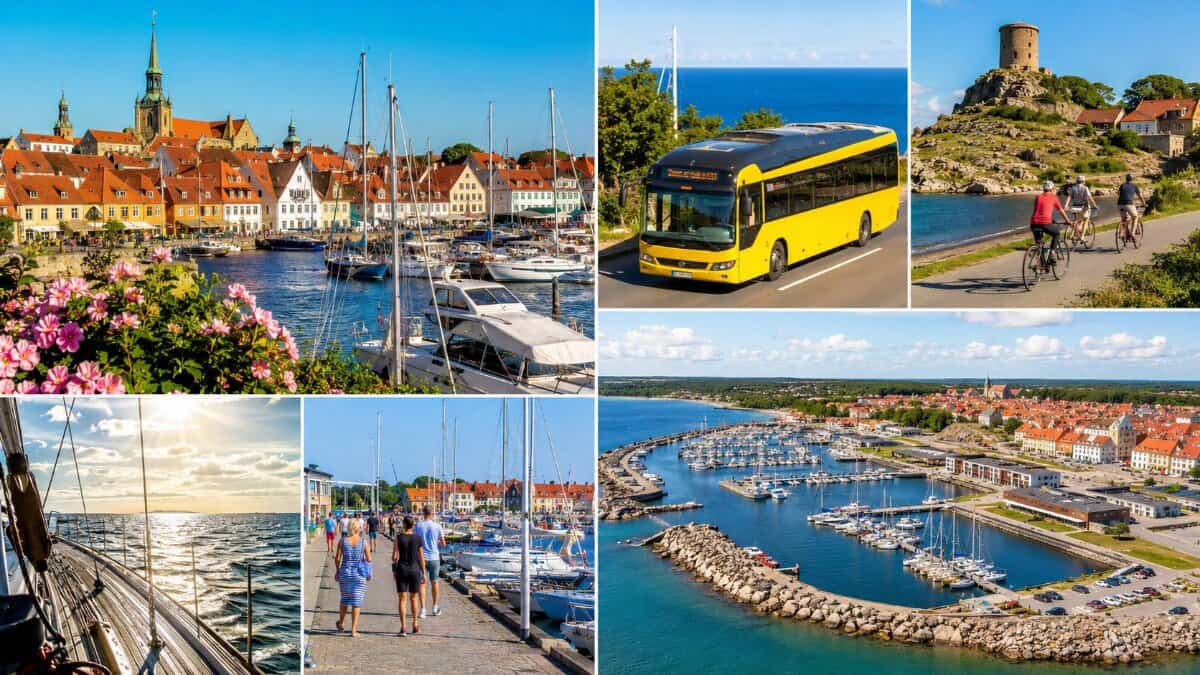
Image generated with Ai
Bornholm has entered a commercially significant late-summer maritime window. From 16 to 31 August, groups of at least 20 visiting boats can receive discounts ranging from 20% to 50% at Bornholm’s municipal harbours, while longer-stay sailors can use separate multi-night incentives across the network. At the same time, BAT’s revised island bus timetable is already operating and seasonal coastal routes continue until 26 September, creating a practical opportunity for travel companies to package car-light sailing holidays beyond Bornholm’s main peak period.
Bornholm’s 16 August Pricing Change Creates a Different Late-Summer Travel Market
The important development for the travel trade is not simply that harbour fees become cheaper after 15 August. Bornholm’s municipal framework changes the commercial equation specifically for organised maritime groups. According to Bornholms Regionskommune, visiting groups of 20 to 29 boats qualify for a 20% discount, 30 to 39 boats receive 30%, 40 to 49 receive 40%, while groups containing 50 boats or more qualify for 50%. The scheme applies from 16 to 31 August, following an earlier qualifying period from 1 to 30 June.
Advertisement
Advertisement
The conditions matter for tour operators. The group must make a combined advance booking, payment, arrival and departure arrangement. This means the mechanism is particularly suited to sailing associations, yacht clubs, organised flotillas, specialist Baltic itineraries and maritime events rather than unrelated individual sailors arriving independently.
This makes 16 August more significant than an ordinary seasonal tariff date. The previous high-season period effectively ends on 15 August, while the discounted group regime becomes available immediately afterwards. For product planners, that creates a clear pricing boundary around which departures can potentially be scheduled.
Advertisement
Advertisement
What Visiting Boats Pay in 2026
Bornholm’s official 2026 municipal tariff places daily guest-sailor charges between DKK175 for vessels below seven metres and DKK1,090 for boats longer than 30 metres. A typical seven-to-ten-metre visiting yacht is charged DKK273 per day before applicable discounts, while a ten-to-thirteen-metre vessel is charged DKK343.
Advertisement
Advertisement
| 2026 municipal guest-boat category | Standard daily charge | Potential late-August group reduction |
|---|---|---|
| Under 7 metres | DKK175 | 20%–50% |
| 7–10 metres | DKK273 | 20%–50% |
| 10–13 metres | DKK343 | 20%–50% |
| 13–16 metres | DKK440 | 20%–50% |
| 16–20 metres | DKK531 | 20%–50% |
| 20–30 metres | DKK769 | 20%–50% |
| Over 30 metres | DKK1,090 | 20%–50% |
Source: Bornholms Regionskommune. The percentage reduction depends on group size and qualifying conditions.
For a seven-to-ten-metre vessel, the published DKK273 base charge would mathematically fall to DKK218.40 under the 20% tier and DKK136.50 under the 50% tier, before considering any other itinerary costs. These are derived calculations from the municipality’s official tariff and should not be confused with separately published municipal prices.
The Bigger Opportunity Is Harbour-Hopping Rather Than a Single Discounted Stay
Bornholm’s longer-stay rules provide an important second layer. According to Bornholms Regionskommune’s administrative framework for municipal harbours, buying five to seven overnight stays provides one additional night without charge, purchasing eight to thirteen provides two, and purchasing fourteen provides fourteen additional nights. Unused qualifying nights can remain valid for five years, although unused stays are not refundable.
Advertisement
Advertisement
More importantly for itinerary design, guest and discount tickets can be used across Bornholm’s municipal harbour network rather than remaining tied to one marina. The municipality lists ten municipal facilities: Nørrekås Marina, Hasle, Hammerhavn, Sandvig, Allinge, Tejn, Gudhjem, Nørresand, Bølshavn and Svaneke.
This creates the clearest new B2B opportunity. Operators do not necessarily need to sell Bornholm as one marina stay. They can construct a moving maritime itinerary in which accommodation travels with the client while shore spending can be distributed among several coastal communities.
Advertisement
Advertisement
That interpretation also corresponds with Bornholm’s longer-term tourism strategy. The island’s official Tourism Development Plan towards 2030 identifies geographic dispersal of summer tourism, stronger year-round tourism, sustainable development and flexible mobility as strategic priorities. The plan also states that more parts of Bornholm should benefit from tourism expenditure.
The municipality does not state that the August harbour discount was introduced specifically to implement the 2030 strategy. It would therefore be inaccurate to describe the tariff as a newly launched destination-management programme. However, the operational effect of the pricing structure is clearly compatible with the wider policy objective of spreading tourism spatially and strengthening demand outside the most concentrated summer period.
Rønne Gives Maritime Visitors a Direct Entry Point into the Municipal Network
Rønne matters because Nørrekås Marina is located in the island’s principal western gateway city and forms part of the ten-harbour municipal system. Bornholms Regionskommune describes Nørrekås as Bornholm’s largest marina and the first encounter with the island for many boating tourists.
The timing is also notable because the municipality began phase three of a broader Nørrekås development process in 2026. A comprehensive plan scheduled for completion by the end of the year is intended to guide development over the following decade, improve connections between Rønne and the marina area and support smaller improvements and activities around the waterfront.
That infrastructure context gives Rønne greater significance than a simple arrival point. For travel businesses assembling sailing, cycling, walking and public-transport packages, Nørrekås provides a municipal maritime base beside a city whose waterfront relationship is itself undergoing strategic planning.
Advertisement
Advertisement
Nexø Adds an Eastern Tourism Hub Even Though Its Harbour Sits Outside the Municipal Discount Network
Nexø requires an important distinction. Nexø Harbour is not included among the ten municipal harbours governed by the discount framework. Operators should therefore not advertise the 16–31 August municipal group discount as automatically applying to a berth at Nexø Harbour.
Its relevance comes instead from Bornholm’s mobility network and destination development. BAT routes 4, 5 and 6 connect Rønne and Nexø through different parts of the island, while seasonal routes 7 and 8 form wider coastal circuits incorporating both cities. Local routes 61 and 62 also radiate from Nexø towards Svaneke, Paradisbakkerne, Balka, Snogebæk and Dueodde.
Nexø is simultaneously moving through a major waterfront renewal process. According to Bornholms Regionskommune, two components of the Nexø town-and-harbour regeneration programme were moving towards tendering in July 2026, with construction expected from autumn 2026 and completion shortly before the June 2027 tourism season. Planned elements include a stronger pedestrian connection between the historic centre and harbour, public-space improvements and a pedestrian and leisure bridge intended to make movement around the waterfront easier.
That means Rønne and Nexø perform complementary functions in this emerging late-summer proposition. Rønne contains a municipal marina directly participating in the harbour system, while Nexø acts as a major eastern transport and visitor node connected into the wider island itinerary.
BAT Extends the Practical Travel Window Beyond the Harbour Discount Period
The public-transport element significantly strengthens the commercial argument. BAT introduced its 2026/27 timetable on 2 August. Most revisions were modest, but former routes 4A and 6A were integrated into routes 4 and 6, making current timetable checking important for travellers using older route information.
Advertisement
Advertisement
More consequentially for late-summer leisure travel, BAT’s dedicated seasonal routes 7 and 8 operate from 7 June until 26 September 2026. Both travel around the coast and connect Rønne, Nexø and several important visitor areas. The public-transport tourism window therefore remains open for almost four weeks after the special harbour group-discount period finishes on 31 August.
BAT also sells unlimited all-zone travel products valid for one, four or seven days. Official 2026 adult prices are DKK174 for one day, DKK406 for four days and DKK582 for seven days. Groups of between 15 and 50 passengers have a separate fare structure, while bicycles can be carried free when capacity permits, except on the city bus where bicycles are not accepted.
| Late-summer mobility component | 2026 position | Trade relevance |
| Harbour flotilla discount | 16–31 August | Supports organised sailing departures |
| Maximum qualifying reduction | 50% | Available to groups of 50 or more boats |
| BAT timetable | Effective 2 August | Current schedules must replace older route planning |
| Seasonal BAT routes 7 and 8 | Operate to 26 September | Extends car-light coastal touring beyond August |
| Adult 1-day all-zone pass | DKK174 | Useful for short shore programmes |
| Adult 4-day all-zone pass | DKK406 | Fits mid-length sailing itineraries |
| Adult 7-day all-zone pass | DKK582 | Supports week-long island exploration |
| Municipal harbour network | 10 harbours | Enables multi-stop sailing products |
Sources: Bornholms Regionskommune and BAT.
Why This Matters for Denmark’s Wider Maritime Tourism Economy
The timing also comes against a stronger national marina market. According to Statistics Denmark, its currently published year-to-date accommodation dataset records 184,126 marina overnight stays in 2026 compared with 144,864 in the comparable 2025 column, an increase of approximately 27%. Foreign marina nights rise from 77,159 to 93,809 in the same published comparison. Statistics Denmark notes that marina reporting is voluntary and takes place between May and September, so the figures should be interpreted with that methodological limitation.
The wider economic stakes are substantial. VisitDenmark’s July 2026 assessment estimates that overall Danish tourism spending reached DKK171 billion in 2025, including DKK129 billion from leisure tourism. Foreign visitors accounted for almost DKK75 billion. The same assessment estimates DKK2 billion of 2025 tourism consumption associated with marinas nationally.
Advertisement
Advertisement
For Bornholm, the strategic significance is therefore not simply attracting another boat. Greater value can come from increasing length of stay, moving visitors between communities and converting maritime arrivals into expenditure on local transport, attractions, retail, accommodation extensions and land-based experiences.
Operational Takeaways for Travel Agents and Tour Operators
- Schedule flotilla arrivals carefully: the 20%–50% group discount applies specifically from 16 to 31 August and requires combined advance booking, payment, arrival and departure.
- Do not advertise Nexø as part of the ten-harbour municipal discount network: Nexø remains highly relevant to itineraries but is not listed among the qualifying municipal facilities.
- Use Rønne strategically: Nørrekås Marina is a qualifying municipal harbour and an established boating gateway in Rønne.
- Build land excursions around current BAT schedules: the 2026/27 timetable took effect on 2 August, and routes 4A and 6A no longer appear separately.
- Exploit the longer transport season: coastal routes 7 and 8 continue through 26 September, allowing post-sailing or shoulder-season extensions after the harbour discount closes.
- Check marina-level utility charging before final pricing: Bornholm is implementing a new harbour payment system during 2026, meaning some facilities remain inclusive while others can involve separate payment for electricity and harbour amenities.
- Protect itineraries against marine conditions: group pricing does not remove weather, berth availability or navigation risk, so operators should retain operational flexibility and direct contact with relevant harbour masters.
Outlook: Bornholm Is Building a More Packageable Post-Peak Island Product
Bornholm’s 16 August transition is important because several previously separate components now overlap in a commercially useful way. Reduced municipal harbour pricing supports larger organised sailing groups. Multi-night benefits encourage longer stays. Tickets usable across municipal harbours make coastal movement easier to productise. Rønne provides a major maritime gateway. Nexø is strengthening its eastern waterfront while functioning as a public-transport hub. BAT’s summer coastal routes then carry the land-based travel season deeper into September.
There is no official evidence that these elements constitute a single coordinated tourism package. Their convergence nevertheless creates a notable opening for specialist operators. If operators can combine sailing, public transport and dispersed coastal spending effectively, Bornholm offers a practical case study in how a European island destination can use existing pricing, mobility and infrastructure tools to make the period immediately after peak summer commercially more valuable.
Advertisement
