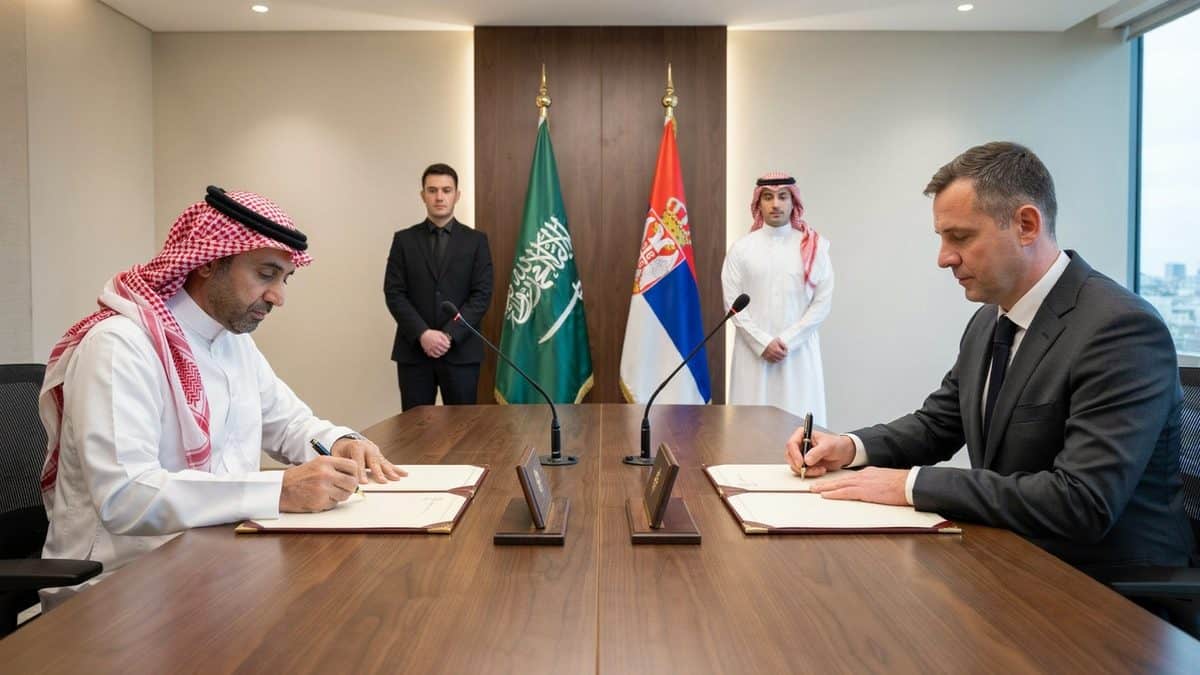
Image generated with Ai
Saudi Arabia and Serbia have made a move to strengthen their relationship after signing a visa exemption agreement for people who have diplomatic, special and service passports. The agreement was signed in Belgrade on September 3 2026 during a meeting between Saudi Vice Minister of Foreign Affairs Waleed Elkhereiji and Serbian Foreign Minister Marko Đurić. The action removes the need for short-stay visas for those types of passports as reported by Saudi officials. This does not mean that regular Saudi or Serbian passport holders can travel without a visa. The agreement adds another step to the increasing economic and tourism cooperation, between Saudi Arabia and Serbia.
Saudi Arabia and Serbia have signed a new visa exemption agreement covering holders of diplomatic, special and service passports, marking a fresh development in relations between the two countries.
Advertisement
The announcement is important because it establishes a formal mechanism for easier short-stay movement by officials and other eligible passport holders. It also sits within a broader relationship that Saudi Arabia and Serbia have been developing for more than a decade.
It is not a blanket visa-free agreement for all Saudi and Serbian citizens.
Advertisement
Advertisement
That distinction matters for travellers.
Serbia’s official Ministry of Foreign Affairs visa-regime page currently lists visa requirements for Saudi nationals holding diplomatic and official passports as well as ordinary passports. The newly signed agreement is therefore a new bilateral development, and travellers should check the Serbian authorities for implementation details before relying on the exemption.
The Saudi Press Agency‘s official announcement confirms the agreement but does not state an implementation date, length of permitted stay or additional operational conditions in the announcement available publicly.
This makes the agreement primarily a diplomatic and administrative development at this stage, while its wider economic and tourism significance will depend on how the two governments implement it.
The central point is simple.
Saudi Arabia and Serbia have agreed on mutual exemption from short-stay visa requirements for holders of diplomatic, special and service passports.
It does not, based on the official announcement, provide a general tourist visa waiver for ordinary passport holders.
That is particularly important because visa headlines can easily create confusion among travellers.
The exact practical conditions also remain important.
The official announcement does not specify the precise maximum number of days covered by the exemption. It also does not provide a public effective date in the announcement.
Serbia’s Ministry of Foreign Affairs provides country-specific visa information. Its current Saudi Arabia page lists visas as required for holders of diplomatic and official passports and for ordinary passport holders.
A visa exemption agreement for diplomatic and official categories can make official travel easier.
Government representatives often travel for bilateral meetings, negotiations, conferences and international events. Removing a visa requirement for eligible short stays can reduce administrative steps and make official exchanges more efficient.
That matters for Saudi Arabia and Serbia because both countries have been working to expand their relationship.It also says bilateral economic cooperation has been rising since 2018.
The relationship has developed beyond formal diplomatic contact.
The Serbian foreign ministry lists a 2015 memorandum of understanding on cooperation in tourism between the Serbian Ministry of Trade, Tourism and Telecommunications and the Saudi Commission for Tourism and National Heritage.
That agreement provides useful historical context for the latest visa development.
Tourism cooperation is therefore not a new subject between the two countries. The new visa agreement adds another administrative link to a relationship that already includes tourism cooperation, political dialogue and commercial exchange.
The two countries established diplomatic relations in April 2013.
Since then, officials have repeatedly discussed ways to strengthen political and economic cooperation.
In January 2022, Serbia’s then Foreign Minister Nikola Selaković met Saudi Arabia’s ambassador and highlighted the potential for stronger cooperation in political and economic fields. The Serbian ministry also said the meeting included discussion of the possibility of changing the visa regime.
That historical point is significant.
The latest agreement did not appear in isolation. The question of easier movement between the two countries has been part of the bilateral dialogue for several years.
The latest signing therefore represents the formalisation of one element of that longer relationship.
Serbia’s foreign ministry currently describes bilateral economic cooperation as having risen since 2018. It reports that total trade between Serbia and Saudi Arabia reached €107.2 million in 2025, with Serbian exports accounting for €51.1 million and imports from Saudi Arabia reaching €56.1 million.
The latest Saudi Arabia-Serbia agreement arrives as the two countries continue to look for areas of economic cooperation.
According to Serbia’s Ministry of Foreign Affairs, bilateral trade in 2025 totalled €107.2 million.
Serbian exports to Saudi Arabia were worth €51.1 million, while imports from Saudi Arabia were €56.1 million.
The figures show that commercial links exist in both directions. Serbia recorded €51.1 million in exports against €56.1 million in imports.
The latest visa agreement does not itself establish a trade agreement. Nor does the official announcement claim that it will automatically increase trade.
However, easier official travel can support the practical side of bilateral relations.
Government officials need to meet. Businesses need government contacts. Investment discussions require visits. International events create opportunities for delegations.
The removal of short-stay visa requirements for eligible passport holders can make those activities easier for the categories covered. That is the direct administrative effect.
Tourism provides another important layer.
Serbia‘s official bilateral profile records a 2015 tourism cooperation memorandum involving the Serbian government ministry responsible for tourism and the Saudi Commission for Tourism and National Heritage.
The distinction is essential.
Saudi Arabia and Serbia have signed an exemption covering diplomatic, special and service passports. Ordinary tourists do not automatically receive the same treatment under the announcement.
For tourism businesses, the agreement is nevertheless relevant because official travel is part of the wider ecosystem around tourism cooperation.
Government delegations can support destination promotion. Tourism officials can exchange policy experience. Businesses can meet during official events. Investment discussions can involve hospitality, infrastructure and destination development.
But these are potential areas of cooperation, not confirmed outcomes of the agreement.
Official Serbian tourism statistics show that Serbia has continued to attract large numbers of domestic and international visitors during 2026.
The Statistical Office of the Republic of Serbia reported 2,591,019 tourist arrivals in the first seven months of 2026, including 1,358,422 foreign arrivals. Total arrivals were 6.2% higher than during the same period of 2025, while foreign arrivals were 5.0% higher.
Foreign tourists also generated 3,596,464 overnight stays during January to July 2026, 5.0% more than in the corresponding period of 2025.
The July figures were also strong.
Serbia recorded 475,871 tourist arrivals in July 2026. Foreign tourists accounted for 283,890 of those arrivals. Foreign tourist arrivals were 3.7% higher than in July 2025.
The country’s leading destinations include major urban centres, spa resorts and mountain destinations.
The Statistical Office identifies Belgrade, Novi Sad and Subotica among the most visited urban destinations in July 2026. Vrnjačka Banja, Sokobanja and Banja Vrdnik were among the leading spa destinations, while Zlatibor, Kopaonik and Tara led among mountain centres.
These figures demonstrate that Serbia has an active and expanding tourism market.
They do not, however, establish how many Saudi visitors travelled to Serbia.
The scale of Serbia’s tourism sector makes international connectivity increasingly important.
Foreign arrivals reached more than 1.35 million during the first seven months of 2026. That was 5.0% above the same period of 2025.
The country’s official tourism data also show that foreign visitors are not concentrated in only one type of destination.
Urban tourism, spa tourism and mountain tourism all play roles.
That gives Serbia a broad tourism product.
Belgrade offers a major urban and cultural base. Novi Sad adds another important city destination. Spa resorts provide wellness-focused tourism, while mountain destinations offer nature and seasonal travel.
The official figures show that the country’s tourism economy is attracting visitors across these different categories.
For Saudi Arabia, this creates a broad potential destination portfolio. But again, the new visa agreement does not make ordinary Saudi tourists visa-free.
The significance of Serbia’s tourism growth is therefore contextual rather than a direct consequence of the diplomatic passport agreement.
Saudi Arabia is undergoing a major tourism transformation of its own.
Official Saudi tourism data show that the Kingdom recorded 123 million tourists in 2025, comprising 29.3 million inbound tourists and 93.3 million domestic tourists.
The official DataSaudi platform reports that inbound tourism reached 29.3 million tourists in 2025.
Religious travel represented 48.3% of inbound tourism, equivalent to 14.1 million tourists. Leisure accounted for 24.1%, or about 7.0 million tourists. Visiting friends and relatives represented 14.9%, while business travel accounted for 7.7%.
The figures underline the enormous scale of Saudi Arabia’s visitor economy.
Saudi Arabia is also seeking to diversify the reasons people travel within the Kingdom.
The data show a substantial leisure market alongside the dominant religious segment.
That creates a broader tourism environment in which international relationships can matter.
But the Saudi-Serbia agreement announced on 3 September 2026 should not be presented as a general Saudi tourism liberalisation measure.
It is a bilateral agreement for specified passport categories.
For most leisure travellers, the most important issue is whether ordinary passport holders can travel without a visa.
The answer cannot currently be presented as yes on the basis of this agreement.
Serbia’s Ministry of Foreign Affairs currently lists visa required for Saudi holders of diplomatic and official passports and for Saudi holders of ordinary passports and other travel documents.
That official page is particularly important because it provides a direct government reference for travellers.
The new agreement may require corresponding administrative updates before its exemption is reflected in the standard visa regime.
The official announcement also does not specify a precise implementation date.
Therefore, ordinary Saudi tourists should not assume that the agreement allows visa-free holidays in Serbia.
Likewise, Serbian ordinary passport holders should not assume that they can enter Saudi Arabia without a visa because of this agreement.
The scope announced by Saudi Arabia is limited.
This is one of the most important facts for readers to understand.
Serbia has also been modernising its visa administration.
The Serbian Government announced in June 2025 that Serbia had launched an electronic visa system allowing citizens of eligible countries to apply online. The government said citizens of 46 countries were then able to apply through an online portal without visiting a diplomatic or consular office.
The system is part of Serbia’s wider digitalisation of public administration.
The official government announcement said applicants could submit basic passport information, upload a photograph and provide their travel plan through the online system. Once approved, the electronic visa could be generated in PDF form and accessed through the portal.
Serbia’s official visa guidance also states that the country issues short-stay C visas for stays of up to 90 days within a 180-day period, where a visa is required.
The same official guidance says Serbia also has long-stay D visas for stays between 90 and 180 days, depending on the purpose of travel.
These systems matter because visa policy is not only about whether a visa is required.
The ease of applying for one also affects the traveller experience.
Serbia’s digital visa programme demonstrates a wider effort to simplify immigration procedures.
The official Government of Serbia says its e-visa system is designed to allow applications from anywhere in the world and operates through an online process.
Its Ministry of Foreign Affairs also says Serbia has issued digital travel authorisations in electronic form since April 2025 for eligible nationalities and qualifying circumstances.
This is relevant to the Saudi relationship because the two countries are now combining two different elements of travel administration.
One is bilateral visa exemption for specific official passport categories.
The other is Serbia’s broader digital visa infrastructure for travellers who remain subject to visa requirements.
They should not be confused.
A digital visa is still a visa.
A visa exemption means that an eligible traveller does not need to obtain that visa under the terms of the applicable agreement.
For ordinary travellers, the distinction remains fundamental.
The latest agreement comes against a background of growing official contact.
Serbia’s foreign ministry says bilateral political relations with Saudi Arabia are good, while also describing them as not yet matching their potential.
That wording indicates that both countries see room for further development.
Economic relations are one area.
Tourism is another.
Diplomatic engagement is a third.
The two countries have also been involved in discussions connected with major international events.
In October 2025, Serbian Foreign Minister Marko Đurić met Talal Al-Marri, chief executive officer of Expo 2030 Riyadh, on the sidelines of the Future Investment Initiative Conference in Riyadh. Serbia’s foreign ministry said the meeting focused on preparations for the two countries’ respective major exhibitions and opportunities for cooperation.
Serbia is preparing for Expo 2027 in Belgrade, while Saudi Arabia is preparing to host Expo 2030 in Riyadh.
That creates a clear institutional reason for officials and business representatives from both countries to maintain contact.
The new passport agreement can make some official travel easier within its defined scope.
Major international exhibitions can create significant opportunities for government-to-government and business-to-business engagement.
Serbia is preparing Belgrade for Expo 2027.
Saudi Arabia is preparing Riyadh for Expo 2030.
The Serbian Ministry of Foreign Affairs has already highlighted the opportunity for the countries to exchange experience related to their respective events.
This provides an important backdrop to the latest visa agreement.
Diplomatic, special and service passport holders can include people travelling for official government functions.
Easier short-stay movement can therefore be useful when governments are coordinating major international programmes.
However, the official announcement does not say that the visa exemption was created specifically for Expo 2027 or Expo 2030.
It should therefore be treated as a bilateral diplomatic measure that exists within a wider environment of cooperation.
For businesses, the direct effect of the agreement is limited by its passport scope.
Most corporate travellers use ordinary passports.
They would therefore need to continue following the applicable visa rules unless separate arrangements are announced.
However, official delegations often include senior government officials, diplomatic representatives and other holders of special or service passports.
For these groups, removing short-stay visa requirements can reduce administrative friction.
This may make official meetings easier to arrange.
It may also help government-supported investment missions and bilateral forums.
Serbia’s official data show that trade with Saudi Arabia reached €107.2 million in 2025.
That means a commercial relationship already exists.
Whether the new agreement eventually contributes to stronger commercial activity cannot yet be measured.
There is no official announcement establishing a forecast for trade growth resulting from the visa exemption.
A responsible assessment is therefore that the agreement improves a specific part of the travel framework for eligible officials, while any broader commercial benefit remains dependent on future activity.
Tour operators, hotels and destination organisations may see the agreement as another sign of closer Saudi-Serbia relations.
But businesses must communicate its scope correctly.
A hotel in Belgrade should not advertise the agreement as meaning that all Saudi citizens can enter Serbia without a visa.
A Serbian travel business should not tell ordinary Serbian travellers that they can enter Saudi Arabia visa-free on the basis of this agreement.
The exemption concerns specified passport categories.
That distinction should remain clear in travel marketing and customer information.
Serbia’s official tourism statistics show strong international demand in 2026, while Saudi Arabia’s official data show a large and growing tourism market.
Those trends make bilateral tourism cooperation commercially interesting.
But they are separate from the legal scope of the visa exemption.
It is tempting to interpret any visa agreement between two countries as a tourism breakthrough.
The official evidence does not support that description here.
This is a targeted passport agreement.
It does not cover all ordinary passport holders.
It does not state that Saudi tourists can now enter Serbia without a visa.
Those distinctions are especially important for Google Discover and Google News readers because headlines can quickly spread beyond their original context.
The most accurate description is that Saudi Arabia and Serbia have agreed to mutually exempt holders of diplomatic, special and service passports from short-stay visa requirements.
That is significant.
But it is not the same as opening unrestricted visa-free tourism between the two countries.
The Serbian Ministry of Foreign Affairs maintains country-specific visa information and advises travellers to check the applicable regime before travelling.
Its current Saudi Arabia page lists visa requirements for diplomatic and official passport holders and for ordinary passport holders.
That makes the official page an important reference point as the new agreement moves towards implementation.
Travellers should also consider that an agreement may require administrative steps before the new rules become operational.
The Saudi Press Agency announcement does not publish those implementation details.
Therefore, the safest approach is simple.
Eligible diplomatic, special and service passport holders should check the latest instructions from the relevant embassy or foreign ministry before travelling.
Ordinary passport holders should continue to follow the rules currently applicable to their passport category until official authorities publish a change.
There is a clear historical thread.
In January 2022, Serbia’s foreign minister discussed opportunities for intensifying economic cooperation with Saudi Arabia and specifically mentioned the possibility of changing the visa regime.
More than four years later, the two sides have signed a visa exemption agreement for specified passport categories.
The development therefore illustrates how bilateral agreements can evolve gradually.
Visa policy is closely linked to diplomatic relations, security considerations and administrative arrangements.
The signing of an agreement represents a political and legal step.
The actual travel experience depends on its implementation.
That is why the distinction between signed, effective and applicable to ordinary travellers is important.
The official information currently available confirms the signing.
It does not provide enough detail to state that the agreement is already operating for every eligible traveller or that a particular duration of visa-free stay applies.
Saudi Arabia has expanded its tourism infrastructure and international visitor strategy in recent years.
Official Saudi data show 29.3 million inbound tourists in 2025. The Kingdom also recorded 93.3 million domestic tourists, bringing the total number of tourists to 123 million.
Inbound tourism was dominated by religious travel, but leisure was also a major category.
The data show that 7.0 million inbound tourists travelled for leisure in 2025, representing 24.1% of inbound tourism.
Saudi Arabia is therefore not simply a major source market.
It is also becoming an increasingly important international destination.
That wider transformation makes bilateral travel agreements more significant as part of the Kingdom’s broader international engagement.
Still, the Serbia agreement should be viewed on its own terms.
It is a specific short-stay exemption for specific passport categories.
The immediate advice for travellers is straightforward.
Diplomatic, special and service passport holders: the two countries have signed a mutual short-stay visa exemption agreement. They should check the implementing instructions and effective date before travelling.
Ordinary Saudi passport holders travelling to Serbia: do not assume that the new agreement provides visa-free entry. Serbia’s official visa-regime page currently lists a visa requirement for Saudi ordinary passport holders.
Ordinary Serbian passport holders travelling to Saudi Arabia: the new agreement should not be interpreted as a general tourist exemption.
Tour operators and travel agencies: ensure customer information clearly distinguishes the covered passport categories from ordinary passports.
Business travellers: verify whether the passport type and purpose of travel fall within the exemption.
Government delegations: consult the relevant diplomatic authorities for implementation procedures.
Serbia’s official visa system also provides online services for eligible applicants, while its short-stay C visa framework covers stays of up to 90 days within a 180-day period where a visa is required.
The bilateral trade figure of €107.2 million in 2025 gives Saudi Arabia and Serbia a measurable economic relationship.
The tourism relationship also has a formal foundation through the 2015 memorandum recorded by Serbia’s Ministry of Foreign Affairs.
At the same time, Serbia’s tourism industry is growing.
The country recorded more than 2.59 million tourist arrivals during the first seven months of 2026, including more than 1.35 million foreign arrivals.
Saudi Arabia’s tourism market is considerably larger, with 123 million tourists recorded in 2025.
These figures create a strong statistical backdrop for future bilateral tourism and business cooperation.
But the data should not be used to claim that the new agreement will automatically increase visitor numbers.
The correct conclusion is more measured.
The two countries have a growing institutional relationship, an established tourism cooperation framework, measurable trade and now a new visa exemption for selected passport holders.
The next stage will be implementation.
The signing is confirmed.
The precise operational details need to be followed through official government channels.
The most important future information will include the effective date, the exact passport categories recognised by each government, the permitted duration of short stays and any conditions attached to the exemption.
These details are especially important for travellers and diplomatic missions.
The Serbian Ministry of Foreign Affairs is the authoritative source for Serbia’s visa regime. The Saudi Ministry of Foreign Affairs provides Saudi visa services and official consular information. Serbia’s official immigration portal also provides guidance on visas and entry requirements.
Until those details are formally reflected in the relevant systems, travellers should not rely solely on headlines.
The agreement is real.
Its scope is clear.
Its broader implications will become clearer as implementation progresses.
The Saudi Arabia-Serbia visa exemption agreement is an important bilateral development.
It removes short-stay visa requirements for holders of diplomatic, special and service passports under the agreement signed in Belgrade on 3 September 2026.
It also arrives after years of diplomatic and economic engagement.
Serbia established diplomatic relations with Saudi Arabia in 2013. The two countries have an existing tourism cooperation memorandum from 2015, while bilateral trade reached €107.2 million in 2025.
Both countries are also strengthening their international profiles.
Serbia is preparing for Expo 2027 in Belgrade.
Saudi Arabia is preparing for Expo 2030 in Riyadh.
Meanwhile, Serbia’s tourism sector continues to grow, with foreign arrivals up 5.0% in the first seven months of 2026, while Saudi Arabia recorded 29.3 million inbound tourists in 2025.
These developments create a strong foundation for closer cooperation.
But the key message for ordinary travellers remains unchanged: this is not a general tourist visa-free agreement.
Saudi Arabia and Serbia have signed a visa exemption agreement for diplomatic, special and service passport holders for short visits. The agreement strengthens the relationship that already exists, built on economic and tourism cooperation. Serbia recorded than 1.35 million foreign tourist arrivals, in the first seven months of 2026 and Saudi Arabia welcomed 29.3 million inbound tourists in 2025. However ordinary passport holders should not assume visa‑free access. Official implementation details remain important. The Saudi Arabia Serbia visa exemption agreement is therefore a diplomatic step but its wider tourism and economic impact will depend on future implementation and deeper bilateral cooperation. I think the Saudi Arabia Serbia visa exemption agreement could open doors if both sides follow through..
[Source:- The Saudi Gazzete]
Advertisement
Advertisement
Advertisement












Thursday, September 3, 2026
Thursday, September 3, 2026

Thursday, September 3, 2026

Thursday, September 3, 2026

Wednesday, September 2, 2026

Thursday, September 3, 2026

Thursday, September 3, 2026