
Germany Overtakes Other Countries to Become Slovenia’s Top Tourism Market as Summer Travel Boom Gains Momentum

Published
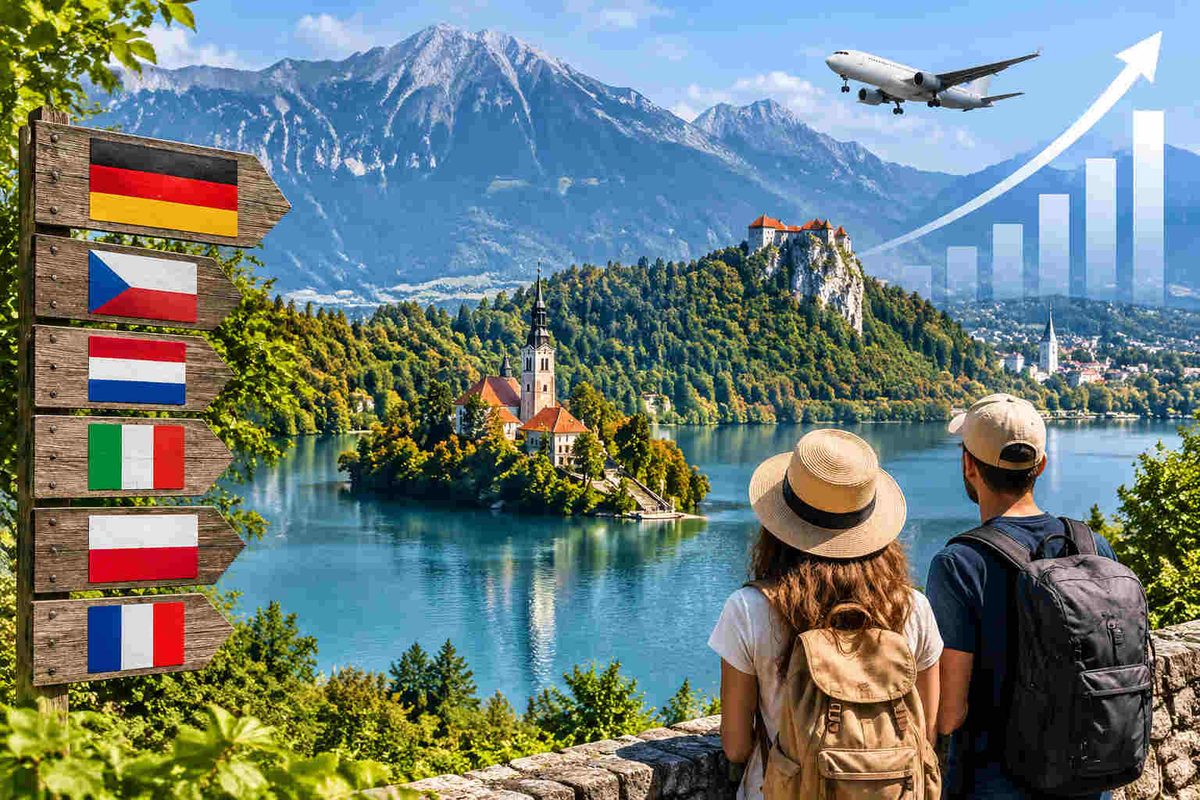
Image generated with Ai
Germany is now Slovenia’s most important tourist destination. With records shattering each summer, millions more people visit Slovenian shores and spend more nights there, boosting the travel market.
The tourism industry gained a boost in the center of the summer, with arrivals and overnight stays marking solid growth in July and August. The two-month statistics placed 2.2 million tourists in Slovenia, with accommodation suppliers noting 6.3 million overnight stays. This represented a 7% increase from the same two-month period of the previous year. This continued growth shows the strong interest in Slovenia as a tourist destination within Europe.
Advertisement
Advertisement
International travellers played the biggest role in the expansion. Overnight stays generated by foreign tourists increased by almost 9%, while domestic tourism remained comparatively stable, with the number of nights booked by Slovenian residents showing little significant change.
The figures underline the increasingly international character of Slovenia’s tourism market and indicate that overseas demand is becoming an important source of growth for destinations across the country.
Advertisement
Advertisement
Germany Remains Slovenia’s Largest Summer Tourism Market
Germany continued to hold a commanding position among Slovenia’s international source markets during the summer period.
Advertisement
Advertisement
German travellers, together with visitors from Czechia, the Netherlands, Italy and Poland, accounted for nearly half of all foreign tourist overnight stays. The strength of these markets demonstrates Slovenia’s broad appeal across Central and Western Europe, particularly among travellers seeking nature, outdoor recreation, historic towns and smaller-scale European destinations.
One notable change was Poland’s rise into the five largest international markets. Stronger demand from Polish visitors pushed France outside the top five, reflecting shifting travel patterns across Europe.
Several markets also recorded particularly strong rates of growth. Arrivals and overnight stays from the United Kingdom, United States, Spain, Serbia and Poland increased sharply, providing Slovenia with a more diversified mix of international travellers.
The expansion across multiple countries is important for the long-term stability of the tourism sector because it reduces dependence on a limited number of traditional markets.
US Tourism Market Emerges as a Major Growth Opportunity
The United States is becoming an increasingly important market for Slovenian tourism.
Advertisement
Advertisement
Growing awareness of Slovenia among American travellers, combined with stronger international exposure, has helped raise the country’s profile in the US market. Recent high-profile international sporting connections have also contributed to greater visibility for Slovenia among American audiences.
An even more significant development is expected with the planned introduction of direct air connections between the United States and Slovenia from next spring.
Direct flights could remove one of the main obstacles facing American travellers considering a trip to the country. At present, many journeys require passengers to connect through larger European aviation hubs before reaching Slovenia. A nonstop service could therefore make the destination easier to access while improving its competitiveness against other European countries with established transatlantic connections.
The development is particularly significant for major tourism centres such as Ljubljana and Bled, which see considerable potential in attracting more travellers from North America.
American visitors are also considered valuable because they often have stronger spending power and may travel outside the busiest summer months. That could support Slovenia’s wider objective of extending tourism activity throughout the year rather than concentrating demand during a short peak season.
Advertisement
Advertisement
Slovenia Tourism Could Grow by Up to Six Per Cent
Based on current performance, Slovenia’s tourism industry is expected to record annual growth of between 5% and 6%.
However, national tourism policy is increasingly moving beyond a simple focus on visitor numbers.
Authorities are placing greater emphasis on economic value, resident wellbeing, environmental protection and the overall quality of the visitor experience. This reflects a broader change taking place across European tourism, where destinations are increasingly questioning whether continuously increasing arrivals should remain the main measurement of success.
Strong visitor growth can bring economic benefits, support hotels and restaurants, create employment and strengthen local businesses. At the same time, rapid expansion can create pressure on transport infrastructure, public spaces, housing and natural environments.
Slovenia is therefore seeking a balance between tourism growth and destination protection.
Advertisement
Advertisement
Bled Faces the Challenge of Managing Tourism Popularity
Few Slovenian destinations demonstrate this challenge more clearly than Bled.
The Alpine resort is internationally recognised for its lake, island church, surrounding mountains and historic castle. Its distinctive landscape has made it one of Slovenia’s most recognisable tourism destinations.
Yet the enormous difference between its resident population and annual tourism activity illustrates the pressure created by its international popularity.
Bled has a population of around 8,000 people, but the destination recorded approximately 1.2 million tourist overnight stays last year.
Such volumes create significant economic opportunities for accommodation providers, restaurants, attractions and local businesses. However, they also increase pressure on roads, parking facilities, public services and popular visitor sites.
Advertisement
Advertisement
A new tourism strategy is consequently being prepared to help the destination manage future growth more carefully.
The objective is not simply to attract larger numbers of visitors but to protect the character, landscape and quality of life that make Bled attractive in the first place.
Managing visitor flows, encouraging longer stays, promoting travel outside peak periods and spreading tourism activity across surrounding areas could become increasingly important as visitor numbers continue to rise.
Tourism Growth Begins Spreading Beyond Famous Destinations
Another encouraging development is the growing geographical distribution of tourism across Slovenia.
Visitor growth is increasingly reaching areas beyond the country’s best-known tourism centres. This could help ease pressure on heavily visited destinations while giving smaller towns and rural regions an opportunity to benefit from international tourism.
Advertisement
Advertisement
Slovenia’s compact geography makes such diversification particularly achievable.
Travellers can experience mountains, lakes, historic towns, vineyards, caves and coastal areas within relatively short distances. Promoting a wider range of destinations could therefore encourage visitors to spend more time in the country while distributing tourism income across more communities.
The approach also supports Slovenia’s ambition to position itself around sustainable, experience-driven tourism rather than high-volume mass travel.
Traveller Behaviour Is Changing Rapidly
The tourism industry is also adapting to changing booking patterns and visitor expectations.
Last-minute reservations are becoming more common, forcing hotels, destination organisations and tourism businesses to respond more quickly to fluctuations in demand.
Advertisement
Advertisement
At the same time, travellers are increasingly looking for authentic and experience-led holidays. Instead of simply visiting major attractions, many tourists want local food, cultural experiences, outdoor adventures and meaningful interaction with destinations.
This trend could work in Slovenia’s favour because the country offers a broad range of nature-based and cultural experiences within a relatively small area.
Tourism planners are increasingly focused on generating greater economic value from every visitor rather than relying only on higher volumes.
Longer stays, higher visitor spending and demand for locally operated experiences could help tourism businesses generate stronger returns without requiring unsustainable increases in overall arrivals.
Diverse International Markets Strengthen Tourism Resilience
Slovenia’s varied international visitor base remains one of its strongest competitive advantages.
Advertisement
Advertisement
Unlike destinations that depend heavily on one or two major countries, Slovenia attracts travellers from numerous European and long-haul markets. That diversification can make the sector more resilient when economic conditions, airline capacity or consumer behaviour changes in individual countries.
Central European markets remain particularly important.
Poland, Czechia, Hungary and Slovakia collectively represent one of Slovenia’s most valuable foreign tourism regions. Continued targeted promotion in these countries could generate further growth because they offer strong road connectivity and relatively short travel distances.
Poland’s recent performance provides evidence of that potential.
At the same time, stronger demand from the United Kingdom, United States, Spain and Serbia demonstrates that Slovenia is expanding beyond its traditional regional markets.
Advertisement
Advertisement
Slovenia Looks Beyond Tourism Records
Slovenia’s summer performance shows that international demand remains strong, with 2.2 million tourist arrivals and 6.3 million overnight stays recorded across July and August.
Yet the next stage of the country’s tourism development is likely to focus less on breaking visitor records and more on managing growth intelligently.
Direct air connectivity with the United States, expanding demand from Central Europe and stronger international recognition could bring significantly more visitors in the years ahead. The challenge will be ensuring that this growth strengthens local economies without damaging the places travellers come to experience.
For destinations such as Bled, that balance is becoming increasingly important. For the wider country, spreading visitors across different regions, seasons and tourism experiences could provide a more sustainable path forward.
Slovenia’s tourism story is therefore evolving from one centred purely on increasing arrivals into a broader strategy focused on value, resilience, destination quality and long-term sustainability.
Advertisement
