

Asia Visa Policy Puts Japan, Malaysia and Thailand in Focus as Travellers Rethink Destination Choices

Published
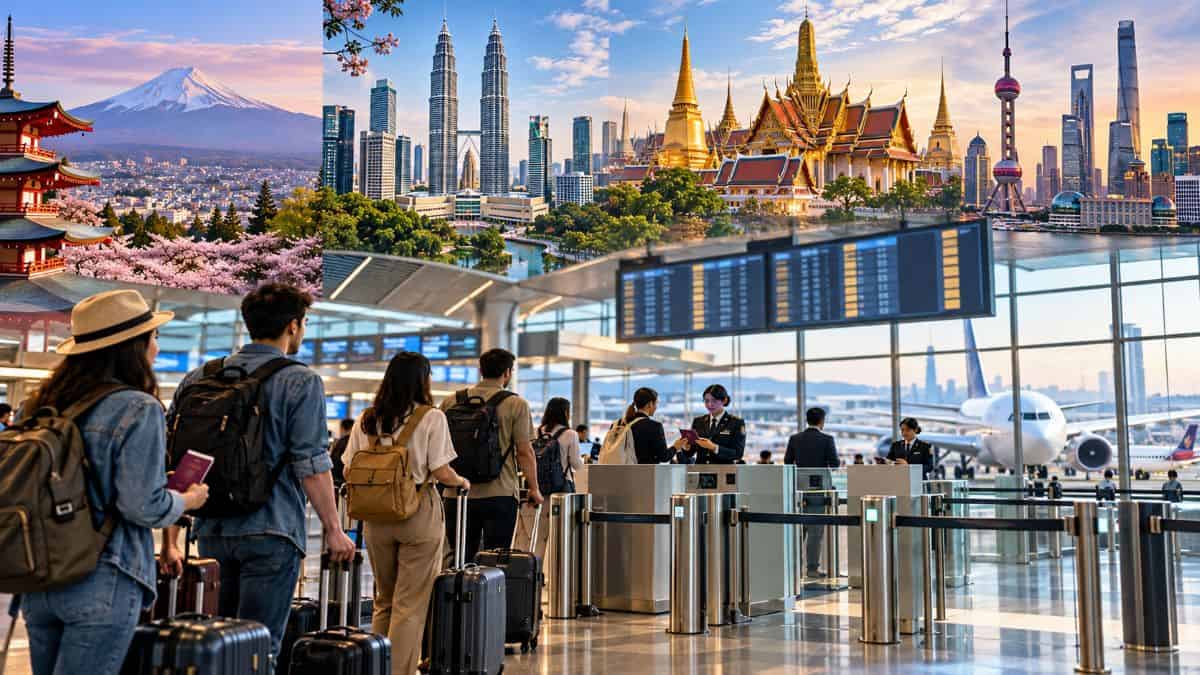
Asia visa policy is becoming an important factor in destination competition, as governments balance easier entry with tourism growth, security and visitor spending. Japan welcomed a record 42.68 million international visitors in 2025, while Malaysia recorded 42.2 million visitors and Vietnam received nearly 21.2 million international arrivals. However, Thailand’s international visitor numbers fell 7.23% to 32.97 million during the same year, despite extensive visa facilitation. China’s expanding visa-waiver arrangements and the China–Malaysia mutual exemption agreement, effective from 17 July 2025, provide further evidence of changing regional access strategies. These contrasting results raise a critical question for travellers and tourism businesses. Can easier entry genuinely influence destination choice, or do airfares, exchange rates, attractions and travel confidence ultimately determine where visitors spend their money?
Asia’s Visa Policies Reshape the Holiday Decision
Visa requirements can influence a holiday before travellers compare hotels, attractions or flight schedules. Advance applications, documentation, processing delays and uncertainty can increase the effort involved in planning an international trip. Conversely, visa-free access can make spontaneous holidays, short business visits and repeat journeys easier to arrange.
Across Asia, governments increasingly treat entry facilitation as part of their wider tourism strategies. China has expanded unilateral visa waivers, Malaysia and China have introduced reciprocal arrangements, and regional competitors continue to refine their approaches to international visitors. Nevertheless, these measures differ substantially in their eligible nationalities, permitted activities and maximum stays.
The distinction matters because visa-free entry is not the same as unrestricted travel. Travellers may still need to satisfy passport-validity requirements, arrival declarations, onward-ticket conditions and immigration checks. Electronic visas and visas on arrival also reduce some administrative burdens, but they retain different procedures and potential costs.
Advertisement
Advertisement
For travellers, the practical question is whether a destination offers a sufficiently convenient and affordable journey. For tourism authorities, the strategic challenge is converting that convenience into additional arrivals, longer stays and greater expenditure.
Japan and Malaysia Set New Tourism Benchmarks
Japan provides one of Asia’s clearest examples of substantial inbound tourism growth. The Japan National Tourism Organization recorded 42,683,600 international visitors in 2025, an increase of 15.8% from 36,870,148 in 2024. The annual total surpassed the previous record by more than 5.8 million visitors.
Advertisement
Advertisement
That performance demonstrates the strength of Japan’s tourism appeal, but it does not establish that visa policy alone drove the increase. Air connectivity, favourable travel costs for some overseas visitors, seasonal attractions, shopping and established transport infrastructure also influence demand. The country is therefore a useful benchmark for examining how entry arrangements interact with wider destination advantages.
Malaysia also recorded a strong headline result. The country reported 42.2 million visitors in 2025, up 11.2% from 38 million in 2024 and 20.4% above the 35 million recorded in 2019. These figures were reported in January 2026 as Malaysia prepared to strengthen its Visit Malaysia 2026 campaign.
However, Japan’s international visitor statistics and Malaysia’s broader visitor totals should not be treated as directly equivalent without reconciling their definitions. The difference illustrates an important principle for tourism research: headline numbers can reveal momentum, but sound comparisons require consistent statistical methods.
| Destination | 2025 tourism performance | Year-on-year change |
|---|---|---|
| Japan | 42.68 million international visitors | +15.8% |
| Malaysia | 42.2 million visitors | +11.2% |
| Vietnam | Nearly 21.2 million international visitors | +20.4% |
| Thailand | 32.97 million international visitors | −7.23% |
| Singapore | 16.91 million international visitor arrivals | +2.3% |
Sources: Japan National Tourism Organization, Malaysian government reporting, Vietnam National Statistics Office, Thailand’s government public-relations department and Singapore Department of Statistics. Their statistical definitions differ, so these figures indicate individual market performance rather than a definitive ranking.
China and Malaysia Remove a Major Travel Barrier
A significant regional development took effect on 17 July 2025, when China and Malaysia implemented their mutual visa exemption agreement for eligible ordinary passport holders. The arrangement covers Malaysian ordinary passports and Chinese ordinary and public-affairs passports, subject to the agreement’s conditions. It permits qualifying visits of up to 30 days per entry, with a cumulative limit of 90 days within any 180-day period.
The agreement covers tourism, family visits, business, cultural exchange and several other specified purposes. However, travellers intending to stay beyond 30 days, undertake employment or study, or perform activities requiring prior approval must obtain the appropriate authorisation. The exemption also does not automatically extend to every passport category.
Advertisement
Advertisement
For holidaymakers, the change reduces the need to arrange a conventional visa for eligible short visits. For airlines and travel operators, it may make regional itineraries easier to sell, particularly when customers consider combining Kuala Lumpur with other destinations.
Yet the agreement’s commercial impact requires closer measurement. Researchers must compare Chinese arrivals to Malaysia before and after implementation, examine comparable outbound travel to competing destinations, and account for flight capacity and seasonal demand. Without that analysis, the policy’s existence demonstrates improved access, not a proven increase in tourism caused by the agreement.
China’s Visa Waivers Carry a New Deadline
China’s unilateral visa-waiver programme provides another important example of how entry policy can influence international travel planning. An official Chinese foreign ministry notice published in November 2025 listed 50 nationalities eligible for visa-free entry for specified purposes, including tourism, subject to a maximum stay of 30 days.
The arrangements do not all share the same expiry date. According to that notice, the exemption for Russian ordinary passport holders runs until 31 December 2027, while the arrangements covering 48 other nationalities run until 31 December 2026. Brunei’s exemption has no specified implementation deadline in the notice.
This distinction is particularly relevant on 9 October 2026, because the stated deadline for those 48 nationalities is approaching. Travellers planning journeys beyond the end of 2026 should check whether the relevant exemption has been extended or replaced before making non-refundable bookings. The published deadline should not be interpreted as confirmation that the policy will end, nor should an extension be assumed without an official announcement.
China’s approach also demonstrates how visa facilitation can serve different markets simultaneously. The programme covers a range of European, Asian, Oceanian and Latin American nationalities, while separate reciprocal agreements govern other passport categories. A traveller’s eligibility therefore depends on the specific arrangement applicable to their nationality and passport.
Advertisement
Advertisement
The wider lesson is that visa access can be both a tourism incentive and a source of planning uncertainty. Clear policy communication matters almost as much as the exemption itself, particularly for long-haul travellers booking months in advance.
Thailand Shows Why Easier Entry Is Not Enough
Thailand offers a valuable counterpoint to the growth recorded by Japan, Malaysia and Vietnam. The country welcomed 32.97 million international visitors in 2025, down 7.23% from the previous year. Tourism revenue also declined, with international visitors generating approximately 1.54 trillion baht, a fall of 4.71%.
The results underline why simplified entry cannot guarantee stronger tourism performance. A visitor may face fewer administrative barriers yet still choose another destination because of airfare, personal safety concerns, changing travel preferences, exchange rates or the availability of competing holiday packages.
Thailand’s source-market figures offer further insight. Malaysia remained its largest international visitor market in 2025, with approximately 4.52 million visitors, followed closely by China at 4.47 million. However, Chinese arrivals fell 33.55% year on year, while arrivals from Malaysia declined 8.71%. Visitors from South Korea also decreased, while the Russian market grew.
These differences matter more than a simple national arrival total. A destination can experience growth from one market while losing visitors from another, even when both groups face broadly similar entry arrangements. Tourism authorities must therefore investigate nationality-specific demand rather than assuming one visa policy produces the same response across all travellers.
Thailand announced proposed revisions to its visa-exemption and visa-on-arrival arrangements in May 2026. Before treating those proposals as implemented changes, however, travellers and travel businesses must verify the relevant final regulations and effective dates through official channels.
Advertisement
Advertisement
For the industry, the priority is to determine whether future access changes improve conversion from travel interest to completed bookings. That requires evidence on visitor origin, trip purpose, booking behaviour and spending, rather than relying solely on the number of nationalities eligible for simplified entry.
Vietnam Turns Access Into a Growth Opportunity
Vietnam’s tourism performance strengthens the case for examining visa facilitation alongside destination development. The country received nearly 21.2 million international visitors in 2025, an increase of 20.4% compared with 2024, according to its National Statistics Office. Air travel accounted for more than 17.8 million arrivals, representing 84.3% of the total. Road arrivals reached nearly 3.1 million, while sea arrivals numbered approximately 273,900.
The transport breakdown reveals an important practical consideration. Visa access may simplify the administrative side of a trip, but visitors still need convenient routes to reach their destinations. For Vietnam, the dominance of air arrivals makes flight availability, airport capacity and competitive fares essential parts of the tourism equation.
The country also illustrates why governments should assess the interaction between immigration policy and tourism promotion. Entry facilitation may help travellers consider a destination, while cultural attractions, coastal resorts, food tourism and multi-city itineraries provide reasons to complete the booking.
However, the 20.4% increase cannot be attributed to visa policy alone. Establishing its contribution would require a nationality-level analysis of relevant policy changes, alongside flight capacity, travel costs and other demand factors. The same standard should apply to every destination in this comparison.
Singapore Proves That Spending Matters Too
Singapore presents a different measure of tourism performance. The city-state recorded 16.91 million international visitor arrivals in 2025, an increase of 2.3%. Tourism receipts reached S$32.755 billion, up 10%, while average length of stay declined 2.1% to 3.48 days.
Advertisement
Advertisement
The divergence between arrivals and receipts is particularly revealing. Visitor numbers increased modestly, yet tourism receipts rose more quickly, suggesting that spending patterns deserve attention alongside total arrivals. The figures alone do not establish why spending increased, but they show why tourism performance cannot be judged by entry volumes alone.
Singapore’s experience is relevant to other destinations competing on convenience and service quality. Short stays can still generate substantial economic activity when visitors spend on accommodation, dining, shopping, attractions and business-related travel. Nevertheless, receipts should be interpreted alongside inflation, exchange rates and changes in visitor composition.
For tourism businesses, this creates a more sophisticated question than whether easier entry attracts additional visitors. Does a policy generate incremental spending, encourage repeat trips or help travellers extend their stay? Those outcomes can have different consequences for airlines, hotels, destination-management companies and local businesses.
The Real Competition Extends Beyond Immigration
A useful comparison must consider the entire journey rather than the visa requirement in isolation. A destination offering visa-free entry may remain less attractive if flights are expensive, connections are inconvenient or accommodation costs exceed a traveller’s budget. Conversely, an electronic visa may not deter visitors when processing is predictable and the destination offers strong value.
| Factor | What travellers should compare | Why it matters |
|---|---|---|
| Entry requirements | Eligibility, fees and processing time | Determines preparation and administrative effort |
| Flight connectivity | Direct routes, frequencies and fares | Influences journey time and total cost |
| Accommodation | Seasonal room rates and availability | Shapes the overall holiday budget |
| Stay conditions | Permitted duration and entry limits | Determines whether the itinerary is practical |
| Destination value | Attractions, dining and transport | Influences spending and perceived value |
| Policy stability | Official expiry dates and amendments | Reduces the risk of unexpected changes |
This framework also helps tourism authorities distinguish an access problem from a wider competitiveness problem. If arrivals remain weak despite simplified entry, the next step should be to investigate route availability, visitor confidence, product quality and market-specific demand. More generous entry conditions alone may not address those obstacles.
For airlines and travel companies, the same analysis can support route planning and destination marketing. An exemption affecting a major source market may create opportunities for additional services or short-break packages, but commercial decisions should depend on booking trends and passenger demand. A policy announcement is an opportunity to investigate, not proof that a new route will succeed.
Advertisement
Advertisement
What Travellers Should Check Before Booking
The changing policy landscape makes official verification essential, particularly for trips extending into 2027. Travellers should confirm whether their passport qualifies for an exemption, whether the visit’s purpose is permitted and whether the intended stay falls within the applicable limit. They should also check passport validity, arrival declarations, onward-travel requirements and any separate transit rules.
The following official resources provide starting points for checking the arrangements discussed in this report.
| Destination or policy | Official information |
|---|---|
| China’s visa-waiver arrangements | Chinese Ministry of Foreign Affairs |
| China–Malaysia mutual exemption | Malaysia Immigration Department visa portal |
| Japan tourism statistics | Japan National Tourism Organization |
| Malaysia tourism information | Tourism Malaysia |
| Vietnam visitor statistics | Vietnam National Statistics Office |
| Singapore tourism statistics | Singapore Department of Statistics |
Travellers should consult the relevant destination’s immigration authority before departure, rather than relying exclusively on tourism articles or third-party summaries. Airlines may also check travel-document compliance before boarding, but their guidance does not replace official immigration requirements.
Asia’s Next Tourism Advantage
Visa policy can influence where travellers choose to go, but its impact depends on the wider travel proposition. Japan’s record visitor numbers, Malaysia’s expanding visitor market, Vietnam’s strong growth and Thailand’s decline demonstrate that Asian tourism markets follow different trajectories. None of these outcomes, on its own, proves that entry rules caused the change.
The most useful measure of success is whether easier access attracts additional visitors, supports repeat travel and generates sustainable spending. Governments need comparable statistics, clear policy communication and evidence about individual source markets to understand those outcomes. For travellers, the practical lesson is equally clear: compare entry conditions alongside flight prices, total trip costs, permitted stays and the experiences available. In Asia’s increasingly competitive tourism market, convenient entry can open the door, but the destination must still give visitors a compelling reason to walk through it.
Advertisement
