
Belgium Improves Evening Railway Connections Between Libramont and Bertrix With Later Weekday Travel

Updated
Published
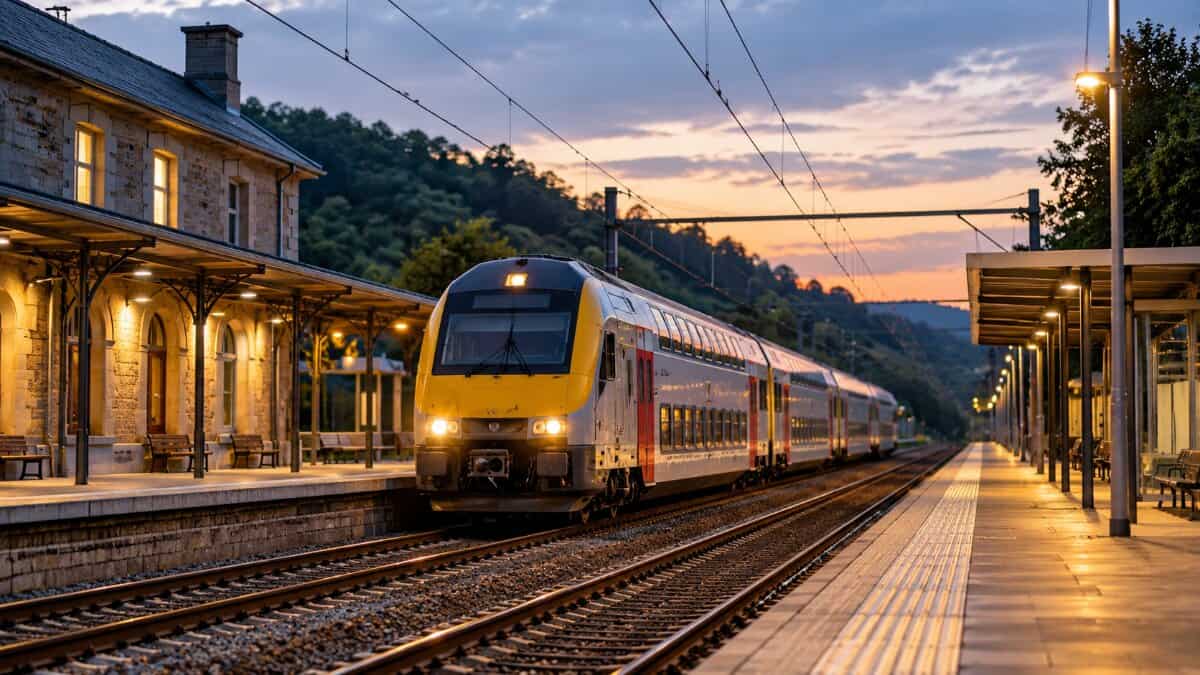
Image generated with Ai
Belgium will substantially improve late-evening rail access between Libramont and Bertrix from the December 2026 timetable change. SNCB is introducing three additional weekday departures at 21:14, 22:14 and 23:11, each reaching Bertrix nine minutes later and connecting at Libramont with IC services on the Brussels–Namur–Arlon/Luxembourg corridor. The real change is not simply a later final train. It is a redesigned interchange that makes late arrivals from central Belgium more practical for rail-based trips into the Ardennes.
Belgium’s December Railway Change Is Really About Connection Timing
SNCB’s new 2026–2029 transport plan formally starts on Sunday, 13 December 2026. Because the Libramont–Bertrix enhancement operates on weekdays, the first ordinary weekday operation should fall on Monday, 14 December. SNCB has already loaded the changes into its journey-planning system.
Advertisement
Advertisement
Three additional evening services are scheduled between Libramont and Bertrix.
| New weekday departure | Libramont | Bertrix | Scheduled running time | Strategic function |
|---|---|---|---|---|
| Evening train 1 | 21:14 | 21:23 | 9 minutes | Later connection from the IC corridor |
| Evening train 2 | 22:14 | 22:23 | 9 minutes | Extends the usable evening interchange window |
| Final new service | 23:11 | 23:20 | 9 minutes | Enables the latest published Brussels/Namur connection |
SNCB says all three trains will connect at Libramont with IC services operating on the Brussels–Namur–Arlon/Luxembourg corridor. For the final service, SNCB specifically identifies a connecting IC coming from Brussels at 20:37 and Namur at 21:46. la
Advertisement
Advertisement
This makes the change more significant than its headline timetable extension suggests.
The current final Libramont–Bertrix journey is scheduled at 22:57. From December, the last departure moves to 23:11. That is only a 14-minute extension of the final departure time. Viewed in isolation, 14 minutes looks marginal.
Advertisement
Advertisement
But railway connectivity works differently. The value of a regional train depends on which main-line services it can meet. A few minutes can determine whether an arriving passenger has a usable connection or faces a long wait, taxi journey or overnight disruption.
SNCB has therefore changed the connection geometry of the journey, not simply added minutes to the operating day.
Advertisement
Advertisement
Why Libramont Becomes More Important for Ardennes Rail Journeys
Libramont already functions as an important railway interchange in southern Belgium. SNCB identifies both Line 165, linking Libramont with Bertrix, Athus, Rodange and Arlon, and Line 166, linking Libramont and Bertrix towards Dinant, within its national passenger timetable structure.
The December change strengthens Libramont’s role as the point where longer-distance passengers can transfer onto a short regional feeder.
That matters particularly for travellers coming from Brussels or Namur. Instead of viewing Libramont as the end of a practical evening journey, passengers gain another short rail leg towards Bertrix.
The concept also aligns with existing destination planning around railway-based tourism. The Maison du Tourisme de la Forêt de Saint-Hubert identifies Libramont as the principal railway station for accessing its Ardennes area through the Brussels–Namur–Luxembourg axis. Its Train and Backpack programme even includes a 29-kilometre station-to-station walking route between Libramont and Bertrix.
Advertisement
Advertisement
That existing tourism infrastructure makes the December rail change more commercially relevant than an ordinary commuter timetable amendment.
The Biggest Traveller Detail May Be What Happens at 23:20
There is an operational detail travel planners should not overlook.
The final new train is scheduled to reach Bertrix at 23:20. However, as of 5 October 2026, SNCB lists Bertrix station’s main hall as open daily from 05:30 until 23:00. The station has ticket vending machines, connecting buses, parking and assistance facilities, but the currently published main-hall closing time falls 20 minutes before the new final arrival.
This does not mean the railway station or platforms close at 23:00. It means passengers should not automatically expect the main indoor hall to remain available when the final new train arrives.
SNCB could still revise opening arrangements before the December timetable begins. No such change was published on the station information page when checked on 5 October.
For tour operators, accommodation providers and independent travellers, that creates a straightforward planning requirement: late arrivals should confirm station facilities, onward transport and accommodation access before travelling.
Advertisement
Advertisement
It is precisely the kind of operational detail that becomes important when rural rail services move later into the evening.
Late Travellers Will Also Face Belgium’s New Pre Boarding Ticket Rule
Libramont’s current SNCB ticket office operates on working days from 07:00 until 14:15. Ticket vending machines remain available, alongside Blue-bike, Cambio, taxi, bus and parking connections.
This matters because Belgium changed its onboard ticketing rules on 1 July 2026.
According to SNCB, passengers can no longer normally purchase a ticket after boarding. Travellers must obtain a valid ticket beforehand through the website, app, vending machine or ticket office. Passengers travelling without a valid ticket can receive a fixed €90 irregularity notice, subject to specified exceptions.
For a late connection through Libramont, travellers should therefore treat digital or machine-based ticket purchasing as part of the journey plan rather than relying on onboard sales.
| Late-evening factor | Published position as of 5 October 2026 | Traveller implication |
|---|---|---|
| New trains | Three additional weekday departures | More evening flexibility |
| Last Libramont departure | 23:11 | Later access towards Bertrix |
| Final Bertrix arrival | 23:20 | Arrival enters an after-hours period |
| Bertrix main hall | Listed until 23:00 | Indoor facilities should not be assumed |
| Libramont ticket office | Weekdays 07:00–14:15 | Evening passengers should use digital sales or machines |
| Onboard ticket purchase | Generally unavailable since 1 July 2026 | Ticket must normally be secured before boarding |
| Weekend operation | New three-train enhancement specified for weekdays | Weekend itineraries require separate timetable checking |
Why Connection Quality Matters to Belgium’s National Rail Strategy
The Libramont–Bertrix adjustment also fits a much larger shift in Belgian rail policy.
Advertisement
Advertisement
According to Belgium’s Federal Public Service Mobility and Transport, connections themselves are a formal performance indicator under SNCB’s 2023–2032 public service contract.
The contract records a starting position of 1,940 planned connections and targets 2,150 by 2027 and 2,800 by 2032. It also aims to raise the percentage of realised connections from a baseline of 87.7% towards 88.6% in 2027 and 89.1% in 2032.
That policy context is important. Frequency alone does not create an effective national railway. Coordinated transfers determine whether passengers can move between high-frequency trunk lines and thinner rural branches.
The December timetable gives a small but unusually clear example of that principle.
| National SNCB connection metric | Baseline | 2027 target | 2032 target |
|---|---|---|---|
| Planned connections | 1,940 | 2,150 | 2,800 |
| Realised connections | 87.7% | 88.6% | 89.1% |
The Federal Council of Ministers also approved the first amendment to SNCB’s 2023–2032 public service contract in April 2026, including adjustments related to accessible and multimodal stations and smart mobility projects. That confirms the wider institutional framework within which the December timetable is being developed.
Three Extra Trains Sit Inside a Much Larger Expansion
The Libramont–Bertrix services represent only a small component of SNCB’s 2026–2029 timetable programme.
Advertisement
Advertisement
SNCB says the programme will be introduced in three phases between December 2026 and December 2028. At full implementation, it is expected to add nearly 600 additional services each week on weekdays and improve rail service at 178 stations.
The wider programme supports Belgium’s objective of increasing train supply by 10% and passenger numbers by 30% by 2032.
Recent national passenger figures underline why timetable design matters. SNCB reported 207.8 million passengers in 2025, using its refined passenger-counting methodology, with overall traffic up 1%. Travel using individual tickets increased by 2.6%. SNCB also expanded late-evening services elsewhere during the final phase of its previous transport plan.
The new southern Belgium timetable therefore continues an established strategy: extending the useful operating day rather than concentrating expansion exclusively around peak commuting periods.
Libramont Is Also Being Prepared as a More Multimodal Station
SNCB’s provincial investment plan extends beyond train paths.
For 2026–2029, seven stations in Luxembourg province are due to receive accessibility projects and eight are included in bicycle-parking projects. Libramont is specifically listed for a bicycle-parking development.
Advertisement
Advertisement
The station already has a controlled-access covered bicycle facility available 24 hours a day with 22 spaces, including two for oversized bicycles, according to SNCB.
Nationally, SNCB reported on 2 October that the number of independently accessible stations had reached 132, while bicycle-parking capacity exceeded 131,000 spaces at the end of the 2025 performance period.
Those figures reinforce the logic behind treating Libramont as more than an interchange between trains. Rail expansion becomes more useful for leisure travel when stations also support bicycles, local transport and other first-and-last-mile options.
September Rail Works Have Ended as Focus Shifts to December Service Changes
There is also an important fact-check for anyone preparing coverage now.
SNCB listed infrastructure work affecting the Libramont–Arlon corridor and some Libramont–Bertrix services from 7 September until 2 October 2026. As of 5 October, that published work period has ended.
Therefore, describing the December announcement by saying that those specific works are still continuing would be misleading.
Advertisement
Advertisement
SNCB does state more broadly that delivery of the 2026–2029 transport plan depends on infrastructure capacity allocated by Infrabel, completion of relevant works, recruitment and delivery of rolling stock. That is the safer infrastructure formulation for current coverage.
Why This Small Timetable Change Has Outsized Value for the Travel Trade
The commercial significance lies in usable arrival time, not raw rail capacity.
A destination can have a railway station and still be difficult to package without a car when the final practical connection leaves too early. Moving the rural feeder deeper into the evening changes the range of viable itineraries.
Travellers can spend longer in Brussels or Namur before continuing south. International visitors reaching Belgium earlier in the day gain more tolerance for delayed city activities or longer transfers. Walking and cycling products can more realistically begin or finish around railway stations. Accommodation providers around Bertrix gain a later rail-based arrival window.
However, the new timetable does not remove every friction point. The trains are weekday services. Late arrivals may occur after indoor station facilities close. Rural onward transport must still be checked separately. Tickets generally need to be purchased before boarding.
This is why the development should not be presented simply as Belgium adding three trains.
Advertisement
Advertisement
It is better understood as a carefully timed rural feeder layer attached to a major IC corridor. For railway tourism, that network design is the real story.
Operational Takeaways for Travel Agents and Tour Operators
- Build weekday itineraries around the 21:14, 22:14 and 23:11 Libramont departures, but do not apply them automatically to weekends.
- Treat Libramont as the principal interchange, because SNCB explicitly links the additional services to Brussels–Namur–Arlon/Luxembourg IC trains.
- Warn passengers using the 23:11 service that Bertrix arrival is 23:20, while the currently published main-hall closing time is 23:00.
- Arrange tickets before boarding, particularly for late connections, because SNCB ended normal onboard ticket sales on 1 July 2026.
- Recheck the SNCB journey planner near departure, especially during infrastructure work, winter operations or timetable updates.
- Do not describe the September–October Libramont-area works as ongoing, because SNCB lists that programme as ending on 2 October.
- Verify onward transfers independently when selling accommodation or activities outside walking distance of Bertrix station.
- Build contingency time into multi-leg itineraries, because the economic value of the new service depends heavily on successful IC-to-regional transfers.
Belgium’s Rural Railway Strategy Could Matter Far Beyond Three Trains
The Libramont–Bertrix change is modest in train numbers but strategically revealing.
Belgium is showing how a national railway can improve rural mobility without creating an entirely new long-distance service. The operator is instead using a short feeder journey, timed against an established IC corridor, to extend the practical reach of the network.
That approach matters for tourism regions where demand may not justify frequent late-night trains over long distances.
If Belgium continues combining stronger main-line frequencies, carefully timed rural connections, station accessibility and multimodal facilities, destinations in the Ardennes could become progressively easier to sell without private-car dependency.
For travellers, the decisive change from December is therefore not that Bertrix receives three more trains.
It is that Libramont becomes a more effective gateway after dark.
Advertisement
