

Jordan Tourism Builds Its Gulf Visitor Push While Petra Awaits a Broader Comeback

Published
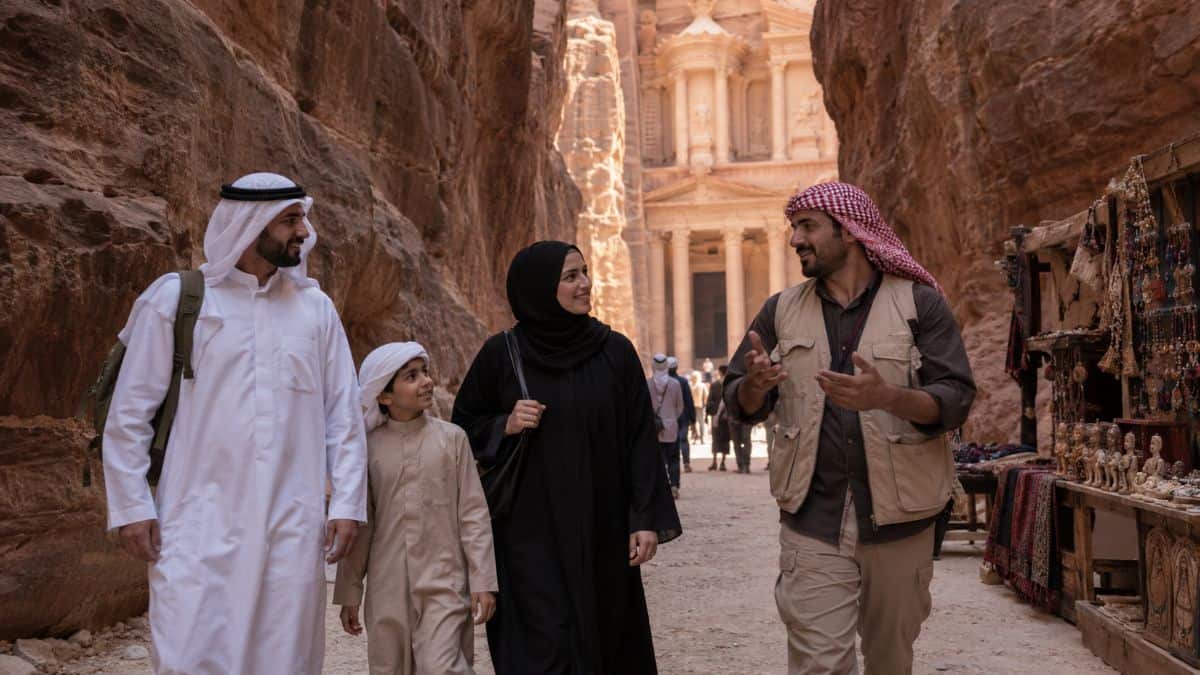
Jordan’s tourism strategy comes up in its plans to woo visitors from the Gulf region. The campaign seeks to lure more visitors from nearby markets. Nonetheless, the recovery of Petra remains a long way off since the number of foreign tourists is still lower than last year’s figure. There have been increases in tourism revenues, as well as success in Arab and Asian markets. Nevertheless, these successes do not say all. The airlines still operate in Jordan, although there are issues regarding airspace instructions. Thus, the main issue is how marketing efforts will help attract people and generate revenues for the country.
Jordan’s new Gulf tourism agreement brings a fresh focus
On 8 October 2026, the Jordan Tourism Board signed a cooperation agreement with VFS Global to promote Jordan in Gulf markets. The goal is to attract more visitors from Gulf Cooperation Council countries.
Advertisement
Advertisement
The agreement creates a timely new angle for Jordan tourism. It follows discussions about joint campaigns, packages designed for Gulf visitors and closer work between tourism businesses. VFS Global representatives also visited tourism sites and met with Royal Jordanian and private-sector representatives to discuss possible products and programmes.
The announcement is a plan for promotion. It does not confirm new flights, cheaper tickets or a set number of visitors. The important question is what happens next. Will the partners turn their discussions into bookable trips? Will those trips include more than one well-known attraction? And will visitors spend enough time in Jordan to support local businesses across the country?
Advertisement
Advertisement
The agreement is not a new air route
The distinction matters because tourism campaigns and airline announcements often appear together. A marketing agreement can help people learn about a destination. It cannot, by itself, put a new service on an airport timetable.
The Jordan Tourism Board and VFS Global discussed packages for Gulf visitors and possible tourism products with industry partners. The official announcement did not identify a new route, an airline launch date, a flight frequency or extra seats.
Advertisement
Advertisement
That gives travel readers a clear point to watch. A campaign may raise interest, but visitors still need a practical way to travel. They need a flight that operates on their dates, a useful itinerary and clear information about the places they plan to visit. For travel businesses, the test will be whether the agreement leads to enquiries, bookings and repeat visits, rather than attention alone.
Tourism income is rising, but the recovery is uneven
Jordan’s tourism income reached about US$5.56 billion during the first eight months of 2026, up 2.9% from the same period in 2025. The Central Bank of Jordan also reported that income rose 17.2% year on year in August, to about US$1.14 billion.
Those figures point to a recovery in national tourism income. Yet one national total cannot show how every market, town or tourism business is doing. The detailed figures tell a more divided story. Income from some visitor groups increased, while income from others declined.
This is why the latest Gulf promotion matters. It comes as Jordan tries to build demand in a region where tourism income has already grown. But the available figures do not prove that Gulf visitors alone caused the increase. They also do not predict how much future campaigns will contribute. A careful article should present the new agreement as a response to market conditions, not as proof that the recovery is secure.
Arab and Asian visitor income is growing while European income falls
The Central Bank’s source-market data show sharply different results for January to August 2026. Income from Arab visitors rose 16.3%, while income from Asian nationals grew 9.5%. By comparison, income from European nationals fell 23.7% and income from US nationals fell 17.1%. Income from Jordanian expatriates declined 5.9%.
The figures reveal a major shift in where tourism income is coming from. The difference between the change in Arab and European income is 40 percentage points. That calculation compares their published growth rates; it does not mean that Arab tourism income is 40% higher.
Advertisement
Advertisement
These categories need careful handling. “Arab visitors” does not mean “GCC visitors”. The official figures do not break out Gulf countries separately in the data cited here. The numbers support a story about changing regional demand, but they cannot measure the future success of the new Gulf campaign.
Petra’s figures challenge the idea of a complete recovery
Petra gives the story a clear destination-level test. The ancient city welcomed 43,901 visitors in September 2026, compared with 47,658 in September 2025. That was an 8% decline.
For January to September, Petra recorded 362,215 visitors, down 2.8% from 372,779 in the same period a year earlier. The sharpest difference appeared among foreign visitors. Petra recorded 184,387 during the first nine months of 2026, compared with 224,296 a year earlier, a fall of 17.8%.
That is a striking contrast with the rise in national tourism income. It shows why a countrywide figure cannot tell the full story of a famous attraction. Petra’s total visitor decline was smaller than its decline in foreign visitors because other visitor groups helped support the overall number.
The figures do not explain every reason for this difference. They do, however, show that attracting more visitors from abroad remains a key challenge for one of Jordan’s best-known destinations.
September offered a hopeful sign, but not a full answer
The Petra Development and Tourism Region Authority said visitor activity improved during the second half of September. Its chief commissioner linked the improvement to the resumption and stabilisation of air travel. The authority also said the figures showed continued interest in visiting Petra despite earlier challenges.
Advertisement
Advertisement
This is an encouraging detail, but it needs context. Petra still recorded fewer visitors in September than in the same month last year. Across the first nine months, foreign visitors remained down by 17.8%.
The difference between a better second half of the month and a lower monthly total is useful for readers. It suggests that the timing of the recovery matters. A late improvement can be a sign of renewed demand, but one month does not prove that demand has returned to previous levels. Future figures will show whether the improvement continues.
Jordanian visitors are helping to support Petra
Domestic visitors have become an important part of Petra’s 2026 picture. The authority recorded 144,536 Jordanian visitors during the first nine months of the year, compared with 114,187 in the same period of 2025. That was an increase of 26.6%. Arab visitors also rose, from 20,389 to 21,065, an increase of 3.3%.
These figures show that local and regional visitors can support a destination when international demand weakens. They also point to a possible opportunity for tourism businesses. Packages that appeal to residents and nearby markets may help hotels, guides and shops during periods when long-haul travel slows.
Still, domestic growth does not erase the fall in foreign visits. The groups have different travel patterns and may spend in different ways. Jordan’s challenge is to welcome domestic and regional visitors while also rebuilding international demand.
More airlines are operating, but planned returns need checking
Jordan’s Civil Aviation Regulatory Commission said on 3 October that more than 32 regional and international airlines were operating scheduled flights to Jordanian airports. It said Wizz Air and TAROM continued to operate regularly. It also reported that British Airways, Lufthansa and Austrian Airlines had submitted requests to resume or operate flights the following month. ETF Airways planned tourist charter flights.
Advertisement
Advertisement
These details make airline status an important part of the tourism story. They must be described precisely. A carrier that is already operating is different from one that has applied to restart. A planned charter is also different from a regular scheduled service.
The October statement included Eurowings Cargo among the applications. Because it is a cargo operation, it should not be counted as passenger capacity for tourists. Likewise, the number of airlines alone does not show how many seats are available or how many passengers are travelling for leisure.
For travellers, the practical step is simple: check the specific flight with the airline before booking onward plans.
A safety advisory creates a crucial aviation caveat
There is a significant difference between Jordan’s report of normal airport operations and the latest EASA bulletin on Jordanian airspace.
Jordan’s Civil Aviation Regulatory Commission said on 3 October that flights were arriving and departing normally. It also said that more than 32 airlines were operating scheduled services.
EASA’s bulletin, revised on 30 September, remained active when checked. It was valid until 16 October 2026, unless reviewed earlier. The bulletin recommended that operators within its scope avoid operating in Jordanian airspace at all altitudes. It also called for current risk assessments and contingency plans.
Advertisement
Advertisement
These statements describe different things. Airport operations can continue while an aviation regulator advises certain operators to avoid the airspace. The EASA bulletin does not say that every airline has stopped flying to Jordan. But it does show why route availability and safety guidance require regular checks.
Travellers should check the exact journey and current advice
The UK Foreign, Commonwealth and Development Office’s Jordan advice was marked current on 9 October 2026. It warned that travel plans could face cancellations, airspace closures and disruption. It also advised against all travel within 3km of the Jordan–Syria border and warned that travelling against FCDO advice could affect insurance.
This guidance does not mean that every part of Jordan has the same travel advice. The border warning applies to a defined area. Readers should check the current advice for their own government and review the specific places on their itinerary.
They should also confirm their flight with the airline and read their booking conditions. An airport operating normally does not guarantee that every route will run as planned. Travellers should keep plans flexible enough to respond to late changes and make sure their insurance covers their intended journey.
Wadi Musa shows why the visitor experience matters on the ground
Jordan’s tourism story does not end when a plane lands. Visitors also need roads, public spaces and services that help them reach attractions and local businesses.
In September, the Petra authority launched the Al-Dara Development Project in Wadi Musa. The plans include an alternative road near the tourist street, pedestrian paths, seating areas, parking, public facilities and commercial premises. The project also aims to link the tourist street with downtown Wadi Musa and improve traffic flow.
Advertisement
Advertisement
This creates a useful local angle for the article. Better access could help visitors move around the area and support commercial activity. But the project’s expected benefits should not be written as results already achieved. The project describes planned improvements, not proof that visitor spending or local business income has already increased.
Jordan’s tourism test goes beyond arrivals
Jordan as the industry slowly recovers. Income from tourism is on the up because Arab and Asian tourists generate higher income. However, Petra is experiencing a reduction in foreign tourists while there are challenges to airspace management which will leave some airlines reevaluating their strategy. There is an increasing trend among Gulf nations but marketing alone is not enough to secure seats and bookings or even occupancy. This is where Jordan will be put to the test in turning tourism interest into tourism visits that will positively impact destinations and communities.
Advertisement
