
United Arab Emirates, Bangladesh and Thailand Air Travel Recovery Accelerates as Emirates Restores Global Flights and Flydubai Expands Tourism Connectivity: What International Travelers Should Watch Now

Published
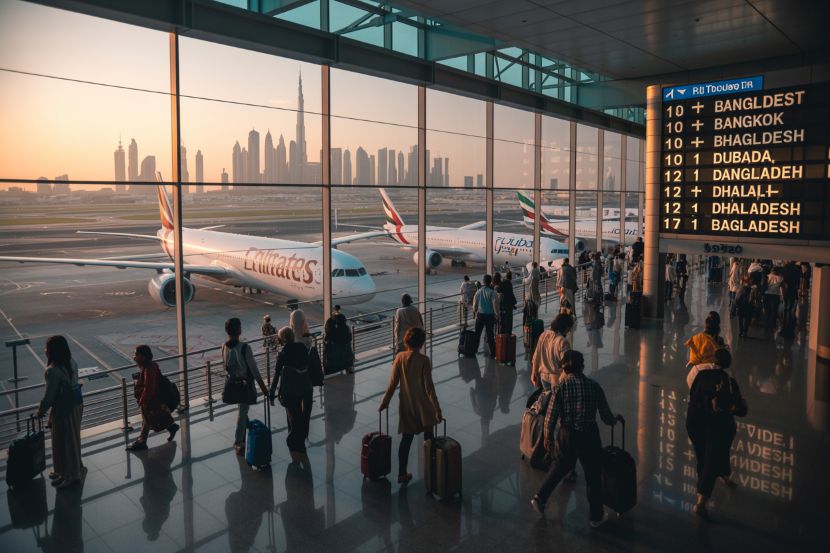
Image generated with Ai
Dubai’s aviation industry is witnessing one of its fastest operational recoveries in recent years as Emirates and Flydubai rapidly restore international connectivity following months of regional airspace disruptions across the Middle East. The reopening of unrestricted air travel by the United Arab Emirates has triggered a strong rebound in passenger movement, tourism demand, and long-haul transit traffic through Dubai International Airport, one of the world’s busiest global aviation hubs.
The recovery carries major implications for global tourism flows connecting Europe, Asia, Africa, and the Gulf region, especially as summer travel demand begins to surge. Emirates has already restored nearly its full international network spanning 72 countries, while Flydubai is gradually rebuilding routes across regional and medium-haul markets, including new expansion plans for Bangladesh and Thailand.
Advertisement
Advertisement
The rebound also highlights the resilience of Dubai’s aviation ecosystem, which remains central to international tourism, business travel, religious tourism, and global transit traffic linking East and West.
Dubai’s Aviation Sector Regains Momentum After Regional Airspace Challenges
The reopening of unrestricted air travel in the UAE on May 2 marked a decisive turning point for the Gulf aviation industry. Following months of operational disruptions caused by regional tensions and temporary airspace complications, Dubai’s airlines have returned to aggressive recovery mode with airlines restoring routes, increasing frequencies, and rebuilding passenger confidence.
Advertisement
Advertisement
Dubai Airports, which handles tens of millions of international travelers annually, has already increased aircraft movements as schedules stabilize across the network. Industry analysts view the speed of recovery as a significant indicator of the emirate’s continued strength as a global aviation and tourism powerhouse.
The aviation rebound comes at a strategically important moment for the tourism sector. Summer bookings across the Gulf, Southeast Asia, and Europe are already rising, with Dubai continuing to attract leisure travelers, luxury tourists, transit passengers, and business visitors.
Advertisement
Advertisement
According to aviation industry data from Airports Council International and IATA, Dubai International Airport has consistently ranked among the world’s leading hubs for international passenger traffic, connecting more than 240 destinations globally through partner carriers and local airlines.
Emirates Pushes Near Full Global Restoration Across 72 Countries
A Strong Signal for International Tourism and Transit Travel
Emirates has restored approximately 96% of its international destination network, reconnecting Dubai with 137 destinations spread across 72 countries. The airline is now operating more than 1,300 weekly flights, representing roughly 75% of its capacity before the regional disruptions affected operations earlier in 2026.
The scale of the recovery is particularly important for global tourism because Emirates plays a critical role in connecting travelers between Europe, Asia-Pacific, Africa, and the Middle East. The carrier’s extensive long-haul network supports tourism economies dependent on transit passengers and international connectivity.
Even during the reduced operational period between February and April 2026, Emirates transported approximately 4.7 million passengers, underscoring the continued demand for Dubai as both a destination and a global transfer hub.
The airline’s recovery is expected to strengthen several travel sectors simultaneously, including:
- Luxury tourism to Dubai and the Gulf
- Corporate and MICE travel
- Religious travel connecting Asia and the Middle East
- Long-haul leisure tourism
- Transit tourism through Dubai
Travel industry experts note that airlines capable of restoring international connectivity quickly often gain a competitive advantage during periods of regional recovery, especially in transit-heavy markets.
Advertisement
Advertisement
Flydubai Rebuilds Regional Operations While Expanding into Asia
Bangladesh and Thailand Routes Add Fresh Tourism Opportunities
While Emirates focuses heavily on long-haul global connectivity, Flydubai has concentrated on rebuilding regional and medium-haul routes across emerging travel corridors.
The airline operated more than 3,800 flights during March despite regional airspace restrictions. During that period, the carrier averaged approximately 130 daily flights compared to nearly 320 daily flights before disruptions affected operations, according to aviation tracking data from Flightradar24.
Current operational data suggests Flydubai has restored close to half of its pre-disruption network, with gradual increases continuing across multiple markets.
The airline’s expansion strategy now includes renewed emphasis on South Asia and Southeast Asia. Flights to Chattogram in Bangladesh launched on April 1, while Bangkok services are scheduled to begin on July 1.
These additions are strategically significant for tourism and regional mobility:
Bangladesh continues to witness rising outbound travel demand to the Gulf for business, family, and tourism travel. Improved air connectivity between Dubai and Chattogram could further strengthen tourism exchanges and labor mobility.
Advertisement
Advertisement
Meanwhile, Thailand, particularly Bangkok, remains one of Asia’s strongest tourism magnets. The addition of Flydubai’s services is expected to benefit leisure travelers seeking affordable connections between the Gulf and Southeast Asia.
Why Dubai’s Aviation Recovery Matters for Global Travelers
Strategic Travel Advantages Emerging Again
Dubai’s rapid airline recovery has wider implications extending beyond the UAE. The city functions as one of the world’s largest transit gateways, linking travelers across continents through highly efficient long-haul and regional networks.
For travelers, the restoration of routes brings several advantages:
Improved Flight Availability
As Emirates and Flydubai restore frequencies, travelers gain access to more direct routes, shorter layovers, and improved scheduling flexibility.
Competitive Airfares May Return
A gradual increase in airline capacity often helps stabilize airfare pricing across major international corridors connecting Europe, Asia, and the Middle East.
Faster Tourism Recovery Across Connected Destinations
Countries dependent on Gulf transit traffic could benefit from stronger tourist arrivals as connectivity improves through Dubai.
Advertisement
Advertisement
Stronger Business Travel Recovery
Dubai remains a major center for conferences, exhibitions, and financial travel. Increased airline operations support the return of large-scale international events and corporate mobility.
Travelers Advised to Monitor Operational Updates During Recovery Phase
Smart Travel Planning Becomes Essential
Although operations are normalizing, travel analysts continue advising passengers to remain attentive to schedule changes during the ongoing recovery phase.
Travelers flying through Dubai are encouraged to:
- Verify flight timings before departure
- Arrive early at airports during peak travel periods
- Monitor transit requirements for connecting destinations
- Review airline notifications for operational updates
Summer 2026 is expected to generate particularly strong demand across Gulf aviation markets, especially with school holidays, religious travel, and international leisure tourism all converging simultaneously.
Dubai Reinforces Its Position as a Global Aviation and Tourism Superhub
The rapid restoration of Emirates’ international network alongside Flydubai’s regional rebuilding demonstrates how Dubai continues to position itself at the center of global air connectivity. The combined recovery efforts of both airlines are expected to stimulate tourism, trade, hospitality demand, and transit traffic throughout 2026.
As airlines resume services and expand into high-demand destinations such as Bangladesh and Thailand, Dubai’s role as a bridge between continents is becoming increasingly evident once again. The recovery also highlights the resilience of the UAE aviation ecosystem, which remains deeply integrated with international tourism growth and global mobility trends.
With passenger demand returning steadily and airlines accelerating operational normalization, Dubai appears poised to reclaim its position among the world’s most influential aviation gateways far sooner than many industry observers initially expected.
Advertisement
