

US Airports on Edge as Winter Storm Sweeps Across Major Hubs: Over 4,000 Flights Canceled, Impacting Passengers from New York, Chicago, Atlanta, Washington DC, and More – Full Travel Update

Published
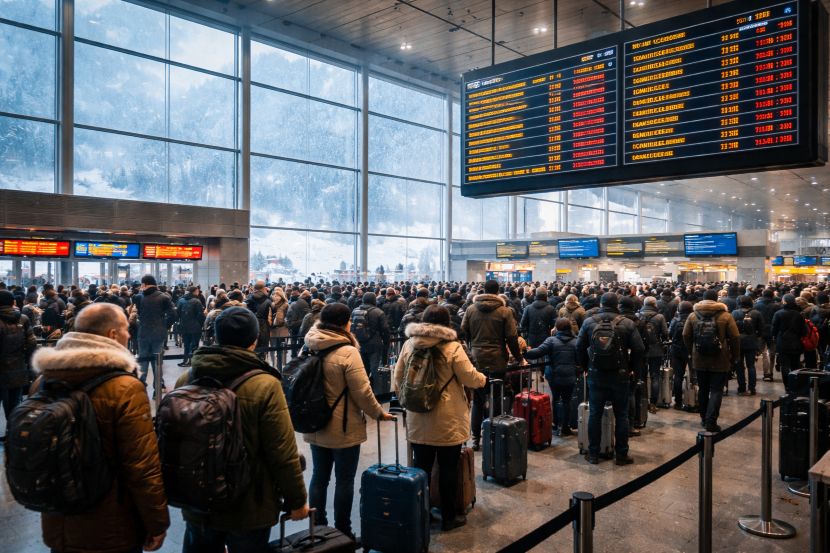 Image generated with Ai
The United States faces unprecedented travel disruption as a powerful March storm complex collides with the ongoing partial government shutdown, leaving airports struggling from New York to Chicago to Atlanta under historic pressure. With spring break travel and NCAA March Madness crowds swelling terminals, severe weather has battered the Midwest and East Coast, grounding aircraft and forcing airlines to scrap thousands of flights. According to FlightAware, more than 4,400 flights were canceled and over 10,400 delayed on Monday alone as blizzard conditions and high winds hammered key gateways, while continuing disruptions have persisted into Tuesday. Meanwhile, the shutdown has weakened TSA staffing security checkpoints, stretching queues and causing further delays for travelers trying to reach their destinations. These compounded challenges mark one of the most chaotic periods for US flights and airport operations in 2026, affecting travelers, airlines, and tourism flows across the nation.
Massive Scale of Cancellations and Delays Across the US
According to real‑time flight‑tracking data, Monday saw a massive storm system force the cancellation of more than 4,400 flights and delay roughly 10,400 others, with significant follow‑on impacts into Tuesday.
Advertisement
Advertisement
Flight tracking on FlightAware showed that cancellations and delays extended well beyond the initial storm period, with subsequent days also experiencing hundreds to thousands of additional flight irregularities as airlines struggled to reset schedules. Adding the major storm impact on Sunday and Monday, more than 8,000 delays and 4,000 cancellations were recorded by mid‑week.
These delays have stretched airline operations, increasing holding times at major hubs and forcing airlines to revise crew schedules, aircraft rotations, and customer itineraries, with ripple effects lasting into the following travel days.
Advertisement
Advertisement
Historic March Storm: Weather Forces Travel Chaos
The underlying culprit for much of the disruption is a historic storm complex spanning March 13–17, 2026, which brought blizzard conditions, heavy snow, high winds, and severe thunderstorms across a huge swath of the United States, from the Pacific Northwest through the Upper Midwest and into the East Coast.
This system produced snow totals exceeding three feet in parts of Michigan and gusts exceeding 65 mph in the Great Lakes region, while also triggering severe weather advisories from the Carolinas to the Mid‑Atlantic. Ground stops and traffic management restrictions by the Federal Aviation Administration (FAA) were put in place at major airfields as the storm weakened visibility and presented unsafe flight conditions.
Advertisement
Advertisement
Travel planners, especially during spring break, were blindsided as cities unaccustomed to late‑season blizzards, such as those in the upper Midwest, grappled with blocked runways and airport services slowed by snow‑clearing priorities.
In‑Depth Look at the March 13–17, 2026 US Storm Complex — A Travel‑Disrupting Mega Weather Event
The massive storm system that disrupted US flights in mid‑March wasn’t a typical winter front — it was a nation‑spanning weather complex that brought blizzard conditions, high‑impact winds, widespread severe thunderstorms, tornadoes and ice across much of the United States, significantly affecting travel, infrastructure, and daily life.
A Multi‑Phase Storm with Extreme Snow and Wind
- The system formed on March 13, 2026 as an extratropical cyclone moving eastward across the Pacific Northwest and over the Rocky Mountains before strengthening dramatically.
- Once it emerged into the central United States, it evolved into a deep Colorado low‑pressure system, which intensified as it tracked into the Upper Midwest and Great Lakes region.
- Snowfall totals were extraordinary in the hardest hit areas. Some locations in Michigan and northern Wisconsin received between 30–50+ inches (2½–4 ft) of snow as the blizzard wrapped around the storm’s core.
- Wind gusts up to 69 mph near Grand Marais, Michigan were reported, capable of creating dangerous drifting snow and near‑whiteout conditions on travel routes and over open terrain.
TSA Staffing Crisis Deepens Airport Gridlock
The travel turmoil has not been caused by weather alone. The ongoing partial government shutdown, now extending for weeks, has left TSA officers and other Department of Homeland Security staff working without pay. According to official DHS‑reported figures, the average TSA call‑out rate has jumped from under 2% to over 6% nationwide, with some airports seeing call‑out rates exceed 30%, especially at New Orleans and Houston.
This high absenteeism has translated into significantly longer security lines — sometimes up to 90 minutes or more — even at non‑storm‑affected airports, compounding delays for travelers already contending with cancellations. Without steady staffing, airport throughput at security checkpoints has suffered, and several smaller airports have even warned they may have to suspend operations temporarily if staffing shortages worsen.
Travelers are now being advised to arrive at least three hours before departure and to carry itinerary changes on their mobile devices due to possible extra screening waits.
Major Hubs Most Affected: What Travelers Should Know
Data from FlightAware and official FAA ground stop logs reveal that major airport hubs experienced some of the highest disruption levels:
Advertisement
Advertisement
- Chicago O’Hare International (ORD): One of the hardest hit, with multiple days of cancellations and delays as weather and staffing issues compounded.
- Atlanta Hartsfield‑Jackson (ATL): High winds and oversaturated flights created cascading delays.
- New York (LGA/JFK): Snow and high wind warnings forced frequent ground stops.
- Charlotte Douglas and Newark Liberty: Also saw extended ground delays as local storm cells passed.
Smaller airports are also feeling the pinch; airlines have reported passengers abandoning flights to drive to nearby cities due to backlog and uncertainty.
Travel Tips and Adaptive Strategies for Stranded Passengers
With multi‑faceted disruption expected to persist, travelers should consider the following:
- Real‑Time Monitoring: Check airline apps and FAA flight status portals before leaving for the airport.
- Alternate Airports: If nearby airports are functional and less congested, rebooking through them may reduce wait times.
- Travel Insurance: Policies covering weather disruptions and cancellations can offer reimbursement for expenses like hotels and meals.
- Flexible Tickets: Booking tickets with flexible change or refund policies can reduce stress in volatile travel conditions.
These adaptive travel strategies are becoming essential during severe weather bursts or staffing shortages that are outside individual travelers’ control.
Airline and Tourism Sector Response
Airlines such as American, Delta, and Southwest have waived change fees and rebooking penalties in an attempt to ease the burden on flyers. Tourism boards in affected cities have also sent advisories to visitors about travel time estimates and local weather conditions.
Some international carriers have announced additional services between global hubs to accommodate travelers rerouted through other cities, helping maintain tourism flows even amid cancellations at major US gateways.
Traveler Preparedness: What’s Next?
With peak spring travel underway and March Madness driving passenger demand, the combination of severe winter storms and internal government funding gridlock represents a rare dual threat to air travel reliability. The FAA and weather prediction authorities warn that while the worst of the storm has passed, residual delays and flight disruptions are expected to continue into the coming travel days — especially at airports with high volumes of inbound and outbound flights.
Travelers are urged to stay informed and prepared for flexible travel plans as conditions evolve.
Advertisement
