
Bank of America Chicago Marathon 2026: Global Runners Converge as World Major Drives Multi-Million Dollar Economic Surge

Published
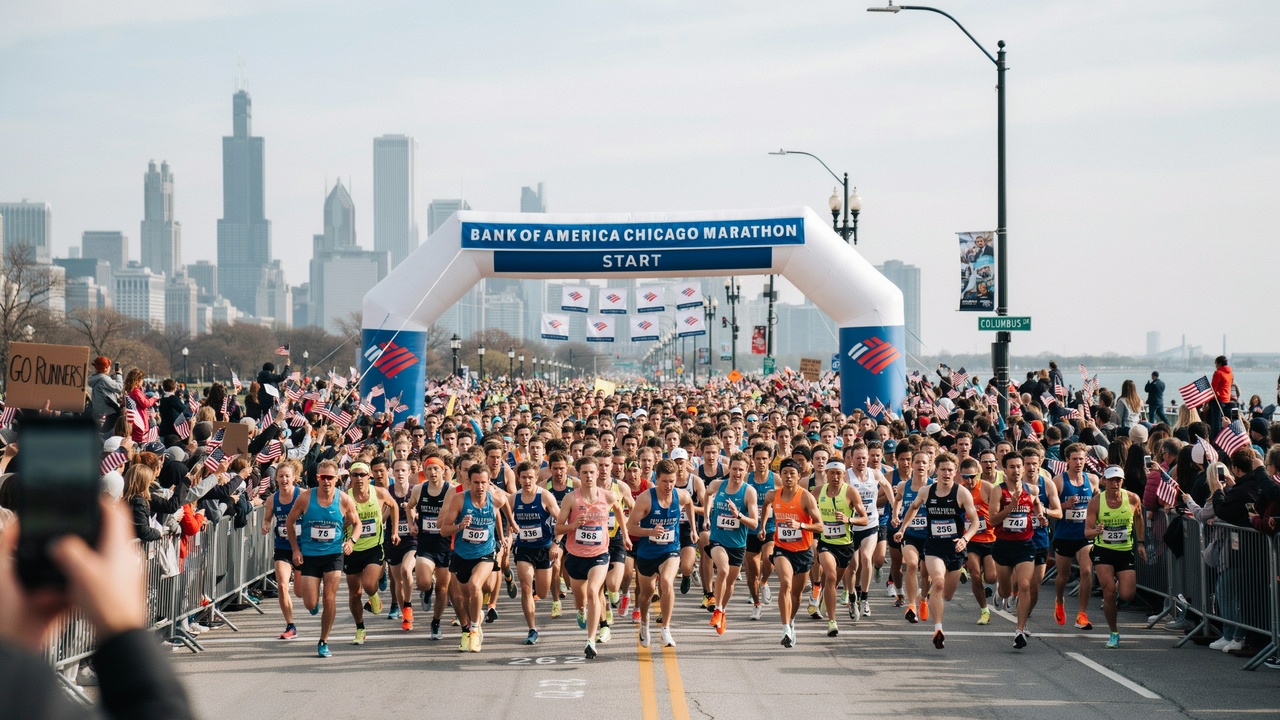
Image generated with Ai
Municipal staging operations, public transit networks, and downtown hospitality corridors across Cook County have entered peak operational readiness as the 48th Bank of America Chicago Marathon prepares to run on Sunday, October 11, 2026. Designated as an elite World Athletics Platinum Label Road Race and a flagship pillar of the Abbott World Marathon Majors, the race stands as one of the largest mass-participation sporting spectacles on earth, drawing over 50,000 registered participants and an estimated 1.7 million on-course spectators through 29 diverse Chicago neighborhoods.
Beyond its world-class competitive standard—renowned globally as the proving ground where men’s and women’s world records have fallen—the Chicago Marathon serves as an autumn economic engine, delivering high-density international sports tourism, retail spend, and city tax yields.
Advertisement
Advertisement
Event Staging, Route Architecture, and Participating Fields
The race course begins and ends in central Chicago’s premier public open space, Grant Park:
- The Course Footprint: Spanning a 26.2-mile looped layout, the route winds through 29 neighborhoods—from the Loop north through Lincoln Park and Lakeview, west into the West Loop and Pilsen, south down to Bronzeville and Chinatown, and back to Columbus Drive. The ultra-flat topography and protected lakefront microclimate make it one of the fastest athletic courses worldwide.
- Elite Marathon Field: The 2026 starting line convenes reigning Olympians, world championship medalists, and global distance elites across men’s and women’s divisions, featuring premier competitors from Kenya, Ethiopia, Uganda, the United States, Japan, and Great Britain.
- Wheelchair & Para Divisions: As an Abbott World Marathon Majors wheelchair series leg, the event hosts the world’s most competitive para-athletics division, including elite racers competing in push-rim and handcycle divisions.
- Mass-Participation Runners: More than 50,000 amateur, masters, and charity runners representing all 50 U.S. states and over 140 foreign territories line up in multi-tier start waves from Columbus Drive.
Audited Five-Year Finisher Trajectory and Attendance Data (2021–2025)
Over the past five years, the Bank of America Chicago Marathon has achieved rapid post-pandemic recovery, culminating in all-time record finisher rates and international participation numbers:
Advertisement
Advertisement
| Year | Edition | Verified Race Finishers | Estimated Spectator Footprint | Key Growth Dynamics & Milestones |
| 2021 | 43rd | 26,111 | ~1.0 million | Post-lockdown return with health protocols; reduced international wave allocations. |
| 2022 | 44th | 39,420 | ~1.2 million | Restoration of unrestricted international travel corridors; high return of charity runners. |
| 2023 | 45th | 47,145 | ~1.4 million | Kelvin Kiptum shatters the men’s world record (2:00:35); surge in global lottery applications. |
| 2024 | 46th | 52,150 | ~1.7 million | Ruth Chepngetich sets women’s world record (2:09:56); first time crossing 52,000 finishers. |
| 2025 | 47th | 54,351 | ~1.7 million+ | Historic finisher benchmark; field capacity expanded to accommodate record global entrants. |
Global Equivalents: Which Other Countries Host Parallel World Marathon Majors?
The Chicago Marathon is a founding pillar of the elite Abbott World Marathon Majors (WMM) network. Parallel premier road marathons operate across global capital centers:
- United States: The Boston Marathon (Massachusetts, world’s oldest annual marathon) and the TCS New York City Marathon (New York, the largest road race in total participation).
- United Kingdom: The TCS London Marathon, traversing the River Thames and ending at The Mall, drawing the world’s largest single-day charity fundraising total.
- Germany: The BMW Berlin Marathon, staged around the historic Brandenburg Gate, known alongside Chicago for its lightning-fast flat profile.
- Japan: The Tokyo Marathon, Asia’s flagship major combining central metropolitan plazas with classical Asakusa heritage corridors.
- Australia: The TCS Sydney Marathon, the newest World Marathon Major, routing runners across the Sydney Harbour Bridge into the Sydney Opera House Forecourt.
Inbound Travel Feeder Corridors: Origin Demographics
Visitor movement metrics compiled in coordination with regional aviation telemetry and municipal surveys identify clear visitor corridors:
Advertisement
Advertisement
- Domestic Travelers (U.S. Core & Midwest): Approximately 65% to 70% of runners and accompanying family groups originate within the United States. Feeder states are led by Illinois, California, New York, Texas, Florida, and neighboring Midwest drive markets (Wisconsin, Indiana, Michigan, and Ohio).
- Latin America & Mexico: The largest regional international contingent, led heavily by Mexican runners and travel clubs who travel directly via short-haul flights into Chicago O’Hare (ORD) and Midway (MDW). Brazil, Colombia, and Argentina represent major secondary Latin American pipelines.
- Western Europe & the UK: Strong representation from the United Kingdom, Germany, France, Italy, and Spain, driven by marathon tour operators and multi-star Abbott Six Star Medal hopefuls.
- East Asia & Asia-Pacific: Highly committed distance running contingents traveling from Japan, China, and Australia to capture official qualifying marks.
Economic and Tourism Impact: Primary Beneficiary
The United States—and specifically the State of Illinois and the City of Chicago—stands as the primary fiscal and economic beneficiary of the event.
- Macroeconomic Impact: According to independent economic research published by Bank of America and regional development assessments monitored via Enjoy Illinois (State Tourism Office), the event injected a record $756 million into the Chicago metropolitan area economy in 2025 (up 7.5% from $683 million in 2024), with 2026 on track to challenge the $800 million mark.
- Hotel Compression and Average Daily Rates (ADR): Downtown Chicago hotels across the Loop, River North, Magnificent Mile, and South Loop achieve occupancy rates between 93% and 97% on race weekend, generating city hotel accommodations tax revenue and lifting dining and entertainment retail receipts.
- Municipal and Philanthropic Circulation: Runners raise upwards of $30 million annually for regional and national charities, while the concentration of visitors supports thousands of local hospitality and service jobs without requiring new long-term public municipal infrastructure bond debt.
Advertisement
Advertisement
Advertisement
