

7.7 Panama Earthquake Plunges the Region Into New Travel Chaos Shocking Costa Rica, Colombia, Ecuador And Multiple Countries

Updated
Published
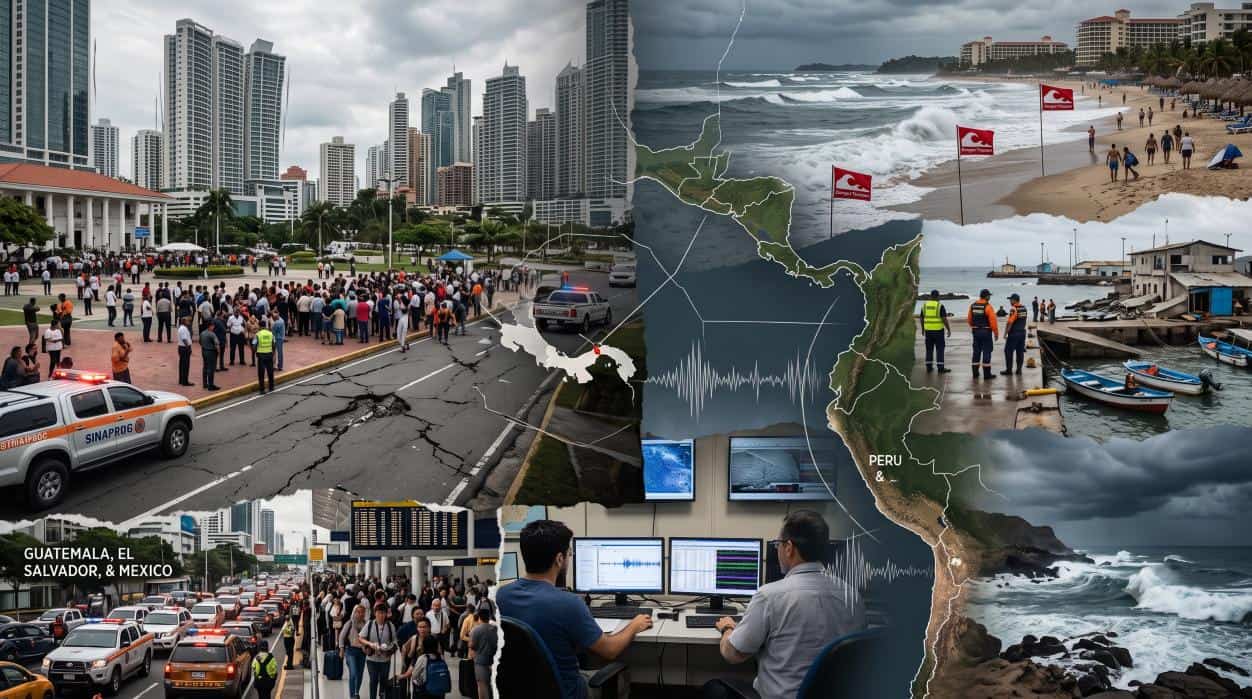
A colossal magnitude 7.7 earthquake struck Panama on October 9, 2026, triggering immediate tsunami warnings across multiple nations. The terrifying seismic event prompted urgent alerts for Colombia, Ecuador, Nicaragua, Guatemala, El Salvador, Mexico, Costa Rica, Peru, and Chile. As residents rushed into the streets in panic, international travel authorities scrambled to assess the regional infrastructure. Consequently, widespread flight suspensions and renewed government travel warnings now severely impact foreign nationals across these affected countries.
The powerful tremor, which was felt as far away as neighbouring Costa Rica and Colombia, has cast a sudden shadow over Panama’s vital tourism and logistics sectors. With over 40 subsequent aftershocks rattling the already damaged foundations of rural homes and urban high-rises alike, the situation on the ground remains highly fluid. This comprehensive report, drawing exclusively on data from the United States Geological Survey (USGS) and official international travel advisories, outlines the full scope of the disaster, the status of critical travel infrastructure, and the essential safety protocols for tourists currently in the region.
Advertisement
Advertisement
Seismic Parameters and Epicentral Impact
Data provided by the United States Geological Survey (USGS) and regional seismic monitoring stations confirm the immense scale of the tectonic rupture.
Automated seismic monitors initially logged maximum readings reaching an astonishing magnitude of 8.0 to 8.1. Following rigorous seismological review, the USGS officially calculated the tremor at a magnitude of 7.7. The earthquake struck at 17:56 UTC (10:56 a.m. local time), completely disrupting the busy Friday morning routine across the Central American nation.
Advertisement
Advertisement
The epicentre was located approximately 10 kilometres (6 miles) southwest of Pitaloza Arriba, a remote rural community in the central province of Herrera. Crucially, the USGS reported that the quake struck at a remarkably shallow depth of just 10.0 to 12.6 kilometres. Shallow-focus earthquakes are notoriously destructive, as their seismic waves travel rapidly to the surface without losing significant energy, resulting in far more violent ground shaking than deeper events of equivalent magnitude.
Despite the epicentre’s rural location in the Azuero Peninsula, the shallow hypocentre caused immense seismic waves to travel rapidly through the regional tectonic structure. High-rise commercial buildings, luxury hotels, and residential structures shook violently in Panama City, located approximately 200 kilometres northeast of the epicentre.
Advertisement
Advertisement
In Herrera province, the physical devastation was immediate. Residents reported prolonged shaking that cracked walls and compromised structural integrities. “We’re scared. It’s just the two of us old folks here. The house has cracked, and we’re afraid it could fall on us,” 74-year-old Ricardo Brown, a resident of Las Minas in Herrera province, told reporters.
Devastating Impact on Travel Infrastructure
The immediate aftermath of the earthquake plunged Panama’s highly developed travel and logistics infrastructure into chaos. The sudden ground movement reverberated across the Azuero Peninsula and central Panama, triggering automated emergency protocols in all major urban centres.
Advertisement
Advertisement
Aviation and Airport Closures
The most significant disruption to international travellers occurred at Tocumen International Airport (PTY), a major regional aviation hub that connects North and South America. Airport authorities immediately suspended all incoming and outgoing flights following the quake to conduct urgent structural assessments of the runways, control towers, and terminal buildings. Thousands of international passengers were left stranded in the terminals or on the tarmac as officials worked to ensure the safety of the aviation network.
Urban Evacuations and Power Grid Failures
Across Panama City, television footage and eyewitness reports showed tens of thousands of office workers, hotel guests, and residents evacuating high-rise structures. Traffic snarled completely across the capital as offices released employees early and the city’s Metro system abruptly halted all services. Schools were evacuated, and students poured into the streets of downtown Panama City as a nationwide suspension of classes was declared.
Electricity provider Naturgy reported catastrophic power outages affecting six distinct provinces. The sudden loss of power crippled local businesses, disabled traffic management systems, and left tourists stranded in hotels without air conditioning or functioning elevators.
Victor Pinzon, a 48-year-old maintenance worker in the capital, recounted the terrifying ordeal of watching high-rise window cleaners during the shaking. “It’s a miracle they didn’t get killed,” he said. “They looked like they were swinging in a hammock.”
Advertisement
Advertisement
The Panama Canal
In a crucial relief to the global shipping industry, the Panama Canal Authority issued an official statement confirming that the vital waterway, its locks, and associated infrastructure sustained no damage. Operations continued normally without disruption. Approximately 90 vessels, including bulk carriers and container ships, were waiting to pass or dock at the time, and their transit schedules remained completely unaffected.
What the Government Says?
Following the earthquake, President José Raúl Mulino declared the situation a “major disaster,” noting that “some roads had completely collapsed”. He also urged citizens to remain calm, stating, “What happened must not be used to spread alarm and disorder”. Furthermore, President Mulino confirmed that “no deaths had been reported immediately after the quake”.
Additionally, President Mulino stated that Minister Dinoska Montalvo and Panama’s civil protection agency, SINAPROC, would hold a press conference to “deliver a report to the nation”.
Local reports attributed to SINAPROC indicated infrastructure impacts in Los Santos, Veraguas, and Coclé.
The United States Geological Survey (USGS) confirmed the earthquake’s magnitude at 7.7. The USGS estimated that economic losses in the region could exceed $1 billion.
Pacific Tsunami Alerts and Coastal Threats
Following the earthquake’s shallow hypocentre and immense magnitude, the U.S. Tsunami Warning System issued maritime hazardous tsunami alerts for the broader region.
Advertisement
Advertisement
The alert warned that hazardous tsunami waves were highly possible within a three-hour window following the initial tremor. The threat radius extended along the coastal zones of Panama, Costa Rica, Colombia, Ecuador, Peru, Nicaragua, El Salvador, Guatemala, and Mexico.
Coastal residents, resort managers, and maritime operators were urgently cautioned regarding sudden sea-level fluctuations, unusually strong rip currents, and hazardous waves in shallow bays. Tourists staying at popular Pacific coastal resorts, such as Santa Catalina and Playa Venao, were temporarily directed to move to higher ground as local authorities monitored the receding tides. While a catastrophic tsunami did not materialise, the alerts caused significant disruption to coastal tourism and marine excursions.
Official Government Travel Advisories and Warnings
In light of the seismic disaster, international travel authorities have reiterated and updated their official safety guidance for foreign nationals visiting or residing in the Republic of Panama. Travellers are urged to consult these government sources before embarking on journeys to the region.
United States Department of State
The U.S. Department of State currently maintains a Level 2 Travel Advisory (“Exercise Increased Caution”) for Panama. While this advisory is primarily rooted in crime, the sudden seismic instability introduces severe secondary risks for tourists.
The State Department formally advises visitors to exercise heightened situational awareness. Furthermore, the State Department explicitly maintains a Level 4 Travel Advisory (“Do Not Travel”) for specific high-risk exclusion zones within Panama. These restrictions remain heavily enforced, and the earthquake further degrades any potential emergency response capabilities in these areas:
- The Mosquito Gulf: Travellers are warned not to travel to the remote northern Caribbean coastline stretching from Alligator Creek to Coclé del Norte due to extreme isolation and illicit activities.
- The Darién Region: The U.S. government strictly prohibits travel to all areas south of Jaqué, Manene, Yaviza, and Lajas Blancas to the Colombian border. Emergency medical and police responses in this dense jungle region are virtually non-existent.
United Kingdom Foreign, Commonwealth & Development Office (FCDO)
The UK FCDO advises British travellers to exercise heightened vigilance and to strictly follow the instructions of local civil protection authorities. The Foreign Office highlights that essential services, including medical care and transportation, may be severely degraded in the provinces surrounding the epicentre.
Advertisement
Advertisement
The FCDO also warns that post-earthquake logistical disruptions often trigger spontaneous civil unrest. Travellers should monitor local media for protests or road blockades, which frequently affect the Pan-American Highway connecting Panama City to the Costa Rican border. Furthermore, foreign nationals are reminded that it is a strict legal requirement in Panama to carry valid physical identification (such as a passport) at all times, as police conduct routine security checks that may be intensified during the current state of emergency.
Global Seismic Context: A Year of Catastrophic Tremors
When placing the Panama earthquake in a broader global context, the terrifying reality of the 2025–2026 seismic cycle becomes clear. Major earthquakes in Panama are historically infrequent compared to the violent fault lines of Chile or Japan. However, this magnitude 7.7 event is currently one of the strongest earthquakes recorded worldwide in 2026.
According to official data from the USGS, the world averages roughly 14 earthquakes of magnitude 7.0 to 7.9 each year. To understand the sheer scale of the Panamanian disaster, it is necessary to review the other catastrophic seismic events that have struck the globe recently.
Recent Earthquakes of Magnitude 7.5 or Higher (2025–2026)
- Indonesia (Magnitude 7.8) – August 14, 2026: Striking off the coast of East Nusa Tenggara, this massively destructive quake killed 136 people and stands as the strongest recorded earthquake of 2026.
- Philippines (Magnitude 7.8) – June 7, 2026: Tied as the strongest quake of the year, this devastating event off the coast of Mindanao resulted in over 100 fatalities and widespread infrastructural collapse.
- Venezuela (Magnitude 7.5 & 7.2) – June 24, 2026: Two incredibly destructive earthquakes struck northern Venezuela within seconds of each other near Catia La Mar and San Felipe. With a death toll exceeding 6,500 people, it remains the deadliest seismic event of the year by a staggering margin.
- Tonga (Magnitude 7.5) – March 24, 2026: A powerful offshore event near Vava’u that triggered widespread regional tsunami warnings.
- Japan (Magnitude 7.6) – December 8, 2025: A massive quake that severely disrupted northern Japan’s Aomori Prefecture during the winter months.
- Russia (Magnitude 7.8) – September 18, 2025: A massive earthquake struck off the remote Kamchatka peninsula, though low population density prevented high casualties.
- Antarctica / Southern Ocean (Magnitude 7.6 & 7.5) – Late 2025: Two major unpopulated oceanic plate earthquakes occurred in the Drake Passage between South America and Antarctica.
The USGS estimates that the economic losses from the Panama earthquake could amount to anywhere between 1% and 10% of the nation’s entire gross domestic product (GDP). This staggering financial blow will severely impact the country’s ability to rebuild its tourism infrastructure in the short term.
Practical Safety Protocols for Stranded Travellers
Emergency authorities, including Panama’s National Civil Protection System (SINAPROC), advise residents and visiting tourists to observe standard, rigorous post-earthquake safety measures:
- Prepare for Aftershocks: Shallow earthquakes of magnitude 7.7 generate highly destructive secondary aftershocks. The USGS confirmed that over 40 aftershocks have already occurred. Tourists must ensure safe exit routes are continuously clear inside hotels or residential buildings.
- Monitor Official Channels: Travellers should follow real-time announcements issued by SINAPROC, the National Police, and their respective diplomatic missions. Rely solely on official government channels rather than social media speculation.
- Observe Coastal Directives: Respect all temporary beach closures and maritime restrictions issued by port authorities. Tsunami threats can persist for hours after the initial tremors.
- Confirm Aviation Schedules: Travellers scheduled to depart via Tocumen International Airport must contact their airlines directly before attempting to travel to the airport, as road networks and terminal operations remain heavily disrupted.
- Maintain Essential Supplies: Ensure mobile devices are fully charged using backup power banks. Keep bottled water, physical identification, and essential medications accessible at all times, as power outages may prevent electronic payments or access to pharmacies.
Conclusion
The magnitude 7.7 earthquake in Panama serves as a stark reminder of the unpredictable and devastating power of the natural world. While the nation has avoided the catastrophic death tolls seen recently in Venezuela and Indonesia, the immense damage to residential structures and the crippling of regional travel infrastructure will take substantial time to repair.
For the global travel industry, the temporary closure of airspace and the widespread power failures underscore the fragility of modern logistics. Tourists currently in Panama are urged to exercise extreme caution, heed all government warnings, and remain vigilant as the earth continues to tremble beneath them. As authorities work tirelessly to assess the damage and restore basic services, the resilience of the Panamanian people faces an unprecedented test.
Advertisement
