

AirTag Luggage Tracking Reveals Why Airlines Still Struggle to Recover Missing Bags Across Global Airports

Published
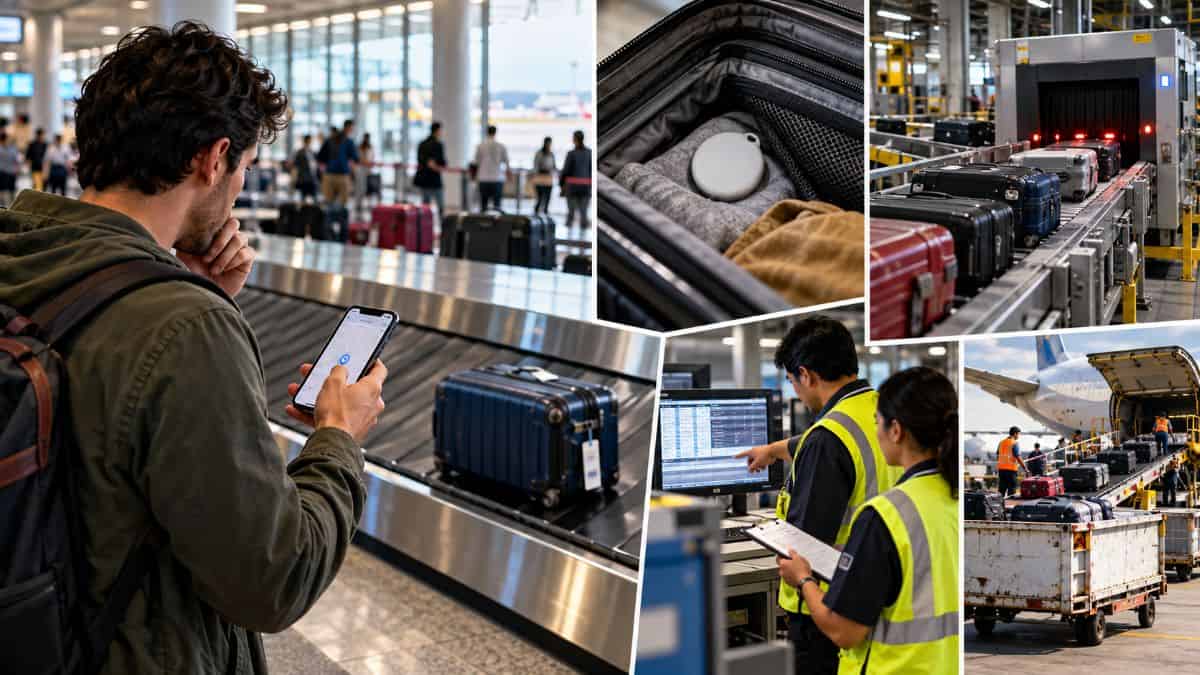
Personal luggage trackers can help travellers locate missing suitcases, yet airlines cannot always turn that information into immediate recovery. Luggage tracking technology is advancing through Apple’s Find My network, Google’s Find Hub and digital baggage management systems. However, these technologies operate differently from the barcode-based processes that airlines use to record baggage movements. SITA’s 2026 Baggage IT Insights report found that airlines mishandled 24 million bags in 2025, despite a 23% reduction in the global mishandling rate. New integrations are helping bridge the information gap, but passengers still need reliable identification, clear reporting procedures and practical safeguards against baggage disruption.
A Smartphone Can Find What Airline Records Cannot
The modern suitcase has become easier to track, but recovering it remains an operational challenge. A passenger might see a suitcase moving through an airport on a smartphone while the airline’s baggage system shows its last recorded scan at another location. This discrepancy does not necessarily mean the airline has lost the bag permanently. Instead, it can indicate that the physical suitcase and its digital record have become disconnected.
Advertisement
Advertisement
Personal tracking devices and airline baggage systems serve different purposes. An AirTag uses Bluetooth signals and Apple’s Find My network to provide location updates when compatible devices detect it. Google’s Find Hub offers a comparable location-sharing ecosystem for supported devices. Neither system automatically guarantees that an airline can identify, access or retrieve the suitcase.
Airlines, meanwhile, depend on baggage tags, barcode scanners, handling records and operational communications. These systems establish when a bag enters a particular stage of the journey. If a scan fails or a transfer goes wrong, the recorded trail may become incomplete.
Advertisement
Advertisement
The central problem is not simply finding a suitcase. It is connecting its real-world location to the airline’s recovery process. That distinction matters because a location pin does not automatically tell staff which baggage room contains the suitcase, who controls access or how quickly it can reach the passenger.
Millions of Bags Still Face Disruption
The scale of the problem explains why better integration matters. SITA’s Baggage IT Insights 2026 report recorded approximately five billion air passengers in 2025, while the total number of mishandled bags fell to 24 million. The mishandling rate declined to 4.9 bags per 1,000 passengers, marking the first time it fell below pre-pandemic levels.
Advertisement
Advertisement
Nevertheless, baggage disruption continues to impose substantial costs on airlines. SITA estimated the annual industry cost at US$6.3 billion, equivalent to an average of US$260 per mishandled bag. These expenses include operational handling, tracing, delivery and compensation.
| Global baggage indicator | 2025 performance |
|---|---|
| Air passengers worldwide | 5 billion |
| Mishandled bags | 24 million |
| Mishandling rate | 4.9 per 1,000 passengers |
| Reduction in mishandling rate | 23% |
| Reduction in mishandled bag volume | 19% |
| Estimated annual industry cost | US$6.3 billion |
| Average cost per mishandled bag | US$260 |
The distinction between mishandled and permanently lost luggage is important. Mishandling includes delayed, damaged, misdirected and lost bags. Many delayed suitcases eventually reach their owners, but the recovery process can disrupt holidays, business trips and onward connections.
Advertisement
Advertisement
For airlines, these incidents create additional tracing work and delivery costs. For passengers, they can mean replacement purchases, missed plans and uncertainty about when essential belongings will arrive.
Why Barcode Scans Still Matter
Airline baggage handling involves several organisations and physical processes. A suitcase may pass through an airline’s check-in operation, an airport’s sorting infrastructure, a ground handler and one or more connecting airports. Each handover creates another opportunity for a missed scan or routing error.
The International Air Transport Association addresses this challenge through Resolution 753, which requires member airlines to track baggage at four principal points. These cover passenger handover, aircraft loading, transfer to the next handling stage and return to the passenger.
The standard improves traceability by establishing a record of key baggage movements. It also supports information-sharing between airlines involved in connecting journeys. However, it does not provide continuous satellite-style tracking of every suitcase.
Advertisement
Advertisement
A barcode system records defined events rather than every movement. A missed scan can therefore leave an information gap even when the suitcase remains somewhere within the airport network.
Airports also differ in infrastructure, automation and data-sharing capabilities. Consequently, the quality and speed of baggage information can vary between carriers and destinations.
This explains why personal trackers complement airline systems rather than replace them. A tracker can supply additional evidence when conventional records are incomplete, while airline staff remain responsible for investigating the case and arranging recovery.
Apple and Google Help Close the Gap
The aviation industry is beginning to connect consumer tracking networks with established baggage recovery platforms. In March 2026, SITA announced the integration of Google’s Find Hub location-sharing feature into WorldTracer, its baggage tracing system.
WorldTracer is used by more than 500 airlines and ground handlers across approximately 2,800 airports. The integration allows participating recovery teams to use location information shared by passengers as another source of evidence when locating delayed luggage.
Apple’s Find My location-sharing technology has also been integrated into supported baggage recovery workflows. SITA reported that the Apple integration reduced permanently lost luggage by 90% during its first year and accelerated delayed-bag recovery by 26%.
Advertisement
Advertisement
These results demonstrate the potential benefits of connecting passenger devices with airline operations. However, they should not be interpreted as a guarantee that every airline supports every tracker or that all missing bags will be recovered faster.
| Technology | Primary function | Practical limitation |
|---|---|---|
| Apple AirTag | Provides location updates through the Find My network | Updates depend on network coverage and compatible nearby devices |
| Google Find Hub | Locates supported devices and enables location sharing | Airline integration and device compatibility vary |
| Tile tracker | Provides location information through its supported network | Coverage depends on participating devices and network conditions |
| Airline barcode tracking | Records baggage movements at operational checkpoints | Missed scans can interrupt the recorded trail |
| QR-coded luggage tag | Provides a contact route when someone finds a suitcase | Requires someone to scan the code and follow the contact instructions |
The next challenge is broader implementation. Airlines need consistent procedures for accepting location links, verifying information and assigning recovery tasks. Without those processes, even accurate consumer tracking data may not translate into a faster return.
Two Trackers Can Provide Extra Resilience
Using more than one tracking device is becoming a practical option for frequent travellers. This approach, often described as tracker stacking, combines different networks to reduce reliance on a single technology.
An iPhone user might pair an AirTag with a Tile, while an Android user could combine a compatible Find Hub tracker with another supported device. A permanent QR-coded identification tag adds another layer by giving someone who finds the suitcase a way to contact its owner.
However, buying multiple trackers is not essential for everyone. Travellers should consider their itinerary, device compatibility, battery requirements and the availability of nearby network devices. A second tracker offers limited benefit if both devices depend on networks with poor coverage in the relevant location.
Placement also deserves attention. A tracker secured inside the suitcase can remain protected during handling, while another positioned nearer the outer shell may be easier to detect in certain circumstances. Travellers should check device manufacturers’ recommendations and confirm that batteries are working before departure.
Advertisement
Advertisement
Redundancy improves the chances of obtaining useful information, but it does not guarantee recovery. A tracker cannot override airport security restrictions or compel an airline to retrieve a suitcase immediately.
Documentation Makes Recovery Easier
Tracking information becomes more useful when passengers can identify their luggage precisely. Before departure, travellers should photograph their suitcase from several angles, including its colour, distinctive markings, handle and wheels. A short video of the packed contents can also help establish what was inside if the bag is damaged or its identification tag disappears.
At check-in, photograph the airline-issued baggage tag and retain the baggage receipt. The tag number provides a specific reference that staff can use to locate the relevant record. Keep the boarding pass and receipt accessible until the suitcase has been returned.
If luggage fails to arrive, report the problem immediately through the airline’s baggage service desk or official reporting channel. Request a property irregularity report reference and confirm how the airline will provide updates.
Passengers should then share tracker information using the carrier’s accepted process. A screenshot showing the reported location and the time of the latest update can help staff assess the situation. However, travellers should avoid assuming that a location pin identifies the precise room, conveyor belt or storage area.
They should also retain receipts for necessary emergency purchases and check the applicable airline conditions and insurance policy. Reimbursement depends on the circumstances, relevant rules and supporting documentation.
Advertisement
Advertisement
Pack Essentials Outside Checked Luggage
Technology cannot eliminate every baggage problem, so sensible packing remains one of the most effective safeguards. Travellers should keep medication, travel documents, valuables and essential chargers in cabin baggage, subject to airline and security restrictions.
A change of clothing and basic toiletries can also prove useful, particularly on long-haul journeys or trips involving children. Keeping these essentials outside checked luggage reduces the immediate consequences of a delayed suitcase.
Connecting itineraries deserve particular attention. Transfers accounted for 39% of mishandled bags in SITA’s 2026 report, making them a significant operational risk. Travellers should allow sufficient connection time, remove outdated baggage tags and verify the final destination printed on their current tag.
When multiple airlines operate an itinerary, passengers should establish which carrier handles baggage enquiries at each stage. They should also check whether the airline supports their chosen tracker’s location-sharing feature before departure.
Better Integration Is the Next Priority
The future of baggage management depends on more than consumer tracking devices. Airlines, airports and ground handlers need accurate scanning, interoperable information systems and recovery teams that can act on shared data.
SITA’s 2026 findings highlight growing use of real-time information-sharing, automated baggage handling, artificial intelligence and passenger-facing tracking tools. These developments can help identify potential problems earlier and improve decisions about where staff should concentrate recovery efforts.
Advertisement
Advertisement
For airlines, the benefits extend beyond customer satisfaction. Better tracking can reduce tracing costs, unnecessary handling and compensation expenses. For passengers, it can provide greater visibility and a more direct role in locating delayed belongings.
The industry’s next task is to make these capabilities consistent across carriers, airports and connecting journeys. Until then, travellers should treat personal tracking as a valuable additional safeguard rather than a substitute for airline reporting procedures.
A phone can reveal where a suitcase may be, but effective recovery requires operational action. Better integration between consumer tracking networks and airline systems offers a promising route towards fewer prolonged baggage disruptions. In the meantime, accurate documentation, prompt reporting and careful packing remain essential parts of a resilient travel plan.
Advertisement
