
Hermosa Beach Earthquake Rattles Los Angeles in California, Raising Fresh Travel Safety Concerns

Published
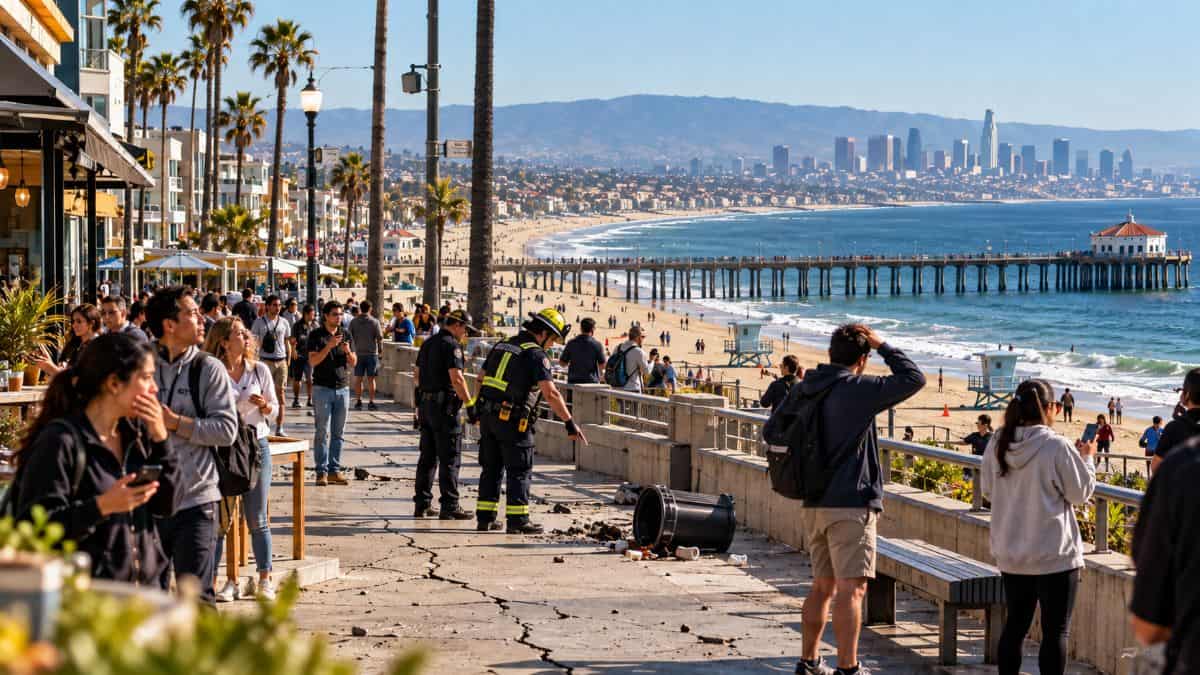
Image generated with Ai
A Hermosa Beach earthquake rattled Southern California on Sunday morning, briefly jolting communities across Los Angeles County’s South Bay. The U.S. Geological Survey recorded the offshore tremor at about 8:40am local time on September 27, with the epicentre roughly four miles west-south-west of Hermosa Beach. The event was initially reported at magnitude 3.5, before later USGS data placed it at 3.6.
The tremor occurred beneath the Pacific west of the popular beach communities, at a depth of roughly 7.4 miles. Reports indicated shaking across Hermosa Beach, Redondo Beach, Manhattan Beach and other parts of the Los Angeles region. There were no initial reports of injuries or structural damage, although the sudden jolt was widely noticed by residents.
What Happened Off Hermosa Beach
The earthquake struck at approximately 8:40am Pacific Time, rather than in the afternoon as some early reports suggested. The USGS event identification is ci41339927, placing the epicentre about 6 kilometres west-south-west of Hermosa Beach. Current event data puts the depth at approximately 11.9 kilometres.
The initial magnitude of 3.5 was subsequently revised to 3.6. Such revisions are normal as seismic networks process additional readings and refine an earthquake’s magnitude and location. For travellers, however, the practical distinction between 3.5 and 3.6 matters less than the actual shaking experienced locally.
Advertisement
Advertisement
The tremor was felt across the South Bay, with reports also emerging from areas including Los Angeles, El Segundo, Hawthorne, Gardena and Long Beach. The distribution illustrates how even a relatively small offshore earthquake can attract attention across a densely populated metropolitan area.
| Earthquake Detail | Latest Reported Information |
|---|---|
| Location | West-south-west of Hermosa Beach |
| Date | September 27, 2026 |
| Local time | Approximately 8:40am |
| Initial magnitude | 3.5 |
| Later magnitude | 3.6 |
| Depth | Approximately 11.9 kilometres |
| Epicentre | About 6 kilometres WSW of Hermosa Beach |
| Event ID | ci41339927 |
| Immediate damage reports | None reported initially |
| Injuries reported | None reported initially |
| Main affected area | Los Angeles County South Bay |
The USGS notes that Southern California experiences around 10,000 earthquakes each year. Most remain too small for people to notice, while several hundred exceed magnitude 3.0. Only around 15 to 20 reach magnitude 4.0 or higher in a typical year.
Advertisement
Advertisement
That wider context is important for international visitors. A noticeable tremor does not automatically signal a major disaster or require travellers to abandon a destination.
Why Travellers Felt the Tremor
Earthquake magnitude measures the size of an earthquake, while shaking intensity describes how strongly people experience it at particular locations. Therefore, a modest earthquake can still produce a noticeable jolt when it occurs relatively close to populated areas.
The offshore location also places the event close to a heavily visited coastal corridor. Hermosa Beach and neighbouring South Bay communities attract visitors for beaches, cycling, dining, nightlife and waterfront activities. Consequently, a sudden tremor can be startling even when it causes little or no physical disruption.
Los Angeles County itself describes Southern California as “earthquake country” and warns that damaging earthquakes can occur without warning. Its official guidance encourages residents and visitors to understand earthquake procedures before an event occurs.
For tourism businesses, this creates a practical responsibility. Hotels, attractions, transport operators and event venues need clear emergency procedures that visitors can understand quickly, regardless of nationality or language.
What This Means for Los Angeles Visitors
There was no indication from the information reviewed that the tremor caused a broad travel shutdown. The absence of reported damage or injuries means visitors should distinguish between a felt earthquake and a major disruption to tourism infrastructure.
Advertisement
Advertisement
That distinction is especially relevant in Los Angeles. The region combines a major international airport, extensive road networks, high-rise buildings, coastal attractions and large visitor volumes. A stronger seismic event could therefore create secondary effects even if the initial ground movement lasted only seconds.
For now, travellers should rely on official alerts rather than social-media speculation. Los Angeles County provides emergency information covering earthquakes, wildfires, flooding, tsunamis, extreme heat and other hazards.
Visitors staying in hotels should also identify the property’s emergency exits when checking in. They should keep mobile phones charged and avoid assuming that lifts will remain available during or immediately after significant shaking.
| Traveller Situation | Recommended Response |
|---|---|
| Inside a hotel | Stay indoors and Drop, Cover and Hold On |
| In a high-rise | Stay away from windows and avoid lifts |
| Driving | Pull over away from buildings, trees and utility wires |
| At the beach | Drop, Cover and Hold On during shaking |
| Near the coast after severe prolonged shaking | Move inland or towards higher ground |
| Outdoors | Move away from structures and overhead hazards |
| In a theatre or stadium | Remain in place and follow venue instructions |
| After noticeable shaking | Check official alerts and local transport information |
Los Angeles County specifically advises people indoors to Drop, Cover and Hold On. It also warns against running outside during shaking because falling debris can create additional risks.
Coastal Tourism Requires Extra Awareness
The South Bay’s coastal geography gives the earthquake story an additional travel dimension. Visitors near the shoreline need to understand that earthquake safety and tsunami awareness are separate but connected considerations.
Los Angeles County advises people near the shore to remain aware of tsunami risk after significant shaking. If severe shaking lasts 20 seconds or longer, its guidance recommends moving inland or towards higher ground rather than waiting for an official warning.
Advertisement
Advertisement
That guidance does not mean the September 27 tremor generated a tsunami. There is no indication in the information reviewed that such an event occurred. Instead, it highlights a broader preparedness principle for travellers exploring Southern California’s coastline.
Beach visitors should therefore know their surroundings before an earthquake occurs. This is particularly relevant for travellers who spend time around promenades, piers, beachfront hotels and coastal roads.
California Has Built a Warning Network
California has invested heavily in earthquake early-warning technology. The state’s Earthquake Warning California system uses ground-motion sensors to identify earthquakes and can provide some users with seconds of warning before stronger shaking arrives.
The system includes the MyShake mobile application, Android earthquake alerts and Wireless Emergency Alerts. California says MyShake can provide warnings for earthquakes meeting specified magnitude and shaking thresholds, while wireless alerts can be issued for stronger events.
This has direct relevance for international tourism. Travellers do not need specialist geological knowledge to benefit from the system. Keeping a smartphone charged and enabling emergency notifications can provide an additional layer of preparedness during a Los Angeles stay.
| Preparedness Tool | Traveller Benefit |
|---|---|
| MyShake | Smartphone earthquake warnings |
| Android Earthquake Alerts | Automatic alerts on supported devices |
| Wireless Emergency Alerts | Emergency notifications on compatible phones |
| Alert LA County | Local emergency information |
| Hotel emergency plan | Property-specific evacuation guidance |
| Local transport updates | Information on roads and public transport |
California’s official earthquake-warning programme says warnings may provide seconds to tens of seconds of notice. However, warning time depends heavily on the user’s distance from the earthquake. People close to the source may receive little or no advance notice.
Advertisement
Advertisement
Tourism Operators Face Resilience Test
The latest tremor was minor, but the wider issue matters for Los Angeles tourism. A more powerful earthquake could affect hotels, convention venues, roads, utilities, airports and attractions simultaneously.
California’s earthquake preparedness programme specifically includes resources for businesses and transportation operators. It also provides an earthquake-readiness framework for organisations operating critical infrastructure.
For the travel industry, resilience therefore extends beyond structural engineering. Operators need communication plans, guest-accounting procedures, emergency power arrangements and clear multilingual instructions.
The issue is particularly significant for international visitors. Tourists may not know local emergency numbers, evacuation routes or the geography of Southern California. Hotels and attractions can reduce confusion by displaying simple instructions and directing guests towards official information.
Los Angeles County has also expanded preparedness messaging during National Preparedness Month 2026. Its September guidance highlights earthquakes alongside wildfires, floods, tsunamis, mudslides and power outages.
How This Compares With Major Quakes
The September 27 tremor sits at the lower end of the earthquake scale compared with historically destructive Southern California events. The distinction is important because magnitude increases represent a substantial increase in released seismic energy.
Advertisement
Advertisement
The 1994 Northridge earthquake, for example, reached approximately magnitude 6.7 and caused extensive damage across the Los Angeles region. USGS research uses that event as a benchmark when discussing potentially damaging earthquakes in California.
The comparison should not suggest that the latest tremor forecasts another major earthquake. Scientists cannot use one small earthquake to predict precisely when a larger event will occur.
Instead, the event provides a timely reminder that earthquake preparedness remains part of responsible travel planning in Southern California.
| Event Type | Travel Significance |
|---|---|
| M3–M3.9 | Often noticeable locally, generally limited travel impact |
| M4–M4.9 | Can produce stronger shaking and local disruption |
| M5–M5.9 | Potential for significant local damage |
| M6+ | Can create major infrastructure and tourism disruption |
| M6.7 Northridge benchmark | Historically demonstrated region-wide consequences |
The figures above describe broad earthquake behaviour rather than a prediction for Los Angeles. Actual consequences depend on depth, location, distance, ground conditions, construction and infrastructure resilience.
What International Travellers Should Do
Travellers should not automatically change Los Angeles plans because of this earthquake. Instead, they should treat the tremor as a reminder to understand the region’s emergency systems before visiting.
The official tourism organisation for Los Angeles advises visitors to stay informed and familiarise themselves with local emergency resources. It also points travellers towards Ready LA, the city’s emergency management resources and earthquake preparedness organisations.
Advertisement
Advertisement
Visitors can also register for local alerts where available. Los Angeles County offers Alert LA County, while the city operates emergency notification systems for public safety information.
For travellers staying along the South Bay, knowing the nearest major road, hotel emergency exit and safe outdoor location can make a significant difference. Keeping passports, phones, medications and essential documents accessible can also reduce complications during a larger emergency.
Los Angeles Remains Open to Travellers
The September 27 tremor was a noticeable seismic event, but it was not reported as a major disaster. Its initial magnitude of 3.5 was later revised to 3.6, while available reports indicated no immediate injuries or structural damage.
For the travel sector, the more significant message lies in preparedness rather than disruption. Southern California records thousands of earthquakes annually, and most are too small to affect daily life.
Visitors should therefore continue to monitor official information while travelling through Los Angeles. A charged phone, awareness of emergency procedures and knowledge of local alerts can turn an unexpected tremor into a manageable travel interruption rather than a source of unnecessary alarm.
Advertisement
