
Romania Resorts Bring Austrian-Style Mountain Luxury to Travellers for Half the Price

Published
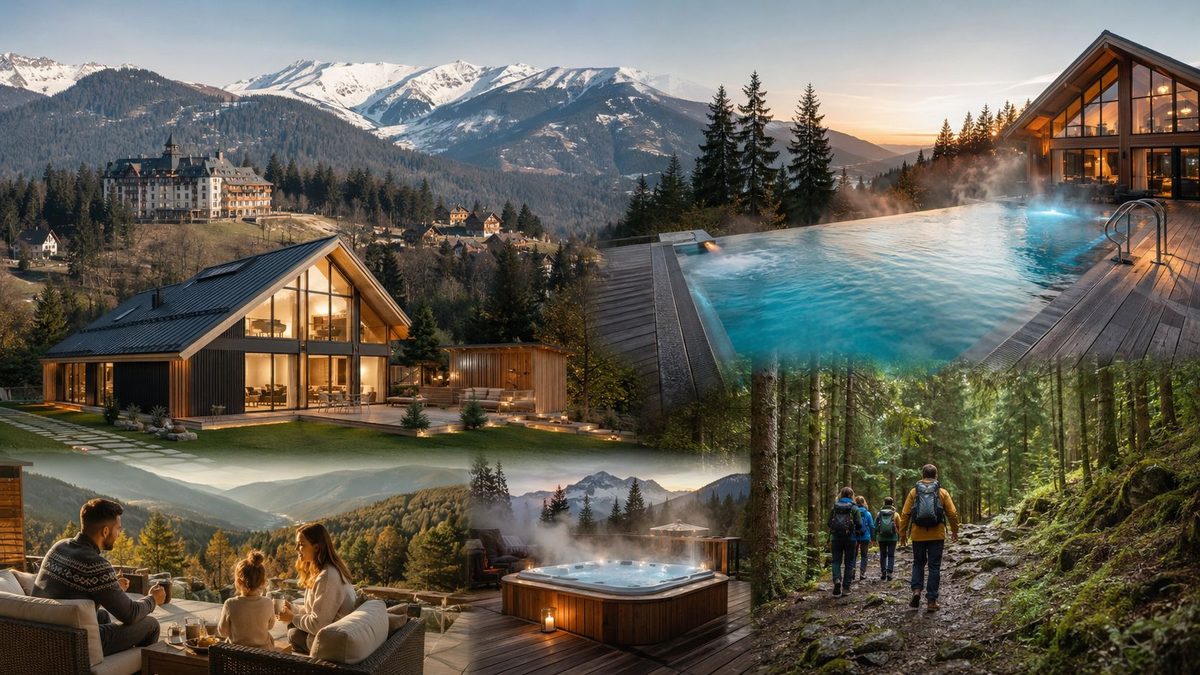
Image generated with Ai
Romania is shaking up its mountain accommodation market as travellers increasingly demand wellness, privacy, heated pools and all-weather experiences. New resort developments are extending beyond the traditional guest house to create self contained holiday environments. Taking inspiration from Austria, Switzerland and northern Italy, the model comes at a significantly lower price point.
The change is happening as domestic travellers still remain the backbone of Romanian tourism. Despite the continued fall in domestic travel, 78.6% of arrivals to accommodation in the first half of 2026 were Romanian residents. Meanwhile, tourism activity in Romania was down on last year, putting more pressure on operators to deliver more engaging experiences.
Romania Resorts Target A New Traveller
The Romanian mountain holiday is undergoing a subtle but significant transformation. For years, rural tourism centred on guesthouses, traditional pensions and small hotels, with travellers mainly choosing accommodation for location, price and proximity to nature. That equation is now changing as the property itself becomes part of the holiday experience.
Travellers increasingly expect more than a comfortable room and attractive scenery. Heated swimming pools, private wellness facilities, children’s activities and indoor entertainment can influence booking decisions, particularly for families and groups. Consequently, Romanian operators are beginning to package several experiences into one accommodation concept.
Advertisement
Advertisement
The emerging format typically consists of independent villas grouped around shared resort facilities. Guests receive bedrooms, bathrooms, kitchens and private terraces, while also gaining access to pools, sports courts, playgrounds and organised activities. This creates a hybrid between a private holiday home and a full-service resort.
Advertisement
Advertisement
That distinction is commercially important because it changes the perception of value. Instead of paying separately for several hotel rooms, families or groups can divide the cost of one entire house. The arrangement can therefore make premium-style mountain holidays considerably more accessible.
Alpine Comfort Meets Romanian Value
Austria has spent decades refining the mountain-resort formula. Its leading destinations combine dramatic landscapes with sophisticated accommodation, wellness infrastructure and year-round recreational activities. Switzerland and northern Italy have developed similarly strong propositions, although costs can be significantly higher.
Romania cannot simply reproduce the Alpine model. However, it can adopt some of its strongest commercial features while competing through price, space and natural surroundings. That combination could become one of the country’s most important advantages in the European mountain tourism market.
Advertisement
Advertisement
A two-bedroom Alpine villa with wellness facilities can reportedly command rates from around €400 per night in Austria, depending on location and season. Comparable Romanian properties can be booked at close to half that figure, according to the source report. For four travellers, that difference can reduce the indicative cost from about €100 to approximately €50 per person per night.
| Accommodation Model | Indicative Nightly Cost | Four-Person Equivalent | Main Proposition |
|---|---|---|---|
| Alpine villa in Austria | From about €400 | About €100 per person | Private villa and wellness |
| Comparable Romanian villa | Around half the Austrian rate | About €50 per person | Villa, nature and resort facilities |
| Traditional hotel room | Varies | Usually priced per room | Conventional accommodation |
| Romanian resort villa | Shared across occupants | Cost divided among guests | Privacy plus shared amenities |
These figures should be treated as indicative rather than universal market rates. Actual prices can change substantially according to season, location, occupancy, facilities and booking conditions. Nevertheless, the comparison highlights why villa-based Romanian resorts can compete effectively on perceived value.
Advertisement
Advertisement
The traveller is not necessarily looking for the cheapest available bed. Instead, the decision increasingly centres on the experience delivered for every euro spent. That represents a more sophisticated form of competition for Romania’s tourism industry.
Heated Pools Could Stretch The Tourism Season
Seasonality remains one of Romania’s most persistent tourism challenges. Mountain destinations can attract strong demand during summer and winter, yet shoulder periods often struggle to deliver comparable occupancy. Properties that rely heavily on outdoor activities remain particularly exposed to poor weather.
Heated pools and wellness facilities offer one potential solution. They give guests a reason to enjoy a resort even when hiking conditions deteriorate or temperatures fall sharply. More importantly, they can turn the accommodation itself into a destination.
This model has long formed part of established Alpine tourism. Heated outdoor pools surrounded by mountains provide both a distinctive visual experience and a practical all-weather attraction. Romanian operators are increasingly adopting the same principle.
Eurostat recorded 29.7 million tourism nights in Romania during 2025. August produced roughly 5.1 million nights, while March recorded approximately 1.6 million, illustrating the significant seasonal variation across the year.
Advertisement
Advertisement
| Indicator | Romania | Tourism Significance |
|---|---|---|
| Tourism nights in 2025 | 29.7 million | Shows national accommodation demand |
| August 2025 nights | About 5.1 million | Peak seasonal demand |
| March 2025 nights | About 1.6 million | Significantly weaker period |
| August versus March | About 3.3 times higher | Highlights seasonality |
The gap creates an obvious commercial opportunity. Resorts that combine accommodation with wellness, recreation and indoor experiences can potentially attract visitors outside traditional peak periods. They may also encourage longer stays because guests have more reasons to remain on the property.
For investors, this is more than an amenity upgrade. All-season facilities can become an occupancy strategy when they are integrated into a broader destination proposition. That could help Romanian mountain resorts reduce their reliance on short summer and winter peaks.
Eskaperdo Illustrates The New Model
Eskaperdo Resort near Vărșag in Harghita County offers a useful example of this changing accommodation philosophy. The development comprises 20 Scandinavian-style villas, with 15 featuring private jacuzzis. The complex also includes a heated outdoor swimming pool surrounded by mountain scenery.
Each villa can accommodate four guests and provides two bedrooms, two bathrooms, a living room, a fully equipped kitchen and a terrace. The arrangement gives visitors the independence of a private house without removing access to communal resort facilities. That combination is particularly relevant to families and small groups.
The resort also provides tennis and football courts, a playground and bicycles. Guests can access hiking trails and nearby natural attractions, allowing the property to combine passive relaxation with outdoor activity. The result is a holiday model designed around several age groups and travel preferences.
Advertisement
Advertisement
For families, the format can provide greater privacy than adjoining hotel rooms. For groups of friends, the shared living space can create a social environment while reducing the per-person accommodation cost. Wellness facilities add another layer for travellers who want relaxation without abandoning the mountain setting.
| Traveller Segment | Resort Features | Practical Advantage |
|---|---|---|
| Families | Multiple bedrooms and playground | Privacy and child-friendly recreation |
| Couples | Private villas and jacuzzis | Greater seclusion |
| Friends | Shared living areas | Better cost distribution |
| Active travellers | Cycling, tennis and hiking | Easy access to activities |
| Wellness travellers | Heated pool and jacuzzis | Relaxation in all weather |
| Longer-stay guests | Kitchens and independent living | More flexibility and self-catering |
The significance of Eskaperdo extends beyond one property. It demonstrates how smaller developments can create a complete tourism product without constructing a large conventional hotel. The resort becomes the experience rather than simply the place where guests sleep.
Domestic Demand Still Shapes The Market
Romania’s tourism market remains unusually dependent on its own residents. Figures for the first six months of 2026 put Romanian travellers at 78.6% of accommodation arrivals nationwide. That makes domestic purchasing behaviour critical for the country’s hotels, villas and resorts.
Eurostat’s overnight-stay figures reinforce the same picture. Foreign visitors represented only 23.0% of Romania’s tourism nights during the first half of 2026. Domestic tourism therefore continues to provide the market’s core demand base.
That dependence creates both an opportunity and a risk. Romanian resorts have access to a substantial home market, but operators remain exposed when domestic travel budgets weaken. Consequently, properties must provide a clear reason for residents to choose a Romanian mountain holiday instead of travelling abroad.
Advertisement
Advertisement
The latest figures underline the challenge. Romania recorded a 6.7% decline in tourism nights during the first half of 2026, according to Eurostat. Foreign overnight stays increased across the European Union during the same period, making international demand an increasingly important competitive factor.
For Romanian operators, simply cutting prices may not be enough. A stronger approach involves increasing the value attached to the accommodation through wellness, privacy, recreation and better-designed spaces. This allows operators to compete on experience rather than entering a race towards the lowest nightly rate.
Romania Faces A Stronger European Benchmark
Romania is competing against a European tourism market that continues to evolve. The European Union recorded almost 3.1 billion tourism nights in 2025, representing a 2.2% annual increase. International overnight stays rose 3.4%, while domestic nights increased 1.1%.
Romania moved in the opposite direction during the year. Its tourism nights declined by 1.7% in 2025, according to Eurostat. That contrast makes product development increasingly important for Romanian accommodation providers.
Romania does possess an important competitive asset. The Carpathian Mountains offer forests, valleys, wildlife, hiking routes and rural landscapes that can support a strong nature-based tourism proposition. The challenge is turning those resources into consistently high-quality visitor experiences.
Advertisement
Advertisement
| Market | 2025 Tourism Nights | Recent Direction | Competitive Strength |
|---|---|---|---|
| Romania | 29.7 million | -1.7% | Nature and value |
| EU overall | About 3.1 billion | +2.2% | Scale and diversity |
| Austria | Large established Alpine market | Mature | Mountain infrastructure |
| Italy | Major European tourism market | Strong | Mountains, culture and food |
| France | Major European tourism market | Strong | Destination diversity |
Romania does not need to compete with Western Europe on scale. It can instead compete through affordable premium accommodation, authentic landscapes and flexible private spaces. That positioning could become particularly attractive to travellers who want upscale experiences without Alpine-level costs.
What Travellers Should Check Before Booking
The changing market gives travellers more choice, but it also makes comparison more complicated. A property advertising a heated pool may provide a very different experience from another resort with a full wellness centre. Travellers should therefore assess the complete package rather than relying only on accommodation photographs.
Location remains equally important. Guests should examine driving times, winter access, road conditions and distances to nearby attractions before booking. A remote resort can offer exceptional privacy, but limited transport options may make independent travel essential.
Families should check playground arrangements, occupancy rules and bedroom configurations. Groups should confirm whether communal spaces comfortably accommodate everyone, while wellness travellers should establish whether jacuzzi or spa facilities are private, shared or subject to additional charges.
Travellers should also verify whether facilities operate throughout the year. Some outdoor amenities may close during maintenance periods or operate differently during winter. Checking cancellation policies and seasonal restrictions can prevent unpleasant surprises.
Advertisement
Advertisement
Official tourism information can provide another layer of reassurance. Romania’s tourism authorities maintain information on authorised accommodation structures and tourism services, while the country’s statistical office publishes official tourism data.
The Romanian National Institute of Statistics provides official tourism statistics. Travellers can also consult the Romanian Directorate-General for Tourism for official tourism and accommodation information.
Infrastructure Will Decide The Next Stage
Better accommodation alone cannot transform Romania into a major Alpine competitor. Roads, public transport, digital connectivity, signage and local services remain essential components of the visitor experience. A sophisticated villa can only compensate for poor access to a limited extent.
Destination management will therefore become increasingly important. Resorts can create stronger value when they work with local restaurants, guides, activity providers, cultural attractions and producers. Such partnerships can encourage visitors to explore beyond the property.
This approach can also spread tourism expenditure across surrounding communities. Visitors who stay longer are more likely to spend on food, activities, transport and attractions. The economic benefit therefore extends beyond the accommodation provider.
Advertisement
Advertisement
Sustainability must also remain part of the development equation. Small-scale resorts can reduce the visual impact associated with sprawling developments, but concentrated tourism can still pressure water, energy and waste-management systems. Responsible planning will be essential as demand grows.
The strongest projects are likely to integrate with their surroundings rather than dominate them. Romania’s natural environment remains the core reason travellers visit its mountain regions, so protecting that asset is central to long-term competitiveness.
Romania Can Sell Value More Effectively
Romania’s emerging resort model is a harbinger of a broader transformation in European travel. It is no longer a competition between a Romanian guesthouse and an Austrian hotel. Travellers are looking more and more for complete experiences including privacy, wellness, activities, scenery, accessibility and price.
That gives Romania a significant opening. The country already has mountains, forests, rural traditions and relatively competitive operating costs. What it has lacked historically is a consistent premium layer on top of those natural assets.
That gap is now being filled by developments based in villas. They offer the independence of a vacation home with the amenities that have traditionally been found in higher-end resorts. The result is an accommodation model that is able to appeal to families, groups, couples and wellness-focused travellers alike.
Advertisement
