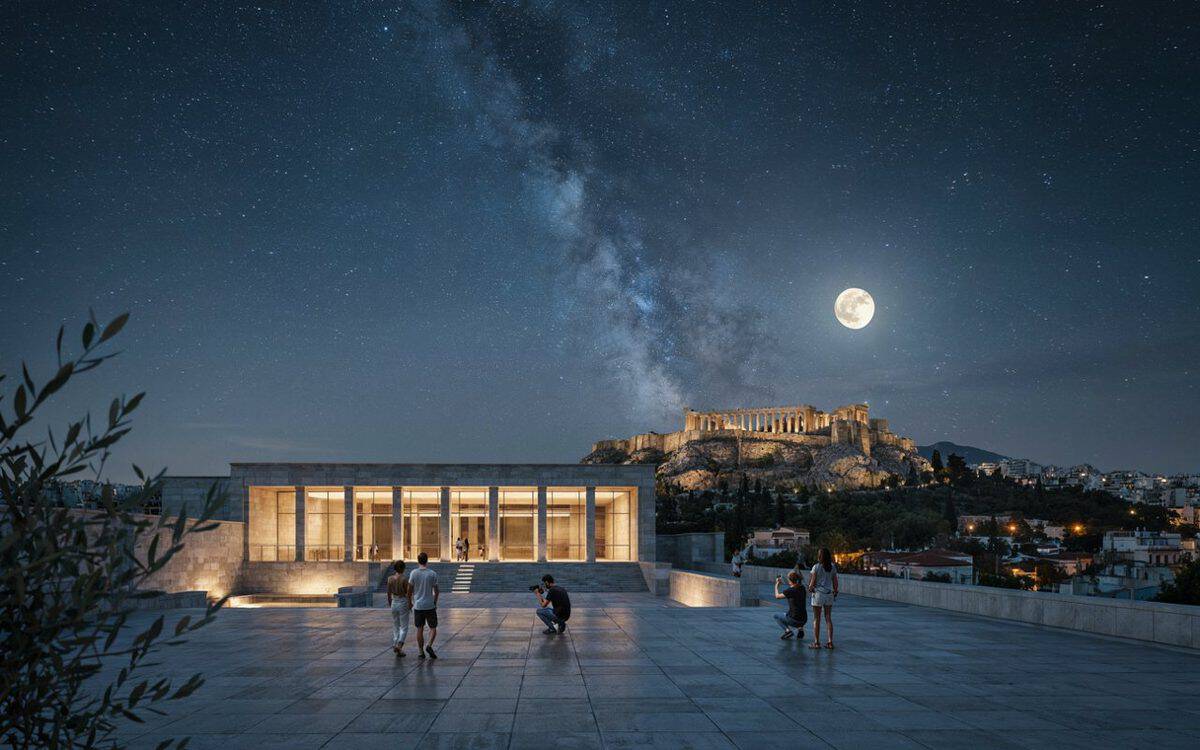
Image generated with Ai
Greece is transforming the traditional sightseeing experience by taking cultural tourism beyond daylight hours. The country’s August Full Moon 2026 celebration has turned ancient monuments, museums and archaeological sites into evening attractions, creating a new model where history, culture and astronomy meet.
The Acropolis Museum in Athens will remain open from 9 am until midnight on 28 August 2026, allowing travellers to explore its galleries and enjoy views of the Acropolis Rock under the moonlit Attic sky. The event also features the temporary exhibition “Inspiration: Ancient Greek Art Living in Italy”, connecting Greek heritage with Italian cultural history.
Greece’s wider programme demonstrates the scale of the movement. The Hellenic Ministry of Culture confirmed that 126 archaeological sites, monuments and museums across the country will participate in the August Full Moon event. Among them, 61 locations will host cultural events, while 65 additional sites will offer free evening access.
The development highlights a major shift in global tourism. Travellers are no longer only searching for famous landmarks during daytime hours. They are increasingly looking for atmospheric experiences, cooler evening visits, fewer crowds and memorable moments connected with nature.
Advertisement
Advertisement
Night tourism is emerging as one of the fastest-changing segments of cultural travel. Destinations are using evenings to extend visitor experiences, manage overcrowding and create new reasons for tourists to stay longer.
For decades, museums and heritage sites operated mainly between morning and early evening. However, rising summer temperatures, increasing visitor numbers and changing traveller expectations are pushing destinations to rethink operating hours.
The new night tourism model combines:
This approach gives travellers more flexibility while helping destinations spread visitor demand throughout the day.
Advertisement
Advertisement
Europe has become a major testing ground for this trend because of its concentration of ancient cities, archaeological sites and cultural landmarks.
Italy is one of the closest comparisons to Greece because both countries rely heavily on ancient history as a tourism attraction.
In 2026, Italy expanded evening access at major cultural landmarks through a special initiative involving Rome and Milan. The programme included extended hours for major attractions such as the Colosseum, Pantheon and Castello Sforzesco, allowing visitors to explore heritage sites during cooler evening periods.
Rome has become a major example of how night tourism can transform historic attractions.
The city’s evening cultural offer includes:
The official Colosseum programme allows visitors to experience the monument between 8 pm and 11 pm on selected evenings, including access to the arena floor and underground areas through guided tours.
Italy’s strategy is similar to Greece’s approach: instead of creating completely new attractions, the country is giving travellers a different way to experience existing heritage.
The comparison:Country Night Tourism Strategy Greece Moonlight access to archaeological sites and museums Italy Evening access to Roman monuments and historic buildings
Both countries are using ancient civilisation as a powerful tourism asset.
The United Kingdom represents a different side of night tourism. While Greece and Italy focus mainly on cultural heritage, the UK has developed a strong market around dark-sky tourism and astronomy experiences.
Travellers are increasingly visiting rural regions to escape artificial light and experience clearer views of the night sky.
Popular UK night tourism activities include:
Scotland, Wales and northern England have become important destinations for astronomy-focused travellers because of their rural landscapes and lower levels of light pollution.
The UK approach shows that night tourism is not limited to museums or monuments. The sky itself has become part of the travel experience.
This creates a different comparison with Greece:Country Main Night Tourism Attraction Greece Ancient monuments under moonlight United Kingdom Natural landscapes under dark skies
Both attract travellers seeking experiences that cannot be easily replicated during daytime travel.
Spain is another Mediterranean country adapting to the growing demand for after-dark tourism.
The country’s warm climate naturally supports evening activities, especially during summer when daytime temperatures can make sightseeing uncomfortable.
Spanish destinations are increasingly promoting:
Cities such as Barcelona, Madrid, Seville and Granada benefit from combining heritage with evening experiences.
Spain’s tourism strength comes from its ability to mix culture, food, architecture and local traditions into a longer daily experience.
The shift is also connected with visitor growth. Spain remains one of the world’s leading tourism destinations, with international arrivals continuing to increase and placing pressure on popular attractions.
Night tourism provides a solution by encouraging travellers to explore beyond peak daytime periods.
The comparison:Country Traveller Experience Greece Full Moon heritage experiences Spain Evening city and cultural experiences
The United States has developed one of the world’s strongest astronomy tourism markets by turning natural darkness into a tourism resource.
Unlike Greece, which connects the moon with ancient heritage, the US focuses on landscapes, national parks and celestial experiences.
The National Park Service highlights the economic importance of night-sky tourism, including activities such as:
The National Park Service reported that in 2022, national park visitors generated approximately $23.9 billion in local gateway communities, supporting 378,000 jobs and significant economic activity. Astronomy-related visits contribute by encouraging travellers to stay overnight and spend money on accommodation, food and local services.
Popular US astronomy tourism locations include:
The US model demonstrates how night tourism can support rural economies.
The five countries are developing different versions of the same global trend.Country Key Attraction Main Tourism Advantage Greece Moonlit archaeological sites Ancient heritage Italy Night monuments and museums Roman history United Kingdom Dark skies Astronomy tourism Spain Evening cultural experiences Mediterranean lifestyle United States National parks and stargazing Nature-based tourism
No single country dominates every category.
Greece leads in combining mythology, archaeology and moonlight. Italy has the strongest historic monument network. The UK and US dominate astronomy tourism, while Spain benefits from its climate and vibrant evening culture.
The growth of night tourism shows that the future of travel will not only focus on where visitors go, but also when they experience a destination.
The Acropolis Museum’s Full Moon opening represents a larger transformation. Museums, monuments and landscapes are becoming flexible experiences that adapt to modern travellers.
Future tourism trends may include:
For travellers, this means more opportunities to experience destinations in unique ways.
Greece’s moonlit Acropolis experience, Italy’s evening Roman monuments, Britain’s dark skies, Spain’s cultural nights and America’s astronomy tourism all point toward the same future: the night is becoming one of the world’s newest travel attractions
Advertisement
Advertisement
Advertisement











Wednesday, September 2, 2026
Tuesday, September 1, 2026
Wednesday, September 2, 2026

Wednesday, September 2, 2026

Wednesday, September 2, 2026
Tuesday, September 1, 2026
Wednesday, September 2, 2026

Wednesday, September 2, 2026



