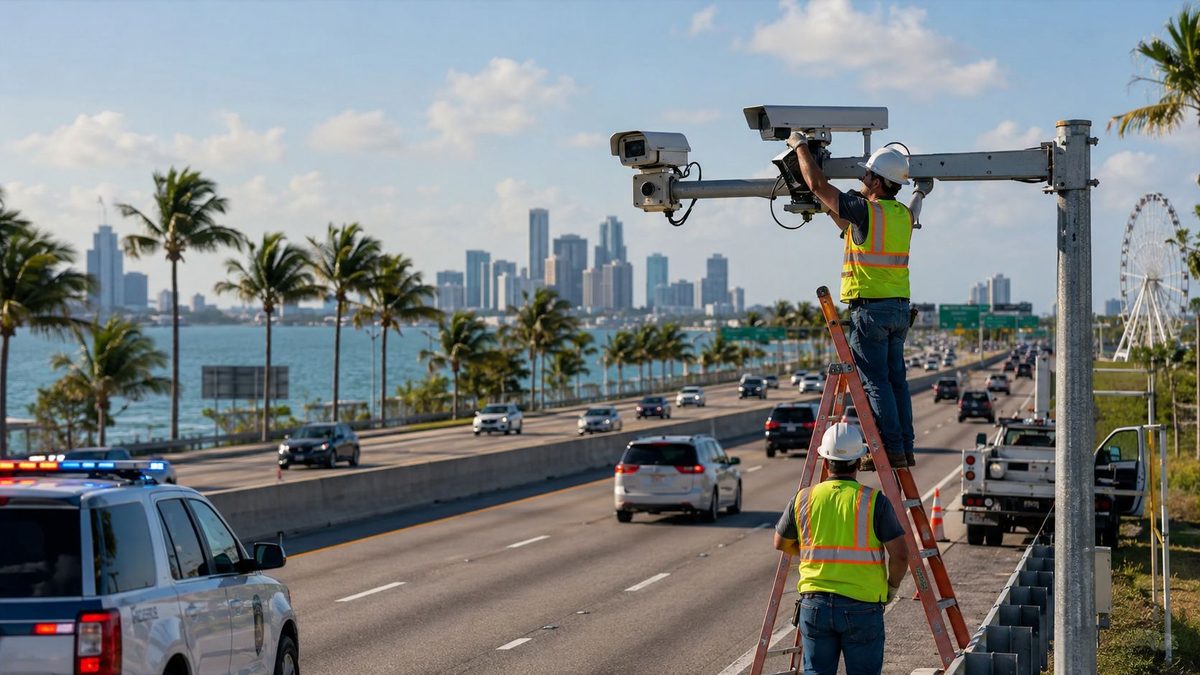
Image generated with Ai
Florida is ordering that license plate readers be removed from state highway rights-of-way in a major shift in roadside surveillance. Florida Department of Transportation rescinded existing approvals on 31 August 2026. It also stopped accepting future permit applications for these systems in its area. Agencies have 30 days to remove the affected cameras or FDOT can remove them itself. The decision comes after increasing reports of abuse, data privacy issues and surveillance-related controversies. The change matters to travellers because Florida depends heavily on road-based tourism. In 2025, the state had 143.33 million visitors, with most visitor trips coming from non-air travel. But the shift doesn’t mean the end for all cameras on Florida’s roads. Local authorities can still operate systems outside of the state highway right-of-way.
Florida has taken an unusually direct approach to the growing debate over automated vehicle surveillance. FDOT’s Engineering and Operations Memorandum 26-01 formally revoked general-use permits for automated license plate readers. The memorandum took effect on 31 August 2026.
Advertisement
The order covers approved systems located within the right-of-way of roads forming part of Florida’s State Highway System. It also prevents FDOT from issuing permits for new systems in those locations.
The agency cited three central concerns: misuse, data privacy and surveillance schemes. It also pointed to what it described as an exponential increase in roadside deployments.
Advertisement
Advertisement
For travellers, the change is more about privacy than road access. Tourists will not face new border-style checks because cameras are removed. Nor does the measure create a new driving restriction.
Instead, it changes what information certain roadside systems can collect and retain about passing vehicles.
Florida law defines an automated licence plate recognition system as high-speed cameras combined with computer algorithms. Those systems convert plate images into computer-readable data.
That distinction matters because modern readers can capture more than a registration number. Depending on the system, they can record vehicle characteristics and contextual information.
Flock Safety says its devices capture licence plates and vehicle characteristics. The company currently states that its data is deleted after seven days.
The policy therefore arrives amid a broader reassessment of how long vehicle-location information should remain accessible.
FDOT has given permit holders a clear deadline. Cameras affected by the order must be removed within 30 days.
If agencies fail to act, the department says it can remove the equipment itself. That creates an immediate operational issue for police departments with cameras mounted along state-controlled corridors.
The practical effect varies by location. A camera installed on a state highway right-of-way falls within the order. A similar camera on a locally controlled road may remain.
That difference could become increasingly important for visitors driving through Florida’s major tourism corridors.
FDOT’s own guidance previously required a General Use Permit for an LPR installation within the right-of-way of a State Highway System road. The department’s May 2026 guidance also stated that only law-enforcement agencies could hold such permits.
The August decision therefore represents a sharp reversal in policy.
Just months earlier, Florida had a formal permitting framework for these systems. It specified installation requirements, applications and renewal arrangements.
Now, those approvals are being revoked.Policy Area Previous Position New Position State highway LPR permits Permits could be issued New permits will not be issued Existing approvals Could remain subject to permit terms Revoked by FDOT Affected cameras Permitted installations Removal required Removal deadline No blanket removal deadline 30 days Enforcement Permit-based oversight FDOT can remove non-compliant equipment Local roads Controlled by relevant local authority Generally outside this FDOT order Traveller impact Vehicle data could be captured Some state-road collection points will disappear
The most important point for visitors is simple: Florida has not banned every licence plate reader statewide.
The decision specifically targets equipment within state highway rights-of-way.
Florida’s tourism economy gives this technology debate an unusually strong travel dimension.
VISIT FLORIDA’s revised figures show that the state welcomed 143.33 million visitors in 2025. That represented a 0.2% increase over the previous year and a record for Florida.
Road travel remains central to that enormous visitor economy.
VISIT FLORIDA estimates that 59.3% of all 2025 visitors arrived through non-air travel, compared with 40.7% travelling by air. The figures underline the importance of highways for tourism mobility.
The state’s own transportation data reinforces the scale. Florida had about 12,273 state-maintained public road miles in 2024. Locally maintained public roads accounted for another 110,029 miles.
That network carries visitors towards theme parks, beaches, national parks, cruise terminals and smaller communities.
For tourism businesses, the camera decision is therefore not merely a policing story. It forms part of a wider conversation about privacy, trust and smart mobility.
Travellers increasingly expect digital services to be convenient. They also expect organisations handling mobility data to explain how that information is used.
Florida’s decision places that tension directly on the state’s road network.
Most visitors are unlikely to notice an immediate change while driving.
The removal of a roadside camera does not alter speed limits, tolls, lane rules or normal traffic enforcement. Travellers must continue following all applicable Florida traffic laws.
However, the surveillance environment could change gradually.
A visitor driving a rental car may previously have passed several automated readers during a journey. Those systems could record a vehicle’s plate and characteristics.
After removal, some of those state-road collection points will no longer operate.
That does not mean rental vehicles become invisible to law enforcement. Traditional policing, toll systems, traffic cameras and other technologies can still exist.
Nor does the order prevent local governments from maintaining their own systems where they have legal authority.
For tourists, the safest interpretation is therefore straightforward: fewer approved LPR cameras on affected state-road rights-of-way, not an end to vehicle monitoring in Florida.
Travellers should also avoid assuming that a camera’s disappearance means enforcement has weakened. Police agencies retain conventional investigative tools.
Florida’s policy creates an important jurisdictional distinction.
FDOT controls the relevant state highway rights-of-way. Cities and counties control many other roads.
That means a traveller could leave a state highway and encounter an LPR system operated under a separate local arrangement.
Recent developments demonstrate how uneven the response could become.
Tampa Police, for example, said it would remove 17 automated licence plate readers from state-road rights-of-way. Hillsborough County officials were separately reviewing their network.
St Petersburg also faced questions over its wider Flock network. Local reporting said the city had more than 50 cameras, although the impact of the state directive on that network remained under review.
The emerging picture is therefore fragmented.Road Location Likely Position Under FDOT Order Traveller Takeaway State Highway System right-of-way Affected Some approved LPRs must be removed County-controlled road Not automatically affected Local rules may apply City-controlled road Not automatically affected Camera networks may continue Private property Not covered by this FDOT order Separate rules may apply Airport or port access roads Depends on road authority Check local arrangements
This distinction will matter particularly around large tourism hubs.
The controversy intensified after reports of officers allegedly misusing LPR systems for personal purposes.
According to the supplied reporting, officers in Massachusetts and Louisiana faced disciplinary action or criminal allegations involving searches connected to people they knew.
Those incidents transformed an abstract privacy debate into a governance problem.
The central question is not whether licence plate readers can help investigations. They can.
The harder question concerns who can search the information, why they can search it and how long records remain available.
Florida already has statutory protections around LPR information. State law treats certain images and data containing personal identifying information as confidential and exempt from public-records disclosure.
Florida law also provides for a records-retention framework for LPR-generated information. The state’s Department of State establishes the applicable retention schedule in consultation with the Department of Law Enforcement.
The latest FDOT move adds another layer.
Instead of focusing solely on retention, the department has restricted where these systems can be installed under its authority.
That is a significant distinction.
The Florida decision also follows changes announced by Flock Safety.
The company now says data from its devices is stored for seven days before deletion. It says images and metadata remain encrypted throughout their lifecycle.
That is a shorter period than the 30-day retention period referenced in the supplied reporting as part of earlier Flock practices.
The company has also introduced tighter search controls following growing scrutiny.
These changes illustrate an important industry trend. Technology providers are increasingly being pushed to demonstrate privacy safeguards rather than simply promote detection capabilities.
For tourism operators, that trend has implications beyond policing.
Hotels, airports, rental-car companies and destination authorities increasingly use digital systems to manage movement and security. Public confidence can influence how visitors perceive those technologies.
The industry therefore has a strong interest in transparent data governance.
The surveillance controversy arrives while Florida tourism remains exceptionally large.
VISIT FLORIDA reported 39.88 million visitors during the first quarter of 2026. Domestic visitors accounted for 36.54 million of that total.
Domestic air visitation rose 2.5% year over year to 13.85 million during the quarter. Non-air visitation reached 22.69 million, although that figure fell 3.4% year over year.
International demand remained stronger.
Overseas visitation increased 8.5% year over year to 2.29 million visitors during the first quarter. UK visitation rose 17.2%, while Irish visitation increased 14.5%.
Those figures matter because international visitors often combine flights with rental cars, domestic road journeys and multi-destination itineraries.
Florida’s road network consequently remains part of the visitor experience.
For tourism planners, privacy policy is becoming another component of that experience.
Florida’s approach differs from simply regulating how cameras operate.
Earlier in 2026, FDOT published detailed guidance governing LPR placement and installation. It described permit requirements for systems located within state highway rights-of-way.
The department’s current position removes that pathway.
This is best understood as a policy reversal rather than a technical upgrade.Stage Florida’s Approach Strategic Direction Earlier framework Permit and regulate LPR installations Controlled expansion May 2026 guidance Detailed installation requirements Formalised oversight August 2026 memorandum Revoke existing approvals Immediate contraction Next 30 days Remove affected equipment Rapid implementation Longer term No new FDOT permits planned Tighter state control
The development could also influence future legislative debate.
Florida Attorney General James Uthmeier has called for legislative protections while acknowledging legitimate law-enforcement uses. He described the issue as a complex topic.
That suggests the debate is unlikely to end with camera removal.
Instead, lawmakers may eventually face questions about permitted locations, access controls, retention periods and independent oversight.
Travellers do not need to change their Florida itineraries because of this decision.
There is no indication that the policy creates new documentation requirements for tourists. Visitors should continue carrying valid driving documents, rental agreements and insurance information where applicable.
The more useful step is understanding jurisdiction.
A camera removed from a state highway does not guarantee that nearby local roads have no LPR equipment. Travellers should also remember that toll infrastructure and other traffic technologies operate independently.
For privacy-conscious visitors, rental-car policies deserve particular attention. Rental companies can collect vehicle and journey information under their own contractual and legal arrangements.
Visitors should therefore distinguish between government LPR systems, tolling technology and commercial vehicle data.
They are not necessarily the same system.
The FDOT’s official transportation map remains useful for understanding road classifications, routes and major transport infrastructure across the state.
Hotels and destination operators should monitor the policy rather than react to it prematurely.
The immediate change concerns roadside infrastructure. It does not directly alter hotel operations, airport security or tourism licensing.
However, the wider policy direction deserves attention.
Travellers increasingly value security without wanting unrestricted surveillance. Tourism brands operating in Florida can benefit from explaining their own data practices clearly.
That includes rental-car providers, parking operators, resorts and attractions.
Transparency can become a competitive advantage when customers increasingly question digital tracking.
The policy also presents an operational question for law-enforcement partners.
Agencies losing cameras on state corridors may seek alternative locations on locally controlled roads. That could shift the geographic pattern of surveillance rather than eliminate it.
Tourism businesses should therefore avoid assuming that statewide removal means statewide disappearance.
Florida’s move sets a new boundary for automated license plate surveillance.
The relevant state highway rights-of-way will no longer permit these systems. Any cameras already permitted must be taken out of those locations within 30 days. Non-compliance can lead to FDOT intervention in agencies.
The immediate impact on travellers should be minimal. Roads will operate as usual, with normal traffic enforcement still in effect.
But the strategic implications are larger.
Florida is one of the biggest tourism markets in America. It relies heavily on highways, rental cars and regional road trips for visitors.
Now the state has locked privacy and surveillance governance into the transport debate.
This might also encourage other jurisdictions to research where vehicle data is being gathered and accessed. So the most important development for travellers may be what happens next.
The future Florida road trip could involve fewer state-road LPR cameras, but greater scrutiny of how mobility data is gathered elsewhere. The issue is no longer simply about cameras. It is about trust in the digital infrastructure surrounding travel.
| Indicator | Latest Figure | Why It Matters |
|---|---|---|
| Florida visitors, 2025 | 143.33 million | Shows the scale of the tourism market |
| Non-air share, 2025 | 59.3% | Highlights road-travel importance |
| Q1 2026 visitors | 39.88 million | Shows continuing demand |
| Q1 2026 overseas visitors | 2.29 million | International road travel remains relevant |
| State-maintained public roads | 12,273 miles | Indicates the scale of state-controlled infrastructure |
| LPR removal deadline | 30 days | Immediate operational timeframe |
| Flock stated data retention | 7 days | Current company privacy position |
| Tampa LPRs targeted for removal | 17 | Demonstrates local operational impact |
Advertisement
Advertisement
Advertisement












Wednesday, September 2, 2026

Tuesday, September 1, 2026
Wednesday, September 2, 2026

Wednesday, September 2, 2026

Tuesday, September 1, 2026

Tuesday, September 1, 2026

Wednesday, September 2, 2026

Wednesday, September 2, 2026



