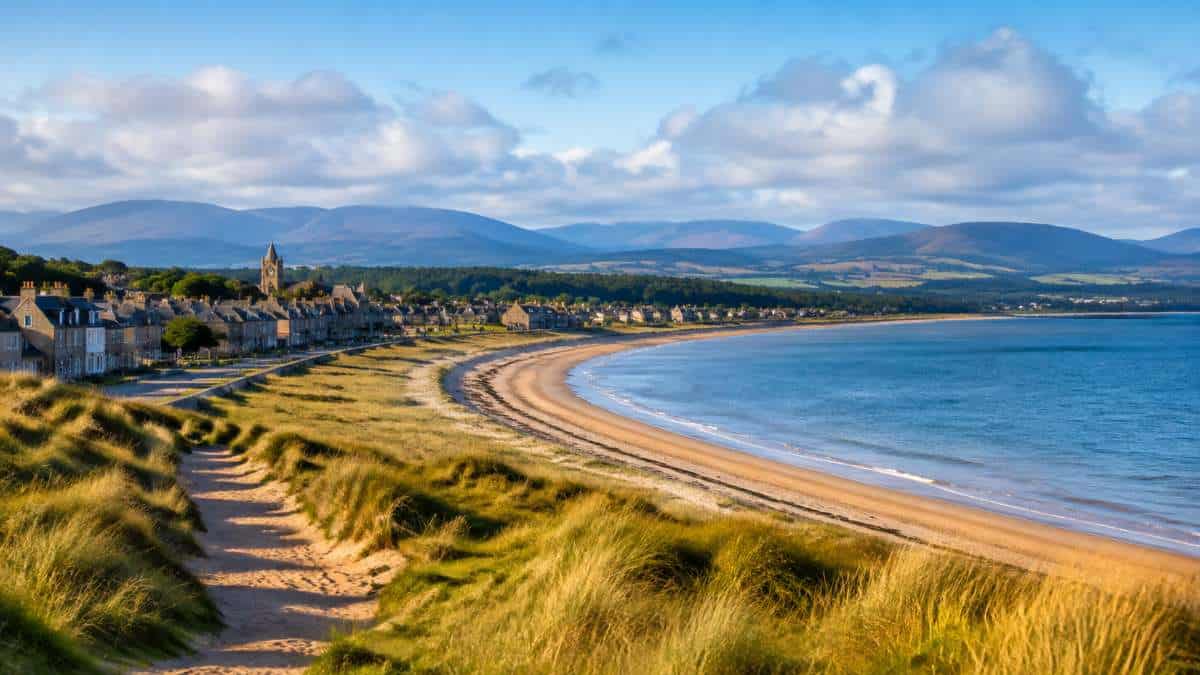
Image generated with Ai
Seaside town Nairn in Moray Firth is situated in the highlands of Scotland, and is now becoming popular for travelers seeking beaches, Scottish wildlife and activities to keep people of all ages entertained and active. Nairn is conveniently found east of Inverness and hosts visiting families through it’s expansive sandy beaches, microclimate that most visitors find surprising, chance to see dolphins, world class golf courses and a history that dates back the centuries. During the Victorian Age, Nairn had the nick name of “Brighton of the North,” and is increasingly becoming known as a resort for families who want to escape the busy cities, relax, and partake in the outdoors, peacefully.
Situated on the southern shore of the Moray Firth, Nairn offers a rare combination of Highland scenery and traditional seaside charm. Unlike many parts of Scotland’s western coastline, which experience higher rainfall and stronger Atlantic weather systems, Nairn benefits from a comparatively mild and dry climate. This special weather pattern has helped establish the town as one of Scotland’s sunniest coastal locations and played a major role in its development as a Victorian holiday resort.
The town’s coastline remains its greatest tourism asset. Nairn Beach features wide areas of fine golden sand, peaceful dunes and uninterrupted views across the Moray Firth towards the Black Isle. The shoreline provides visitors with opportunities for coastal walks, photography, family activities and peaceful seaside escapes. The beach experience is supported by Nairn’s relaxed atmosphere. Unlike some of Scotland’s more crowded tourist centres, Nairn offers a slower pace where visitors can enjoy the landscape, local hospitality and natural surroundings.
| Feature | Tourism Importance |
|---|---|
| Moray Firth location | Provides dramatic coastal views and marine wildlife experiences |
| Golden sandy beaches | Supports walking, relaxation and family tourism |
| Victorian seaside heritage | Adds cultural value and historic identity |
| Dry Highland microclimate | Creates favourable conditions for outdoor activities |
| Nearby Inverness access | Makes Nairn an easy Highland base |
Nairn’s combination of beach scenery and Highland accessibility has helped position the town as a destination that appeals to both domestic and international travellers.
Advertisement
Advertisement
The Moray Firth is one of Scotland’s most famous marine environments, with the region recognised internationally for its resident bottlenose dolphins. For visitors arriving in Nairn, the opportunity to experience wildlife along the coastline adds another layer to the destination’s appeal. Dolphins can often be spotted from coastal viewpoints, beaches and nearby marine locations. Chanonry Point, located across the Moray Firth on the Black Isle, is one of the best-known places in Scotland for shore-based dolphin watching, especially during rising tides when dolphins move closer to the shoreline.
This wildlife connection has strengthened Nairn’s position within Scotland’s nature tourism market. Modern travellers are increasingly seeking destinations where landscapes, wildlife and sustainable experiences are central parts of a holiday. Beyond dolphins, the Moray Firth supports a diverse marine ecosystem, while surrounding coastal areas provide opportunities for birdwatching, photography and outdoor exploration. For tourism businesses in the region, marine wildlife creates opportunities beyond traditional sightseeing. It encourages longer stays, nature-focused travel and experiences that connect visitors directly with Scotland’s natural environment.
While Nairn is recognised for its beaches, the destination also provides access to some of Scotland’s most important historic attractions. The most famous nearby landmark is Cawdor Castle and Gardens, located approximately five miles inland from Nairn. The medieval castle is strongly connected with Shakespeare’s Macbeth and remains one of the Highlands’ most visited heritage attractions. Although the castle was built centuries after the historical Macbeth period, its literary connection has made it internationally recognised.
Visitors can explore the castle’s historic interiors, gardens and surrounding woodland landscapes. The attraction combines architecture, storytelling and natural beauty, making it appealing to history enthusiasts, cultural travellers and families. Another major attraction near Nairn is Fort George, an impressive 18th-century military fortress built after the Jacobite Rising of 1745. The site provides insight into Scotland’s military past while offering panoramic views over the Moray Firth. The wider region also includes Clava Cairns, one of Scotland’s most significant prehistoric sites. The Bronze Age burial complex, dating back around 4,000 years, provides a connection to Scotland’s ancient civilisation.
| Attraction | Key Experience |
|---|---|
| Cawdor Castle | Medieval architecture, gardens and Macbeth connection |
| Fort George | Military history and Moray Firth views |
| Clava Cairns | Bronze Age archaeology |
| Culloden Battlefield | Jacobite history and national heritage |
| Brodie Castle | Historic estate and cultural experiences |
These attractions allow Nairn to offer a complete Highland holiday experience combining coastline, history and culture.
Nairn has developed a strong reputation among international golf travellers due to its world-class links courses.
The town is home to two championship golf venues:
Golf Course Highlights The Nairn Golf Club Historic coastal links course founded in 1887; hosted Walker Cup and Curtis Cup events Nairn Dunbar Golf Club Championship links course with coastal scenery
The Nairn Golf Club is particularly famous for its location beside the Moray Firth, where golfers experience traditional links conditions combined with spectacular sea views. Golf tourism remains an important part of Scotland’s visitor economy because travellers often combine sporting activities with sightseeing, dining and cultural exploration.
Beyond golf, Nairn provides extensive outdoor opportunities. Culbin Forest is one of the region’s most impressive natural landscapes, stretching along the coastline between Nairn and Forres. The forest combines pine woodland, sand dunes and coastal trails, creating opportunities for walking, cycling and wildlife observation. Visitors can explore forest routes, discover viewpoints such as Hill 99 and experience one of the Highlands’ most peaceful outdoor environments. Wildlife enthusiasts may encounter species including red squirrels, roe deer and a variety of coastal birds, making Culbin Forest an important attraction for eco-tourism.
A major advantage for Nairn’s tourism growth is its accessibility. The town is located close to Inverness, the main gateway city for the northern Highlands. Inverness Airport is less than 10 miles from Nairn, allowing visitors to reach the destination quickly after arriving in the region. Rail connections also support tourism movement, with services linking Nairn to Inverness and wider Scottish destinations. Road access through the A96 corridor provides convenient connections for travellers exploring the Highlands by car.
| Transport | Details |
|---|---|
| Air | Inverness Airport provides the nearest regional air connection |
| Train | ScotRail services connect Nairn with Inverness and other destinations |
| Road | A96 provides links between Inverness and Aberdeen |
| Bus | Regional services connect Nairn with Highland towns |
This connectivity allows visitors to use Nairn as a base while exploring nearby castles, battlefields, whisky destinations and Highland landscapes.
Nairn reflects a wider shift in global travel trends. More visitors are searching for destinations that combine natural landscapes, cultural heritage and meaningful experiences rather than only major tourist attractions. Scotland’s Highlands continue to attract international visitors because of their dramatic scenery, historic sites and outdoor activities. Nairn benefits from this demand by offering a quieter alternative while remaining close to major Highland attractions.
The destination appeals strongly to travellers from markets including the United States, Germany, Ireland, the Netherlands and France, who often seek coastal scenery, Scottish history and nature-based holidays. Nairn’s appeal is built around variety. Visitors can spend mornings walking along beaches, afternoons exploring castles and evenings enjoying local food and coastal views.
The best period to visit Nairn is generally from May to August when longer daylight hours and warmer conditions support beach activities, golf, walking and outdoor exploration. Summer also brings local events and cultural activities, creating additional reasons for visitors to explore the town.
Autumn provides a quieter experience, with fewer crowds and excellent conditions for forest walks, heritage visits and photography. Winter offers a peaceful coastal atmosphere. While temperatures are cooler, Nairn’s comparatively dry climate allows visitors to enjoy dramatic seaside scenery and Highland landscapes throughout the year.
Nairn encompasses what modern travelers want with its combination of stunning scenery, heritage, challenge, and connection, making it one of the most attractive destinations on Scotland’s coastal plain. With its beaches full of dolphins, gray seal colonies, historic and ancient sites, golf courses, and winding woodland paths, Nairn has a complete Highland vacation all packaged in one spot.
Nairn’s history as the “Brighton of the North” continues to adapt and evolve to the next phase of environmentally safe coastal tourism. Travelers are looking beyond the norm, and Nairn, Scotland, presents itself perfectly as a beautiful coastal gateway into the calm Moray Firth.
Advertisement
Tags: Cawdor Castle, Culbin Forest, dolphin watching Scotland, Highland coastal destinations, Moray Firth holidays
Advertisement
Advertisement











Wednesday, September 2, 2026

Tuesday, September 1, 2026

Wednesday, September 2, 2026

Wednesday, September 2, 2026

Wednesday, September 2, 2026
Tuesday, September 1, 2026

Wednesday, September 2, 2026

Wednesday, September 2, 2026