
New York and Aspen Join Miami and Others in a High-Cost Christmas Battle as America’s Most Expensive Destinations Emerge

Published
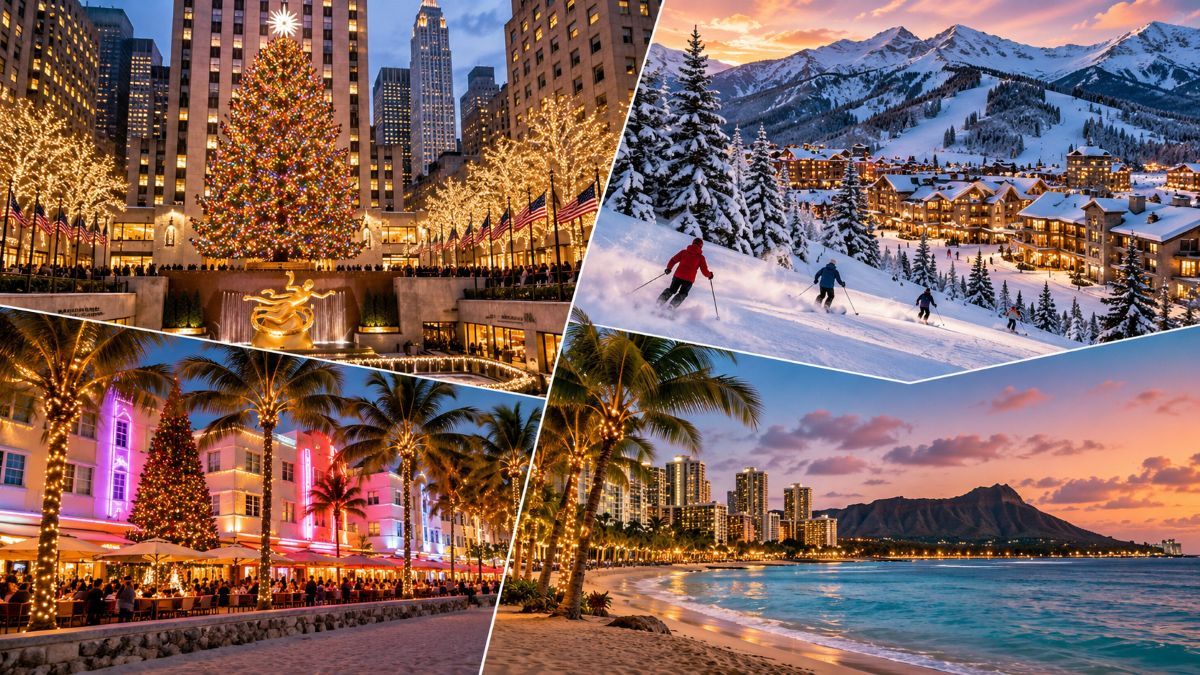
Christmas travel is entering a more expensive phase, with 2026 domestic Christmas airfares averaging $452 return. Hopper says that figure is 23% higher than last year, while domestic hotel rates average $197 nightly. Against that national backdrop, New York, Aspen, Miami and Honolulu reveal four sharply different festive travel economies. New York combines exceptional hotel demand with 65 million annual visitors, while Aspen’s December hotel ADR reached $1,324. Miami-Dade averaged $224.24 in hotel ADR during 2025, while Oahu recorded $284. The result is a revealing cost contest where America’s Most Expensive Christmas Destinations cannot be judged by room rates alone. Air access, length of stay, dining and experiences can radically alter the final bill.
Four Destinations, Four Christmas Price Profiles
The festive travel market has become increasingly segmented. Travellers seeking snow, sunshine, urban entertainment or island relaxation encounter different pricing structures, even during the same Christmas week. That distinction matters because a cheaper room does not automatically produce a cheaper holiday.
New York operates as the urban spectacle premium, with visitors paying for location and concentrated entertainment. Aspen commands a mountain luxury premium, where accommodation sits alongside skiing, equipment, transfers and premium dining. Miami offers a warm-weather lifestyle premium, while Honolulu carries an additional island-access premium because visitors often stay longer.
Hopper’s latest holiday forecast reinforces that pressure. Its 2026 data points to unusually strong Christmas airfare inflation, making destination accessibility increasingly important when travellers calculate their complete holiday budget.
Advertisement
Advertisement
| Destination | Latest hotel indicator | Occupancy | Key tourism indicator |
|---|---|---|---|
| New York City | $333.71 annual ADR, 2025 | 84.1% | 65m visitors |
| Aspen | $1,324 December ADR, 2025 | 57.1% | $1.7bn direct visitor spending |
| Miami-Dade | $224.24 annual ADR, 2025 | 73.9% | Major winter leisure market |
| Oahu/Honolulu | $284 annual ADR, 2025 | 78.6% | $9.42bn Oahu visitor spending |
New York Turns Christmas Into An Urban Spending Engine
New York remains the most complete Christmas destination of the four because visitors can spend heavily without leaving the city. Hotels, restaurants, Broadway, shopping, observation decks, skating and festive attractions create an unusually dense visitor-spending environment.
The city welcomed 65 million visitors in 2025, according to New York City Tourism + Conventions. Those visitors generated $55.6 billion in direct spending and $84.7 billion in total economic impact. Tourism also generated $7.5 billion in tax revenue and supported about 397,000 jobs.
Advertisement
Advertisement
Accommodation provides another major spending channel. The New York State Comptroller recorded a 2025 average hotel room rate of $333.71, up 4.7% from 2024. Occupancy reached 84.1%, the highest among major US markets for the third consecutive year. Hotels captured $13.9 billion of the city’s visitor spending during 2025.
Christmas magnifies an already strong market. Travellers can spend on premium rooms, Broadway tickets, festive dining and attractions within a few blocks. However, they can also moderate the bill through free lights, public spaces and neighbourhood walks.
Christmas Smart Picks for New York
- Where to stay: Midtown Manhattan offers the easiest access to Rockefeller Center, Fifth Avenue, Radio City Music Hall and major holiday attractions, while Brooklyn can provide a different urban base.
- What not to miss: Rockefeller Center, the Christmas tree, the Rockettes, Bryant Park’s holiday market and the Fifth Avenue displays remain the defining festive experiences. NYC Tourism’s 2026 programme also highlights Union Square, Columbus Circle and Grand Central holiday markets.
- Best money-saving strategy: Combine paid attractions with free Christmas experiences, especially window displays, public markets and illuminated neighbourhoods.
- Book early: Broadway, premium Christmas shows, central Manhattan hotels and high-demand dining can become the most expensive components of a short festive stay.
New York’s advantage is therefore choice. A traveller can construct either a relatively controlled Christmas break or an exceptionally lavish one without changing destination.
Aspen Commands The Steepest Lodging Premium
Aspen changes the equation dramatically. Its December hotel figures explain why the Colorado resort deserves serious consideration among America’s Most Expensive Christmas Destinations, even though its visitor volume is tiny beside New York.
Aspen recorded a $1,324 average daily hotel rate in December 2025, according to Aspen Chamber Resort Association’s DestiMetrics report. Paid occupancy reached 57.1%, while December RevPAR stood at $756. The previous December produced a $1,243 ADR, meaning the nightly rate increased 6.5%.
Advertisement
Advertisement
The wider visitor economy is equally revealing. Aspen welcomed more than 1.1 million visitors in 2025, generating $1.7 billion in direct visitor spending. Its total economic impact reached $2 billion, while the typical visitor stayed six days. That longer stay amplifies accommodation and activity costs.
A four-night stay at the reported December ADR would represent roughly $5,296 before taxes. Ski passes, equipment, lessons, dining and mountain transfers can then substantially enlarge the final bill.
The destination itself acknowledges the importance of early planning. Aspen Snowmass operates four mountains covering more than 5,700 acres, while its official 2026–27 guidance encourages advance purchases for lift tickets, rentals and lessons.
Christmas Smart Picks for Aspen
- Where to stay: Base yourself in downtown Aspen for walkable dining and nightlife, or choose Snowmass when ski access and family-oriented facilities matter more. Aspen Snowmass identifies The Little Nell as its luxury ski-in, ski-out option.
- What not to miss: Skiing across the four mountains is the obvious draw, but tubing, snowshoeing, the Breathtaker Alpine Coaster and snowcat dinners broaden the experience.
- Festive highlight: Wintersköl returns from December 10–13, 2026, with torchlight descents, fireworks, snow sculptures, live music and other winter celebrations.
- Best money-saving strategy: Consider early December rather than the immediate Christmas peak. Aspen Snowmass notes that lift tickets, lessons and rentals reach peak pricing during major holiday periods.
Aspen is consequently the clearest example of experience-led inflation. Travellers are not simply buying accommodation. They are buying access to a premium winter ecosystem.
Miami Offers Sunshine With A Luxury Escalator
Miami looks considerably less expensive when measured through its broad hotel market. Miami-Dade recorded a 2025 ADR of $224.24, with occupancy at 73.9% and RevPAR at $165.73. ADR increased 1.2% during the year, showing that the market retained pricing power.
Advertisement
Advertisement
However, the county-wide average conceals a substantial luxury gradient. Beachfront properties, premium resorts and high-end districts can sit far above the market average, particularly around the festive period. Miami also encourages spending beyond accommodation through dining, nightlife, shopping and marine experiences.
AAA’s year-end holiday data placed Miami third among its top domestic holiday destinations for 2025. That strong position demonstrates the continuing appeal of warm-weather Christmas travel.
Miami’s advantage is accessibility. Unlike Honolulu, it sits within the continental US airline network. Unlike Aspen, it does not require a specialist mountain transfer for most visitors. Travellers can therefore spend less on reaching the destination and redirect the budget towards accommodation or experiences.
Christmas Smart Picks for Miami
- Where to stay: South Beach suits travellers seeking beaches, nightlife and Art Deco surroundings, while areas around Coconut Grove, Brickell and other districts provide different urban experiences.
- What not to miss: South Beach, Ocean Drive, Lincoln Road and Miami’s waterfront remain core experiences, while visitors can add cultural attractions and neighbourhood dining.
- Festive highlight: Greater Miami’s official 2026 holiday programme includes illuminated attractions, seasonal entertainment and family events. The holiday calendar also lists winter programming running from December 2026 into March 2027.
- Best money-saving strategy: Compare beachfront luxury properties with hotels farther from the sand before assuming Miami’s overall ADR represents the price of your stay.
Miami therefore occupies an unusual position. It is not the cheapest destination in absolute terms, but it offers the widest spectrum between mainstream and ultra-premium Christmas travel.
Honolulu Adds Distance To The Christmas Bill
Honolulu’s economics are more complicated because Oahu can become expensive through cumulative spending rather than extreme hotel rates alone. The island’s 2025 hotel ADR reached $284, while occupancy stood at 78.6%.
Advertisement
Advertisement
Hawaii’s official visitor figures provide an even stronger signal. Visitors spent $2.12 billion across the state in December 2025, up 3.7% year on year. Daily visitor spending climbed 11% to $273, despite arrivals falling 4.3% to 868,894.
Oahu alone welcomed 492,321 visitors during December 2025. Their spending reached $802.7 million, while calendar-year Oahu spending reached $9.42 billion. The average December stay reached 6.82 days, making length of stay a major component of the final holiday bill.
That longer stay matters. A visitor spending nearly a week on Oahu accumulates accommodation, meals, transport and excursions over several days. Honolulu can therefore become considerably more expensive than a mainland city despite having a lower hotel rate than Aspen.
Christmas Smart Picks for Honolulu
- Where to stay: Waikīkī is the most convenient base for first-time visitors, with dense hotel, dining, shopping and beach access. Downtown Honolulu works well for cultural attractions, while Kāhala and Ko ʻOlina provide quieter resort alternatives.
- What not to miss: Waikīkī Beach, Diamond Head, Pearl Harbor and ʻIolani Palace provide the strongest first-time mix of scenery, history and culture.
- Festive highlight: The Waikīkī Holiday Parade returns on November 27, 2026, running along Kalākaua Avenue towards Kapiʻolani Park.
- Best money-saving strategy: Build an itinerary around Waikīkī and public or organised transport before committing to a rental car for the entire stay. Official Oʻahu itineraries also show how visitors can combine Waikīkī with the North Shore or Leeward Coast.
Honolulu therefore represents the long-stay Christmas model. The nightly rate matters, but the accumulated cost of nearly seven days matters more.
The Christmas Price Gap Becomes Clearer
A useful way to understand the four destinations is to separate the room-rate premium from the whole-trip premium. Hotel data provides the clearest measurable comparison, while airfare and experiences determine how that rate translates into a real holiday budget.
Advertisement
Advertisement
| Cost pressure | New York | Aspen | Miami | Honolulu |
|---|---|---|---|---|
| Hotel pricing pressure | Very high | Extreme | Moderate-high | High |
| Christmas demand | Very high | Very high | High | High |
| Air-access burden | Moderate | Moderate-high | Low-moderate | High |
| Length-of-stay effect | Moderate | High | Moderate | High |
| Paid experiences | Very high | Extreme | High | High |
| Luxury escalation | Extreme | Extreme | Extreme | High |
This is a qualitative editorial synthesis, rather than an invented numerical index. It reflects the available hotel, visitor-spending and stay-duration evidence and illustrates why a single ranking can mislead travellers.
Aspen has the strongest lodging premium. New York has the deepest urban spending ecosystem. Honolulu has the strongest length-of-stay effect, while Miami provides the broadest choice between moderate and luxury spending.
Airfares Could Reshape The 2026 Ranking
The biggest new pressure for Christmas 2026 is airfare. Hopper’s latest holiday data places the average domestic Christmas return fare at $452, an $85 increase from the previous year. Domestic hotel rates average $197, up 18%.
That national figure should not become a destination-specific fare estimate. However, it provides an important benchmark when comparing four markets with radically different air-access profiles.
Honolulu’s distance from continental gateways makes airfare a disproportionately important part of the trip. Aspen’s smaller airport network can make connections and availability more important. New York and Miami benefit from enormous airline networks, creating more opportunities to compare carriers and travel dates.
The practical lesson is straightforward: compare the complete door-to-door cost rather than the advertised hotel rate.
Advertisement
Advertisement
A Four-Night Stay Exposes The Lodging Divide
For two adults, four nights provides a useful benchmark because it exposes the accommodation gap without pretending to forecast an exact Christmas invoice. The calculations below use reported ADR figures and exclude taxes, airfare, resort fees, food and attractions.
| Destination | Indicative nightly ADR | Four-night room cost |
|---|---|---|
| New York City | $333.71 | $1,334.84 |
| Aspen, December 2025 | $1,324 | $5,296 |
| Miami-Dade | $224.24 | $896.96 |
| Oahu | $284 | $1,136 |
These are illustrative calculations, not Christmas 2026 quotations. Actual festive rates vary by hotel, booking date, room category, cancellation conditions and location.
The gap is stark. Aspen’s reported December ADR produces a four-night room bill almost four times Miami-Dade’s annual average benchmark. Yet Miami’s enormous visitor economy shows that lower accommodation prices do not necessarily mean lower total visitor spending.
The Best Value Changes With The Traveller
For families, New York can offer unusually strong value because many festive experiences sit close together. Free public spaces, markets and window displays can offset the cost of major attractions.
For couples seeking luxury, Aspen presents the steepest financial commitment. The combination of December lodging rates, ski expenditure, premium dining and mountain experiences creates a powerful cost multiplier.
Miami suits travellers seeking flexibility. Visitors can choose mainstream accommodation away from the beachfront or spend heavily on luxury hotels, dining, nightlife and marine experiences.
Advertisement
Advertisement
Honolulu sits between those models. Its accommodation is not the most expensive of the four, but its longer average stay and substantial travel distance can make the total holiday budget climb rapidly.
Christmas Premium Matters More Than A Cheap Room
The most useful lesson from this comparison is that hotel ADR alone cannot identify the most expensive festive destination. A destination becomes costly when several pricing forces converge.
New York combines high occupancy with enormous visitor demand. Aspen adds constrained resort inventory and premium winter recreation. Miami channels festive demand into luxury leisure spending, while Honolulu combines strong accommodation economics with longer stays and geographic isolation.
That makes the Christmas market more nuanced than a simple league table. The destination with the highest room rate is not necessarily the destination producing the highest total holiday bill.
What Travellers Should Check Before Booking
The smartest Christmas strategy starts with the entire itinerary. Travellers should compare airfare, room rate, taxes, destination or resort fees, transfers, meals and principal activities before selecting a destination.
Timing also matters. Hopper’s 2026 data indicates that holiday airfare is following a particularly expensive trajectory. Meanwhile, destination hotel data shows that high-demand markets can sustain elevated room rates even when occupancy fluctuates.
Advertisement
Advertisement
The strongest saving opportunity may therefore come from changing the travel pattern rather than changing the destination. A midweek arrival, shorter peak-period stay or early-December visit can reduce the most expensive components without sacrificing the festive atmosphere.
Aspen provides the clearest example. Its official visitor guidance explicitly notes that peak holiday periods push lift tickets, lessons and rentals higher, while early-season travel can offer better value.
Four Destinations Reveal Four Spending Models
The 2026 festive season is shaping up as a test of how much travellers will pay for experience, convenience and scarcity. Aspen demonstrates what happens when luxury accommodation and winter recreation converge, while New York shows how a city can monetise Christmas across almost every part of the visitor economy.
Miami remains a more adaptable proposition, with a broad accommodation spectrum and strong air connectivity. Honolulu demonstrates why daily spending and length of stay can matter as much as the room price.
There is therefore no universal winner in the Christmas cost race. Aspen leads the lodging premium, New York leads visitor-economy scale, Miami offers the broadest price spectrum, and Honolulu combines high daily spending with a lengthy island stay.
For travellers, the most important question is not simply where Christmas costs more. It is which destination delivers the desired festive experience for every dollar spent. That distinction makes the four-way comparison far more useful than a conventional hotel-price ranking, especially as airfare and accommodation costs continue moving at different speeds.
Advertisement
