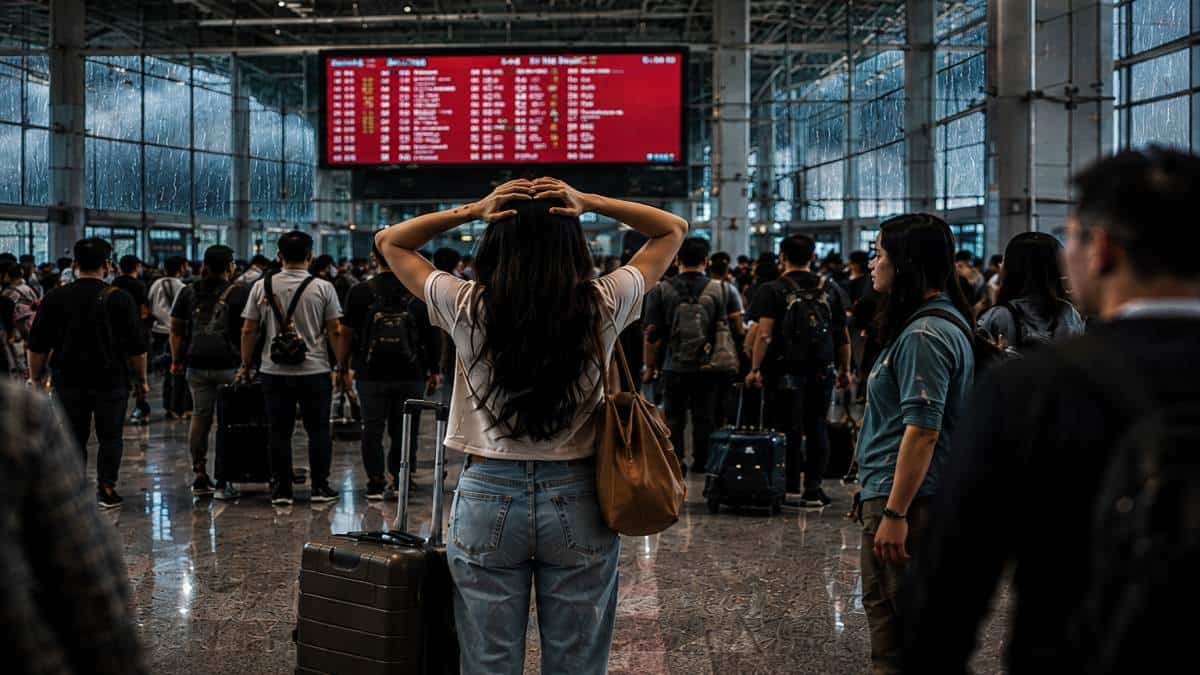
Image generated with Ai
One of Asia’s largest aviation disruptions in recent weeks unfolded today as 3,793 flight delays and 744 cancellations impacted Japan, Hong Kong, Thailand, Singapore, China, South Korea, Indonesia, and Saudi Arabia.
Japan accounted for roughly 79% of all cancellations, with Typhoon Dolphin reshaping the region’s aviation picture into something far more severe than a routine weather event.
The storm’s advance toward Okinawa forced airlines to make difficult operational choices long before its expected landfall, while airports elsewhere across Asia adopted markedly different strategies.
Tokyo Haneda remained the busiest airport for delays (409), even as Naha Airport recorded the highest cancellations (226). Japan Airlines accumulated the largest number of flight delays among airlines operating across the affected airports, while also recording the highest cancellation count, reflecting its extensive domestic network.
As Typhoon Dolphin moved closer to southern Japan, airports responded in very different ways. Some kept flights moving despite growing delays, while others cancelled services well before the worst weather arrived.
The strongest disruption emerged across southern Japan, where airports serving Okinawa and Kagoshima Prefecture increasingly abandoned attempts to maintain schedules. Naha Airport, the gateway to Okinawa, experienced the region’s most severe cancellation wave, while Kagoshima, Yakushima, Tokunoshima and Amami also recorded unusually high cancellation rates. Many of these airports depend on shorter domestic sectors operated by turboprops and narrow-body aircraft serving island communities, making them particularly vulnerable when strong winds and deteriorating weather begin affecting airport operations.
Rather than allowing flights to depart only to encounter worsening conditions, airlines appeared to remove services from schedules before the storm reached its peak. That strategy inevitably stranded passengers but reduced the risk of widespread airborne diversions and aircraft becoming trapped away from their intended bases.
Advertisement
Advertisement
Tokyo told a completely different story.
Instead of widespread cancellations, Tokyo Haneda Airport continued operating an exceptionally busy schedule despite recording the highest delay total in Japan. The capital remained connected to the national network, but aircraft rotations slowed as incoming disruptions from southern Japan rippled through airline schedules. The result was extensive congestion rather than wholesale cancellations.
The contrast highlights two distinct operational philosophies occurring within the same country: southern airports protected safety by sharply reducing flying, while Tokyo absorbed the resulting schedule instability through delays.
If Japan’s response was cancellation-heavy, China demonstrated the opposite.
Advertisement
Advertisement
Across Hong Kong, Shanghai Hongqiao, Beijing Capital, Beijing Daxing, Chongqing, Xiamen and Wuhan, airlines largely kept flights on the timetable even as operations slowed considerably. Together these airports generated 1,398 delays but only 47 cancellations.
That imbalance suggests airports and airlines preferred absorbing congestion rather than removing services from schedules. Aircraft departed later, arrival banks stretched throughout the day, and passengers waited longer, but most flights still operated.
The pattern also reflects the importance of preserving connectivity across China’s extensive domestic aviation network. Chinese airports recorded far more delays than cancellations, allowing many scheduled flights to continue operating despite congestion.
For travelers, the experience differed sharply from Japan. Instead of discovering flights had disappeared from departure boards, many passengers likely spent hours waiting for delayed departures that eventually operated.
Several of Asia’s largest hubs demonstrated remarkable resilience despite the broader disruption.
Singapore Changi processed hundreds of delayed flights while cancelling only a single service, showing an ability to absorb regional congestion without significant schedule reductions.
Suvarnabhumi Airport in Bangkok displayed a similar pattern. Although delays accumulated throughout the day, cancellations remained minimal, allowing Thailand’s largest hub to continue functioning as a major regional connection point.
Incheon International Airport in South Korea also maintained operations with relatively limited cancellations despite serving one of Asia’s busiest international networks.
Indonesia’s Jakarta Soekarno-Hatta experienced notable delays but avoided widespread cancellations, reinforcing how airports outside the direct influence of Typhoon Dolphin generally preferred operational continuity over aggressive schedule cuts.
Together these airports demonstrated that today’s disruption was highly localized rather than continent-wide. Geography, not simply traffic volume, largely determined how airlines responded.
No airline illustrated today’s operational complexity more clearly. Its network spans both heavily affected southern islands and Tokyo, forcing it to balance extensive cancellations near Okinawa while simultaneously managing hundreds of delayed operations elsewhere.
All Nippon relied more heavily on delays than cancellations, particularly through major mainland airports. The carrier appeared focused on preserving its domestic network wherever conditions allowed.
Operations centered on Beijing and western China largely remained active despite growing congestion. Rather than cancelling significant numbers of flights, Air China absorbed delays across several major hubs.
The airline’s largest disruption originated around Shanghai and Beijing Daxing, where delayed departures became the primary operational response instead of widespread flight removals.
Serving numerous regional airports, ANA Wings was especially exposed to southern Japan’s deteriorating weather. Smaller aircraft operating island routes faced conditions that increasingly favoured cancellations over repeated delay extensions.
Saudi Arabia followed an entirely separate operational pattern. Disruption concentrated around Riyadh, Jeddah and several southern airports, where cancellations and delays reflected localized operational challenges rather than the weather system affecting East Asia.
Today’s disruption demonstrates that aviation resilience is not measured solely by the number of delayed flights.
Japan chose to remove flights from schedules before conditions deteriorated further, reducing operational uncertainty but leaving more passengers needing alternative travel arrangements.
China largely protected schedules by accepting longer delays, preserving connectivity while shifting inconvenience from cancelled journeys to extended waiting times.
Singapore and several Southeast Asian hubs showed that robust airport infrastructure and favorable local weather allowed operations to continue despite widespread regional disruption.
Saudi Arabia’s figures reveal an independent disruption pattern unrelated to Typhoon Dolphin, reminding travelers that multiple operational pressures can affect Asia’s aviation network simultaneously.
The Japan Meteorological Agency continues tracking Typhoon Dolphin, describing it as a large and very strong system moving toward Okinawa after strengthening over the Pacific and already affecting the Ogasawara Islands.
Although the most severe disruption has so far concentrated in southern Japan, the storm’s expected movement toward Okinawa raises the possibility of further schedule adjustments over the coming days. Airports serving the Ryukyu Islands remain especially vulnerable to strong crosswinds, heavy rainfall and reduced visibility.
As aircraft rotations become disrupted, delays can spread well beyond the storm’s immediate path. Flights linking Japan with South Korea, Taiwan, Hong Kong and Southeast Asia may experience knock-on effects even where local weather remains favorable.
The storm also follows closely behind recent regional weather events, including Typhoon Bavi and Typhoon Noul, extending an unusually active period for East Asian aviation.
Passengers travelling through Japan should prepare for schedule changes rather than assuming delayed flights will eventually operate, particularly on routes involving Okinawa and southern island airports.
Those flying through China are more likely to encounter lengthy delays than outright cancellations, especially on flights connecting major domestic hubs.
Travelers using Singapore Changi should expect operations to remain comparatively stable, although arriving aircraft from affected regions may continue to run behind schedule.
Passengers connecting through Bangkok can expect some delays but relatively strong schedule continuity compared with airports in Japan.
Those travelling via Riyadh should monitor airline notifications closely, as Saudi Arabia’s disruptions stem from separate operational circumstances rather than the Pacific weather system.
Today’s disruption exposed something aviation professionals understand well but many passengers rarely notice: airports facing similar challenges do not necessarily respond in the same way.
Japan effectively divided into two operational zones. Southern Japan airports relied much more heavily on cancellations, while Tokyo absorbed disruption through delays. Neither approach is inherently better, they simply prioritize different objectives.
China demonstrated a contrasting philosophy. Its major hubs appeared willing to tolerate significant congestion to preserve flight schedules, reflecting the importance of maintaining one of the world’s busiest domestic aviation systems. Passengers waited longer, but airlines avoided widespread schedule collapse.
Singapore and Bangkok showed another model entirely, functioning as regional shock absorbers capable of sustaining international connectivity even as neighboring markets experienced severe disruption.
Taken together, today’s numbers illustrate that weather alone does not determine aviation outcomes. Airline fleet structure, airport capacity, network design and operational philosophy all influence whether passengers see “Delayed” or “Cancelled” on departure boards. That distinction shaped Asia’s aviation landscape just as much as Typhoon Dolphin itself.
Attention now shifts to Typhoon Dolphin’s approach toward Okinawa, where forecast conditions will determine whether additional cancellations become necessary. If the storm weakens or accelerates, airlines are likely to begin rebuilding schedules quickly, but prolonged adverse weather could extend disruptions across southern Japan and continue generating ripple effects throughout the wider Asian aviation network.
Yesterday also saw significant flight cancellations. Read our earlier coverage here.
The data has been extensively curated by our editorial team using real-time aviation figures recorded on 6 August 2026 at 2:53 pm ET USA (7 August 12:23 am IST)
Primary Source: FlightAware.
Verification Protocol: All statistics have been independently reviewed and cross-checked by our human editorial desk. Timestamped records, data logs and feed snapshots are securely archived internally to support historical accuracy and editorial transparency.
Note: Real-time flight-tracking figures reflect active airspace and operational data. Minor variations may occur when compared with information displayed at individual airport terminals or airline departure gates.
Travellers are advised to check directly with their respective airlines and airports for the latest flight status, schedule changes and operational updates.
Advertisement
Tags: Asia flight cancellations today, Asia flight delays today, Japan Airlines Flight Cancellations Today, Japan Flights Cancelled Today, Tokyo Haneda International Airport Cancellations
Advertisement
Advertisement












Wednesday, September 2, 2026

Wednesday, September 2, 2026

Wednesday, September 2, 2026

Wednesday, September 2, 2026

Wednesday, September 2, 2026

Tuesday, September 1, 2026

Wednesday, September 2, 2026

Wednesday, September 2, 2026