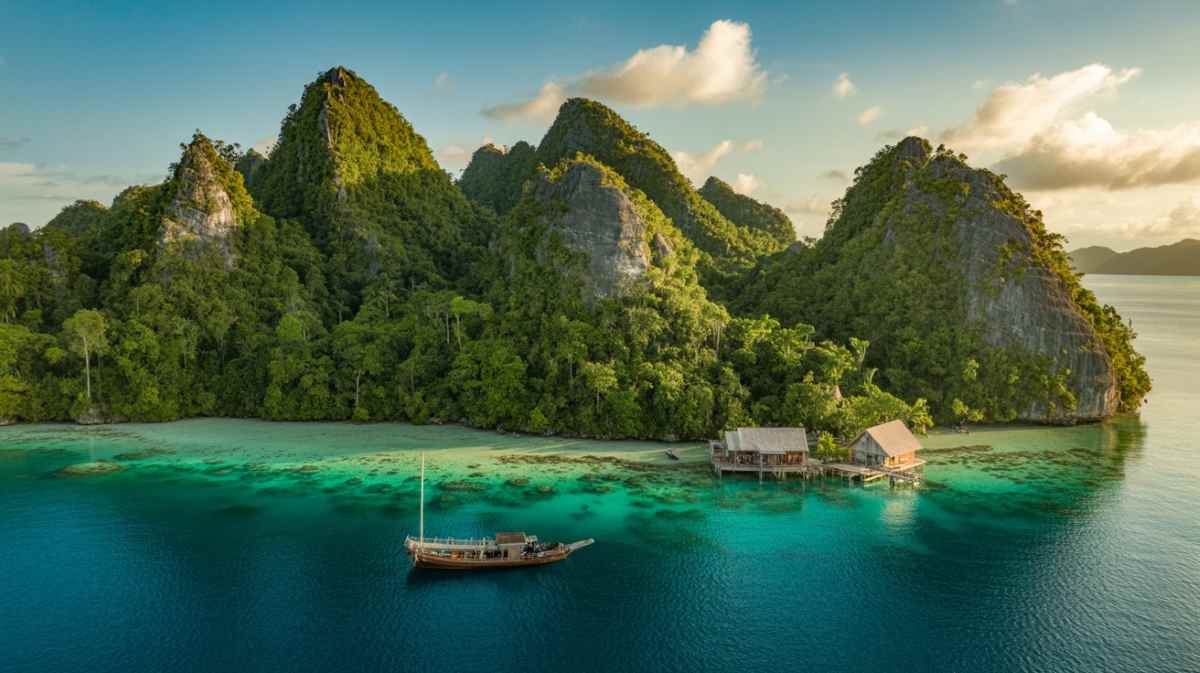
Image generated with Ai
It is already time for one of the busiest periods for marine tourism in Raja Ampat, Indonesia, and the list of guests underwater looks quite impressive as well. Liveaboards are already making plans for routes through the Dampier Strait and the reefs of Misool. The eco-homestays, in their turn, are preparing to welcome tourists interested in a closer connection with locals and nature. The October to April period is usually less stormy, and it is considered the perfect time for visiting by the Raja Ampat Marine Park Authority, and mantas are especially abundant in the north in this time. For scuba divers and underwater photographers, the advice is very clear: the schedule is full, and the best reef adventures won’t wait.
Liveaboards remain one of the most effective ways to experience Raja Ampat because the archipelago is vast and many of its celebrated dive sites are separated by considerable stretches of water.
During the main marine season, vessels can operate itineraries covering the central Dampier Strait and southern Misool. Cape Kri and Blue Magic are among the best-known dive sites around the Dampier Strait, offering access to the region’s exceptional coral and pelagic marine life. Misool, meanwhile, brings a different collection of reefs, limestone formations and underwater habitats.
Current 2026 diving guidance places the strongest liveaboard season broadly between October and April, with November to March generally considered the core period.
Advertisement
Manta encounters are one of the biggest reasons travellers plan Raja Ampat trips around specific months.
The Raja Ampat Marine Park Authority identifies October to April as the ideal period for calmer weather and notes that manta rays are present in northern Raja Ampat during this season. Other diving sources identify December to April as particularly strong for manta encounters around cleaning stations in areas including the Dampier Strait and Misool.
That makes advance planning particularly relevant for travellers whose main objective is seeing manta rays rather than simply exploring the reefs.
Liveaboards are not the only accommodation option attracting marine travellers. Community-based homestays allow visitors to stay within island villages and experience Raja Ampat beyond the dive boat.
Advertisement
Advertisement
Arborek Tourism Village is one of the best-known examples. The Indonesian tourism authority highlights local homestays, community interaction and marine activities, with dive sites reachable by motorised boat in around 15 to 20 minutes. Snorkelling is also possible close to the village pier.
Sauwandarek provides another community-based experience, combining homestays with coral reefs, local handicrafts and access to the Yenauwyau saltwater lake.
Raja Ampat’s tourism appeal is strongest when the accommodation and marine experience work together. Liveaboards offer access to remote reefs that would be difficult to reach through a conventional island itinerary, while eco-homestays provide a more grounded experience of village life and community-based tourism. That combination gives travellers two very different ways to understand the destination. The growing attention around manta sightings also makes timing increasingly important for divers who have a specific wildlife goal. However, Raja Ampat should not be treated simply as a checklist of famous dive sites. Its value comes from the wider ecosystem, including coral reefs, island communities, forests, lagoons and conservation areas. A carefully planned trip that balances marine exploration with local experiences can therefore provide a fuller picture of what makes the archipelago distinctive.
Most travellers begin their journey at Domine Eduard Osok Airport in Sorong, the principal air gateway to Raja Ampat. From Sorong, visitors generally continue to Waisai by ferry, with the journey taking approximately two to three hours.
Waisai, on Waigeo Island, is the capital of Raja Ampat Regency and the main service hub for visitors. It has hotels, restaurants, shops, a traditional market, supermarkets, medical facilities, a port and tourism services.
Raja Ampat has no railway network, so visitors depend on flights, ferries, speedboats and local boats.
Indonesia’s official currency is the Indonesian rupiah (IDR).
Travellers staying around Waisai can explore Waigeo Island, the largest of Raja Ampat’s four principal islands, known for jungle landscapes, bays, cliffs, birdwatching and diving.
Arborek, Sauwandarek, Piaynemo, Wayag and Misool provide additional marine, cultural and nature experiences.
Piaynemo is particularly famous for its elevated viewpoints over karst islands, while Wayag is known for dramatic limestone formations. Misool provides access to some of Raja Ampat’s southern marine environments.
• Main marine season: October to April.
• Core liveaboard period: November to March.
• Sorong-Waisai ferry journey: approximately 2-3 hours.
• Arborek dive sites: approximately 15-20 minutes by motorised boat.
• Raja Ampat’s four principal islands: Waigeo, Batanta, Salawati and Misool.
• Currency: Indonesian rupiah (IDR).
1. When is the best time for a Raja Ampat liveaboard?
October to April generally offers the most favourable conditions, with November to March forming the core high season for many liveaboard operators.
2. Where can travellers see manta rays?
Manta rays are present in northern Raja Ampat during the October-April period, while major cleaning stations in the Dampier Strait and Misool are important manta locations.
3. Can visitors stay in eco-homestays?
Yes. Arborek and other tourism villages offer community-based homestays alongside marine and cultural experiences.
October-April: Main favourable marine tourism season in Raja Ampat.
November-March: Core period for many liveaboard operations.
December-April: Strong period for manta encounters according to current diving guidance.
October 2026-April 2027: Main marine tourism season.
November 2026-March 2027: Core liveaboard period.
Travelling in Raja Ampat, Indonesia is approaching the point where its famous underwater world becomes exceptionally appealing for divers, photography enthusiasts and those who travel for nature. Liveaboards are capable of linking Dampier Strait to the southern part of Misool. There are also eco-homestays in villages like Arborek, offering an opportunity to travel at a much slower pace and be more deeply connected to the local environment. Another reason why manta rays are highly sought is their presence at well-known cleaning stations. Considering Sorong is the main entry point and Waisai is the main hub on the islands, planning is vital.
Advertisement
Advertisement
Advertisement












Wednesday, September 2, 2026

Wednesday, September 2, 2026

Wednesday, September 2, 2026

Wednesday, September 2, 2026

Wednesday, September 2, 2026

Tuesday, September 1, 2026

Wednesday, September 2, 2026

Wednesday, September 2, 2026