
Arizona Unites With Texas and New York as Semiconductor Tech Travel Surges

Published
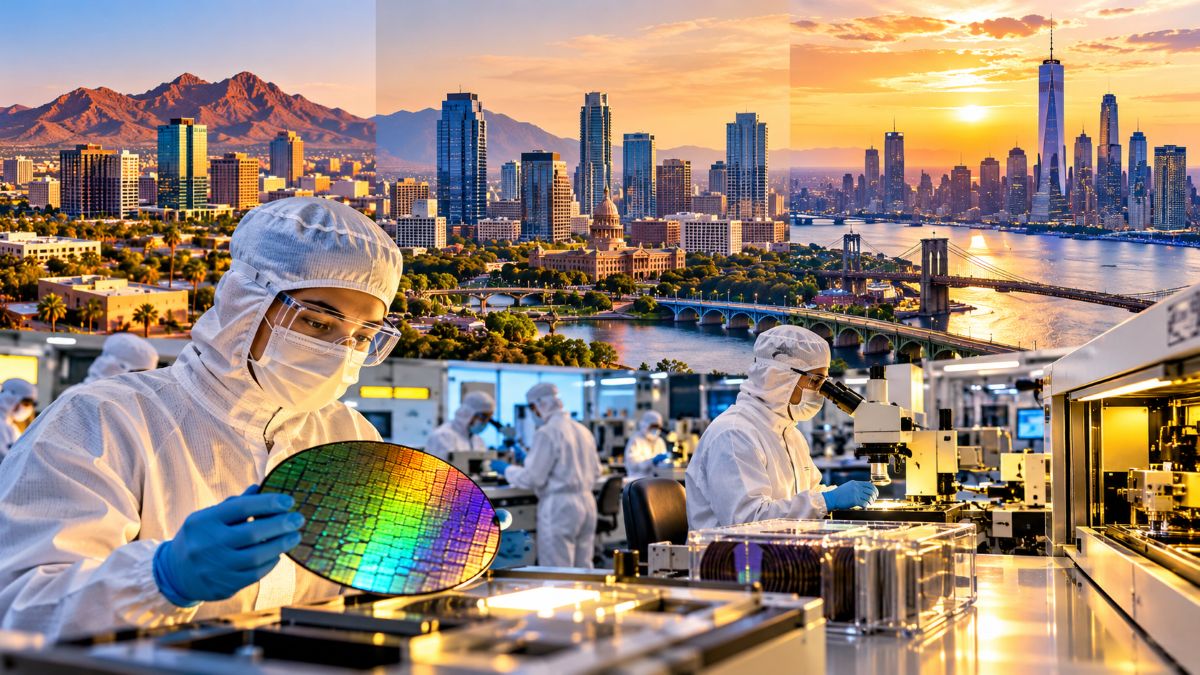
Image generated with Ai
The multi-billion-dollar domestic semiconductor expansion faces an acute human capital shortfall that threatens to stall the country’s manufacturing renaissance. Driven by artificial intelligence demand and historic federal subsidies, chipmakers have committed unprecedented capital toward constructing massive fabrication complexes across traditional and emerging manufacturing corridors. However, joint labor projections from McKinsey & Company and the SEMI Foundation indicate the domestic ecosystem could encounter a deficit of up to 157,000 technical workers by 2030, putting key timelines at risk.
Decades of offshore production stripped American universities, colleges, and trade schools of robust fabrication pipelines. Consequently, mere fractions of contemporary engineering graduates enter semiconductor fields, gravitating instead toward software engineering, cybersecurity, and financial technology. To reverse this structural erosion, state economic development boards, academic consortia, and industrial titans are consolidating resources. By deploying regional apprenticeships, cross-state university tracks, and heavy capital investments into cleanroom facilities, stakeholders are constructing a sustainable domestic workforce pipeline to protect critical sovereign manufacturing capabilities.
Advertisement
Advertisement
The Magnitude of the Modern Fabrication Talent Gap
American fabrication output steadily contracted over the previous three decades, dropping from over a third of global microchip volume down to approximately a tenth. While domestic research and architectural design retained unquestioned preeminence, high-volume silicon manufacturing shifted overseas, leaving commercial training infrastructures largely abandoned. The abrupt pivot back toward domestic manufacturing reveals deep labor vulnerabilities across every tier of fab operations, ranging from equipment operators to doctoral-level materials scientists.
Industrial compensation across leading domestic fabrication hubs remains robust, yet recruitment friction persists. Advanced facilities demand rigorous round-the-clock shift rotations within ultra-sterile cleanrooms, environments that require complete containment suits and exacting physical discipline. Because the vast majority of engineering graduates prioritize fully remote or hybrid computer science positions, chipmakers find themselves locked in an aggressive intra-industry competition for a static talent pool while new production sites prepare for operational activation.
Advertisement
Advertisement
| State Hub | Key Corporate Manufacturers | Projected Initial Headcount | Core Educational Partner | Target Operational Phase |
| Arizona | TSMC, Intel | 4,500+ Specialized Roles | Arizona State University | Active Commercial Run |
| Texas | Samsung Electronics | 3,500 Direct Positions | UT Austin, Regional Colleges | Late 2026 Commissioning |
| New York | Micron Technology | 9,000 Direct Positions | SUNY System | Multi-Year Construction |
| Indiana | SK Hynix | 1,000 Packaging Specialists | Purdue University | Packaging Launch |
| Idaho | Micron Technology | 2,000 Memory Technicians | Boise State University | 2027 Fab Production |
Regional Consortia Rebuilding Educational Infrastructure
Overcoming systemic educational deficits demands coordinated initiatives between competitive states and private sector leaders. In the Southwest, higher education leaders have repurposed legacy microelectronics infrastructure into cutting-edge fabrication centers, outfitting facilities with commercial-grade lithography and deposition tools. These academic pipelines allow technicians and process engineers to gain hands-on cleanroom experience before stepping into multi-billion-dollar commercial fabs, substantially cutting standard corporate onboarding timelines.
Concurrent regional strategies in the Midwest and Northeast emphasize scalable academic pipelines tailored to advanced packaging and dynamic random-access memory fabrication. Specialized collegiate degree paths now enroll thousands of students each semester, offering structured internship rotations and guaranteed corporate interview pathways. Backed by federal workforce allocation grants under the CHIPS and Science Act, over eighty community colleges have introduced two-year microelectronics certificates to address the acute shortage of maintenance technicians.
Advertisement
Advertisement
Strategic Deployment of Global Industrial Expertise
Because cultivating domestic personnel requires years of sustained investment, chip manufacturers are utilizing international technical deployments to navigate immediate factory commissioning deadlines. Engineering specialists from advanced facilities in East Asia are stationed at newly erected facilities in the American West and South, providing critical operational knowledge transfers and guiding complex equipment calibrations.
Simultaneously, American cohorts are completing extensive cross-training overseas to master specialized chemical mechanical planarization, etching, and extreme ultraviolet lithography systems. While immigration pathways like the H-1B program provide temporary relief for highly specialized technical positions, corporate leaders and policymakers agree that sustainable national security and supply chain independence depend entirely on domestic educational reform and homegrown technical talent.
FAQs
What is the primary cause of the current semiconductor workforce shortage?
Decades of manufacturing migration to Asia reduced domestic production capacity, leaving American educational institutions without structured training pipelines for commercial cleanroom fabrication careers.
How large is the projected worker deficit facing the chip industry?
Industry estimates indicate the domestic semiconductor sector could face a shortage of up to 157,000 technicians, engineers, and specialists by 2030.
Advertisement
Advertisement
What percentage of global microchips are manufactured in the United States today?
The domestic manufacturing share stands at approximately ten percent, a sharp contraction from thirty-seven percent recorded in 1990.
Which American states are seeing the highest semiconductor expansion?
Significant fabrication investments are concentrated across Arizona, Texas, New York, Indiana, Idaho, and Ohio.
What typical salaries do semiconductor professionals earn domestically?
Industry figures indicate average domestic semiconductor compensation ranges between $127,000 and $187,000, with specialized senior engineering roles exceeding $238,000 annually.
Advertisement
Advertisement
Why do engineering graduates often avoid semiconductor manufacturing?
Students frequently favor software development, artificial intelligence, and cybersecurity due to flexible work arrangements, avoiding the physical discipline and gear required inside cleanrooms.
How are universities addressing the semiconductor talent deficit?
Institutions are creating specialized semiconductor degree tracks, updating cleanrooms with commercial equipment, and forming corporate partnerships that guarantee interviews.
What role does the CHIPS and Science Act play in workforce development?
The federal legislation allocates hundreds of millions of dollars toward specialized workforce funds, backing curriculum expansion across universities and community colleges nationwide.
Advertisement
Advertisement
Why are international technicians currently working in newly built domestic fabs?
Foreign specialists provide operational expertise during initial equipment start-ups and tool calibrations while local workforces complete training.
What types of roles are the hardest to fill inside a fab?
Process engineers, maintenance technicians, facilities specialists, and advanced packaging engineers represent the most critical talent bottlenecks.
Advertisement
