
Lombardy Cultural Tourism Takes Centre Stage in Italy as Milan Expands Heritage Travel

Published
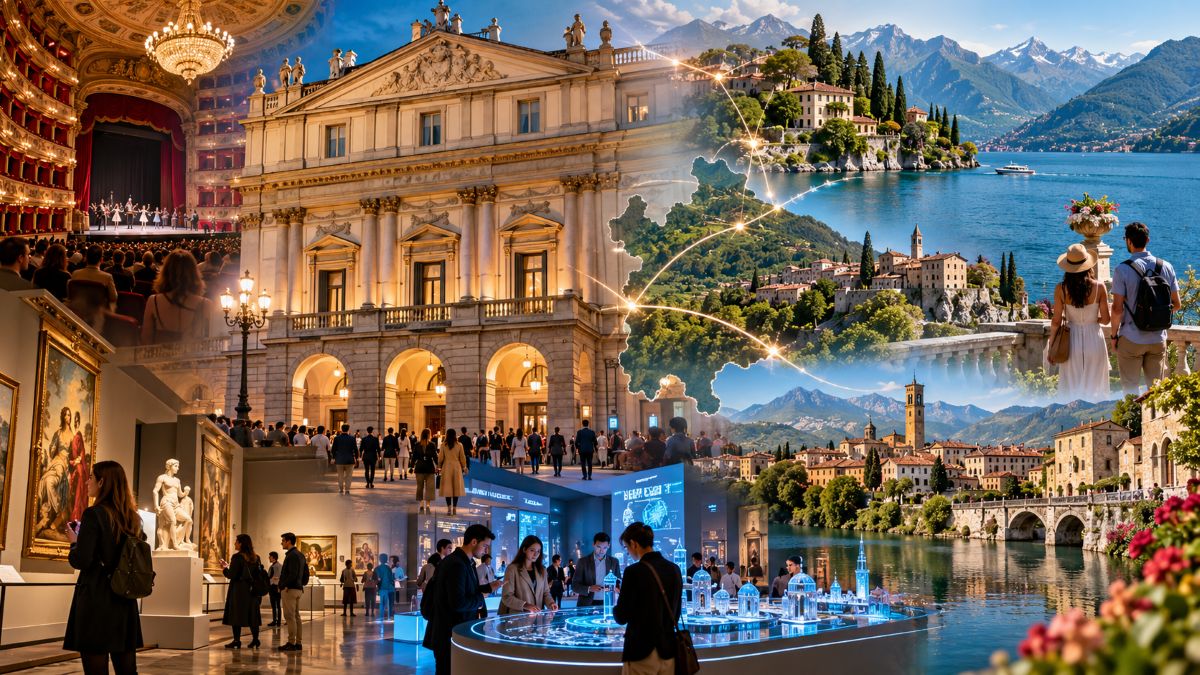
Image generated with Ai
Lombardy is positioning cultural tourism as an economic growth lever, with Milan providing the stage for a wider regional strategy. The second edition of FUTURA. New Perspectives for Culture brought political leaders, artists, designers and cultural figures together at Teatro alla Scala on 2 October 2026. The discussion focused on how heritage, creativity, technology and tourism can generate value beyond major cities. Lombardy recorded 22.35 million tourist arrivals and 56.71 million overnight stays in 2025, according to regional data. International visitors generated more than two-thirds of total nights. Meanwhile, the region’s museums recorded 12.4 million admissions in 2025, strengthening the case for culture-led destination development.
Milan Opens A Wider Cultural Tourism Conversation
Teatro alla Scala became the setting for FUTURA’s second edition, promoted by Lombardy’s Culture Councillor Francesca Caruso. The event brought together institutional leaders and figures from literature, architecture, theatre, design, film, art and business.
President Attilio Fontana and Tourism Minister Gianmarco Mazzi joined Caruso and La Scala Superintendent Fortunato Ortombina. The central theme was deliberately broad, examining how curiosity and questioning can shape cultural innovation in an era of rapid technological change.
The event was held on 2 October, although several reports appeared on 3 and 4 October. This distinction matters because the original information circulated for the story dates the event to 3 October. Contemporary reports from the venue and regional coverage place the actual gathering on 2 October.
Advertisement
Advertisement
Fontana argued that cultural development must embrace digital transformation without severing connections with local identity. His message placed artificial intelligence and technology inside a broader discussion about preserving heritage while creating new cultural experiences.
The discussion therefore moved beyond culture as an attraction. It presented culture as infrastructure for economic activity, destination identity and territorial competitiveness.
Advertisement
Advertisement
Small Towns Become The Next Tourism Frontier
For travellers, the most significant message came from Caruso’s emphasis on smaller municipalities. Lombardy already benefits from Milan’s international profile, yet the regional strategy increasingly seeks to distribute visitor spending across lesser-known destinations.
“We want those visiting Lombardy to discover the heritage and cultural initiatives of small municipalities,” Caruso said during the event.
That approach could reshape how international visitors construct itineraries. Instead of treating Milan as a self-contained city break, travellers could combine the capital with theatres, exhibitions, historic centres and cultural venues elsewhere in the region.
The policy direction also fits Lombardy’s 2026-2028 Tourism and Attractiveness Plan. Approved by the regional council in June, the plan prioritises experience-led tourism, digital innovation, artificial intelligence, territorial cooperation, professional skills and stronger storytelling around local identities.
| Indicator | Latest figure | Why It Matters |
|---|---|---|
| Tourist arrivals in Lombardy, 2025 | 22.35 million | Shows the scale of regional demand |
| Tourist overnight stays, 2025 | 56.71 million | Indicates substantial visitor spending potential |
| International share of arrivals | 63.32% | Demonstrates strong overseas demand |
| International share of overnight stays | 68.07% | Highlights the importance of foreign travellers |
| Museum admissions, 2025 | 12.40 million | Shows the strength of cultural visitation |
| Hotel share of overnight stays | 52.77% | Indicates continued importance of hotels |
| Non-hotel share | 47.23% | Reflects diversification of accommodation |
The official regional figures show that international demand now plays a dominant role. Foreign visitors accounted for 68.07% of overnight stays, while Milan alone exceeded 22.8 million nights in 2025.
Culture Already Carries Serious Economic Weight
The economic argument behind the event is substantial. Lombardy’s cultural and creative economy generated more than €33 billion in value added, according to the 2026 Io sono Cultura findings cited by the region.
Advertisement
Advertisement
The figure places Lombardy first nationally in absolute cultural economic value. The wider ecosystem includes design, architecture, publishing, audiovisual production, software, creative services and cultural enterprises.
A separate regional study found that cultural activity generated more than €33 billion in value added in 2024. It also supported more than 378,000 jobs, demonstrating the sector’s reach beyond museums and performing arts.
| Cultural Economy Measure | Lombardy Position |
|---|---|
| Cultural and creative value added | More than €33 billion |
| Cultural and creative employment | More than 378,000 |
| Cultural enterprises | About 62,000 |
| Architecture and design enterprises | About 23,000 |
| Design share of Italy’s national value added | 33.4% |
| Milan design enterprises | More than 7,300 |
This breadth gives tourism policymakers a powerful advantage. Visitors do not consume culture only through ticketed attractions. They also engage with design districts, festivals, architecture, fashion, food, performance and creative neighbourhoods.
Consequently, a culture-led tourism strategy can generate spending across hotels, restaurants, transport, retail, entertainment and local services.
Museum Demand Strengthens The Strategy
The visitor data provides another compelling signal. Lombardy’s recognised museums recorded 10.08 million visitors in 2025, while state museums added another 2.32 million. Combined admissions reached approximately 12.4 million.
Milan remains the dominant cultural gateway. Eight of the ten most visited recognised museums were located in the city, while museums in Varenna and Gardone Riviera also featured prominently.
Advertisement
Advertisement
However, the regional figures show that cultural demand extends beyond Milan. Como, Bergamo, Mantua, Varese and Cremona also host museums attracting more than 100,000 visitors.
That geographical spread matters for tourism management. It creates opportunities to develop multi-stop itineraries while reducing excessive concentration around the best-known attractions.
Tourism Growth Is Moving Beyond Volume
Lombardy entered 2026 from an unusually strong position. Regional statistics recorded 56.71 million overnight stays in 2025, up from 52.96 million in 2024. Arrivals rose to 22.35 million, an increase of about 1.47 million year on year.
The growth also supports a broader shift towards year-round tourism. International visitors remained the majority throughout the months, helping extend the effective tourism season from April into October.
The region expects further expansion. Figures presented around FUTURA indicated 27.7 million overnight stays between June and September 2026, representing an estimated 5.9% increase. Longer-term projections suggest a potential 16% increase in flows across 2026-2028, equivalent to around nine million additional nights.
The important policy change is therefore qualitative. Lombardy increasingly wants visitor growth to create value for communities, rather than simply increasing headline arrival figures.
Advertisement
Advertisement
What This Means For Travellers
For visitors, the strategy could gradually produce more compelling reasons to stay longer. A traveller arriving in Milan may increasingly find regional cultural experiences promoted as part of one connected destination.
The 2026-2028 tourism plan specifically prioritises experience-led tourism, digital innovation and territorial cooperation. It also seeks to strengthen the identity of individual destinations rather than relying exclusively on Milan’s international brand.
| Traveller Interest | Potential Lombardy Experience |
|---|---|
| Opera and performance | Teatro alla Scala and regional theatres |
| Art and museums | Milan, Mantua, Bergamo, Varese and Cremona |
| Design | Milan and the wider design ecosystem |
| Historic towns | Smaller municipalities across the region |
| Lakes and culture | Como, Garda and surrounding cultural destinations |
| Food and wine | Regional gastronomic and wine routes |
| Heritage landscapes | Alpine, lakeside and historic territories |
For travellers, this creates a practical opportunity to build longer regional itineraries instead of concentrating every night in Milan.
It could also make shoulder-season travel more attractive. Museums, exhibitions, theatres and heritage sites can provide reasons to visit outside traditional summer periods.
Digital Innovation Could Change Cultural Discovery
Technology featured prominently in the FUTURA debate. Fontana highlighted the challenge of artificial intelligence and digital transformation while stressing the importance of retaining cultural roots.
For tourism, that distinction is crucial. Artificial intelligence can improve itinerary planning, multilingual interpretation, destination discovery and personalised recommendations.
Advertisement
Advertisement
Digital tools can also help lesser-known places compete for attention. A small museum or historic town does not need the marketing power of Milan if digital platforms can connect its cultural offer with relevant visitor interests.
Lombardy’s tourism plan explicitly includes artificial intelligence and digital innovation among its strategic priorities. That makes technology a formal component of destination development rather than merely a promotional experiment.
A Regional Model Takes Shape
Lombardy’s approach now combines three powerful assets. Milan supplies global visibility, the wider region provides cultural depth, and technology can connect the two.
The model also follows a broader Italian tourism trend towards experiential, sustainable and geographically distributed travel. Lombardy’s own 2026-2028 strategy seeks to move beyond mass-flow growth and generate value for businesses, communities and destinations.
For the travel industry, the opportunity is considerable. Tour operators can package cultural circuits, hotels can promote regional excursions, transport providers can connect cultural clusters, and local businesses can benefit from longer visitor stays.
For travellers, the result could be a more nuanced Lombardy. Milan remains the gateway, but it increasingly becomes the starting point rather than the entire story.
Advertisement
Advertisement
Lombardy Builds Its Next Cultural Chapter
FUTURA 2026 has placed Lombardy cultural tourism inside a much larger economic conversation. The region already possesses the visitor volumes, cultural infrastructure and creative industries required to support that ambition.
The challenge now lies in converting those assets into wider territorial benefits. That means directing attention towards smaller municipalities, strengthening cultural programming and making destinations easier to discover.
The numbers suggest the foundations are already strong. More than 56.7 million overnight stays, 12.4 million museum admissions and over €33 billion in cultural value create substantial momentum.
For international travellers, the emerging proposition is clear. Milan offers the headline attractions, while the wider Lombardy landscape increasingly offers the depth, diversity and local character that can turn a city break into a richer regional journey.
Advertisement
