
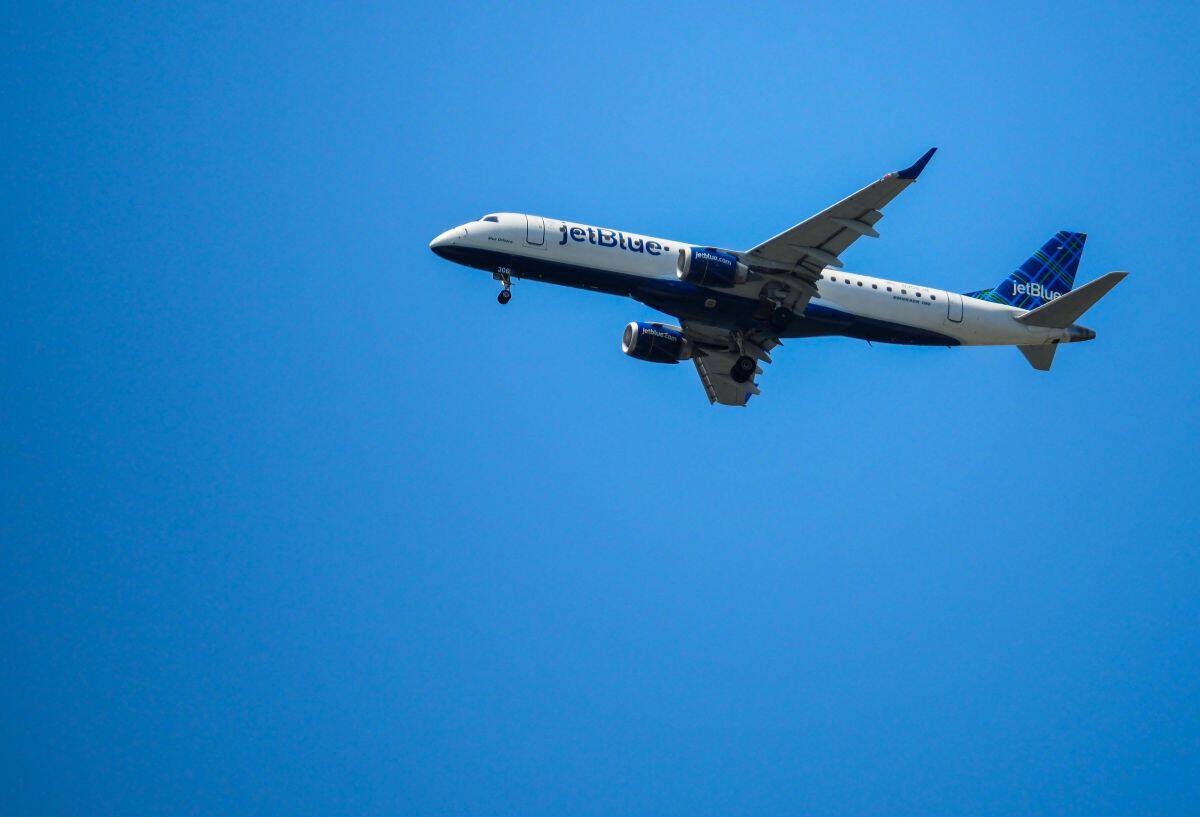
Image generated with Ai
JetBlue Airways Flight JBU805, an Airbus A220-300 from John F. Kennedy to Chicago O’Hare, Diverts to Milwaukee Mitchell International Airport, Wisconsin, United States on 9th August at 9:58 PM STA. JetBlue Airways Flight JBU805 on August 9 from JFK to ORD, operating with an Airbus A220 diverted to Milwaukee Mitchell International Airport, Wisconsin after an operational requirement necessitated a routing change. Operating as JBU805, the Airbus A220 from New York’s John F. Kennedy International Airport to Chicago O’Hare International Airport changed course and diverted to Milwaukee Mitchell International Airport in the state of Wisconsin.
According to standard procedures, diversions allow a flight to use any alternate airport on the route to the destination airport if a direct departure is not possible. While the reason for this diversion has not been announced, diversions are necessary when, due to operational or unexpected reasons, the control of an aircraft in flight must be deviated to a different position than that filed. Among many reasons, flight diversions can occur due to weather, ATC (Air Traffic Control) flow restrictions or operational constraints, and can even occur midflight. JetBlue Airways and the aviation sector, in general, demonstrate that safety of passengers is prioritised when managing disruptions.
A JetBlue Airways flight operating from John F. Kennedy International Airport (JFK), New York, to Chicago O’Hare International Airport (ORD), Illinois, on 9 August 2026, was diverted to Milwaukee Mitchell International Airport (MKE), Wisconsin, instead of completing its scheduled journey to Chicago.
The aircraft involved was an Airbus A220-300, registered as N3156J. Flight tracking records show the aircraft was scheduled to operate the New York JFK–Chicago O’Hare route, with a scheduled departure time of 8:00 PM and planned arrival at 9:58 PM. The aircraft was diverted to Milwaukee during the flight, with the Chicago arrival ultimately cancelled.
Advertisement
Advertisement
The exact reason for the diversion has not been publicly confirmed. JetBlue states that flight diversions can occur for several operational reasons, including extreme weather at the destination airport, excessive holding times, fuel considerations or medical emergencies.

Image generated with Ai
| Information | Details |
|---|---|
| Airline | JetBlue Airways |
| Flight Number | JBU805 |
| Aircraft Type | Airbus A220-300 |
| Aircraft Registration | N3156J |
| Origin | John F. Kennedy International Airport (JFK), New York |
| Scheduled Destination | Chicago O’Hare International Airport (ORD), Illinois |
| Diversion Airport | Milwaukee Mitchell International Airport (MKE), Wisconsin |
| Date | 9 August 2026 |
| Scheduled Departure | 8:00 PM |
| Scheduled Arrival | 9:58 PM |
The Airbus A220-300 involved in the diversion is part of JetBlue’s modern narrow-body fleet and is commonly used for domestic and regional operations. Aircraft tracking records confirm the aircraft was diverted to Milwaukee on the scheduled JFK–Chicago service.
The specific cause behind the JetBlue Airways Flight JBU805 diversion has not been confirmed by the airline. However, diversions are a routine part of commercial aviation operations and are made when flight crews determine that continuing to the planned destination may not be the safest or most practical option.
Milwaukee Mitchell International Airport is a commonly used alternative airport for flights originally scheduled to arrive at Chicago O’Hare because of its location within the same broader Midwest travel region. The airport can support diverted commercial aircraft and provides airlines with an additional operational option during disruptions.
Advertisement
Advertisement
Chicago O’Hare is one of the busiest airports in the United States, handling a significant volume of domestic and international traffic. Weather conditions, air traffic restrictions, congestion or operational issues at major hubs can sometimes require airlines to redirect aircraft.
JetBlue’s own passenger guidance notes that diversions may occur because of destination weather, excessive holding times, fuel-related considerations or medical situations. Image generated with Ai
Chicago’s aviation network can be affected by rapidly changing weather patterns, particularly during summer months when thunderstorms, strong winds and heavy rainfall can disrupt airport operations.
When conditions around Chicago O’Hare become challenging, aircraft may experience delays while waiting for suitable landing opportunities. In some situations, airlines may decide that diverting to an alternative airport is a safer and more efficient option.
Milwaukee Mitchell International Airport provides valuable support in such situations because it offers additional capacity close to Chicago. This allows airlines to avoid prolonged delays in the air and provides aircraft with a secure landing location.
Pilots make diversion decisions in coordination with airline operations teams and air traffic controllers. They consider several factors, including fuel levels, weather forecasts, airport availability and passenger safety.
After a diversion, passengers are typically provided with updated information from the airline’s flight crew and airport operations teams. JetBlue advises passengers that local airport teams and flight crews will communicate the next steps following a diversion.
For Flight JBU805 passengers, the next stage would depend on several operational factors, including conditions at Chicago O’Hare, aircraft availability and crew requirements.
If the aircraft and crew are able to continue, the flight may resume towards Chicago. If the disruption continues, passengers may require alternative arrangements, including rebooking or transportation assistance.
Diversions can create challenges for travellers, particularly those with onward connections. However, they are designed to reduce risk and ensure that airlines can continue operations safely.
The diversion of JetBlue Airways Flight JBU805 from New York JFK to Milwaukee highlights how modern aviation systems respond to unexpected operational challenges.
Flight crews continuously monitor weather, aircraft performance and airport conditions throughout every journey. When circumstances change, pilots have the authority to select an alternative airport that provides a safer operating environment.
Alternative airports such as Milwaukee Mitchell International Airport play an important role in supporting the wider aviation network. They provide airlines with flexibility during periods of disruption while helping protect passengers and crew.
Although diversions may cause delays, they remain an essential safety measure in commercial aviation. The JetBlue Airways Flight JBU805 diversion demonstrates how airlines use established procedures to manage uncertainty and maintain safe air travel operations across the United States.
Flexibility and safety management exemplify modern aviation, both of which the diversion of JetBlue Flight 805 from JFK to O’Hare shows. The Airbus A220-300 safely diverted from the JFK to O’Hare flight route and landed at Milwaukee’s Mitchell International Airport. Why Flight 805 was diverted can’t be confirmed. What is confirmed is the need to follow safety protocol in airline operations to protect passengers and crew. JetBlue is one of the airlines that understands it is better to be flexible and divert a flight. Flight crew, airport teams, and dispatch collaborate to prioritize safety over otherAirline operations to protect passengers and crew. Milwaukee’s Mitchell International On top of being one of the busiest airports, Milwaukee’s Mitchell International Airport is showing itself to be one of the most flexibile airports through operations like Flight 805.
Advertisement
Tags: Chicago O’Hare International Airport, Illinois, John F. Kennedy International Airport, Milwaukee Mitchell International Airport, New York
Advertisement
Advertisement













Friday, September 4, 2026

Friday, September 4, 2026

Friday, September 4, 2026

Friday, September 4, 2026

Thursday, September 3, 2026

Wednesday, September 2, 2026

Friday, September 4, 2026

Friday, September 4, 2026


