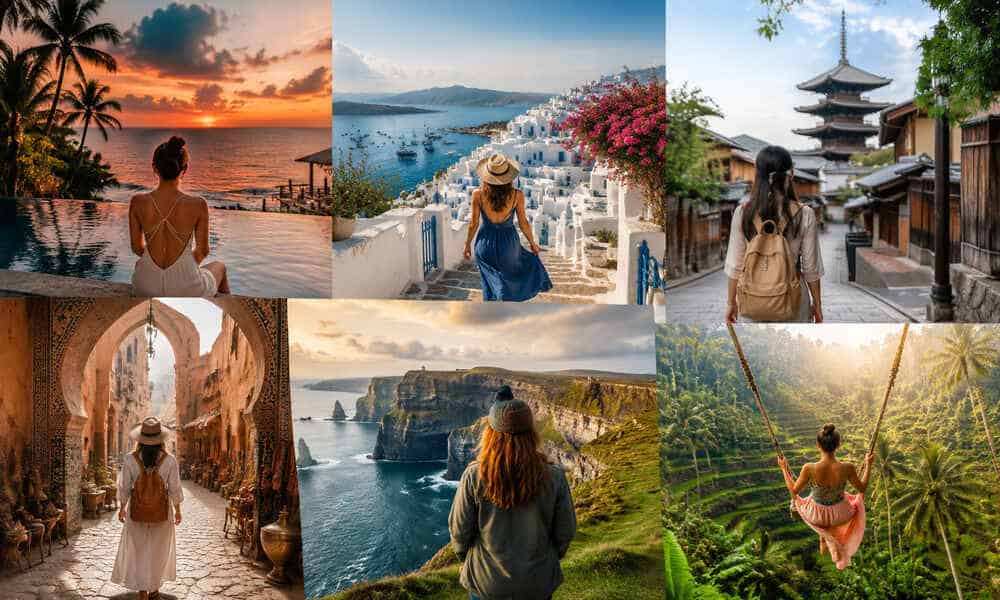
Image generated with Ai
Indonesia, Japan, Greece, Morocco, Ireland fuel solo female travel boom with Bali and Paros rising as safe, high-demand wanderlust hotspots worldwide.
The global tourism landscape is undergoing a structural shift as solo female travel becomes one of the fastest-growing behavioural trends in international mobility. Driven by rising independence, digital empowerment, and a stronger emphasis on personal safety and authentic experiences, women are increasingly choosing to travel alone rather than in groups or traditional package tours.
Advertisement
At the centre of this transformation, destinations such as Indonesia, Japan, Greece, Morocco, and Ireland are emerging as key global hubs for independent women travellers. Within this ecosystem, Bali in Indonesia and Paros in Greece are standing out as flagship destinations, symbolising safety, cultural depth, and experiential freedom.
This evolution is not accidental. It is the result of changing demographics, shifting travel motivations, and a redefinition of what modern tourism represents.
Advertisement
Solo female travel is expanding because the core motivations behind tourism have fundamentally changed. Women are no longer travelling solely for leisure. Instead, travel is increasingly linked to identity-building, self-development, and emotional reset.
Across major source markets, independent travel is being driven by higher income participation among women, improved global connectivity, and greater confidence in navigating unfamiliar environments. The rise of real-time translation tools, digital maps, ride-hailing platforms, and verified accommodation networks has significantly reduced traditional travel barriers.
In parallel, travel content ecosystems on social media and review platforms have normalised solo journeys. What was once perceived as risky is now widely viewed as aspirational, structured, and achievable.
Safety remains the most influential factor shaping destination choice for solo female travellers. However, the definition of safety has evolved beyond crime statistics.
Modern travellers assess safety through transport reliability, nighttime mobility, emergency accessibility, and the presence of women-friendly services. Destinations that offer clear infrastructure support, visible tourism assistance, and predictable public systems consistently outperform others in solo travel rankings.
This is why countries like Japan and Ireland continue to dominate global trust metrics. Their combination of order, hospitality culture, and accessibility creates an environment where independent travel feels intuitive rather than challenging.
Even in culturally complex destinations such as Morocco or Indonesia, structured tourism zones and guided experiences have significantly improved perceived safety levels.
Japan represents one of the most advanced ecosystems for independent travel. Its transport precision, low uncertainty environment, and strong hospitality norms reduce friction for solo travellers. Urban centres are highly navigable, while rural areas offer controlled cultural immersion.
Similarly, Ireland provides a contrasting but equally strong model. Its compact geography, English-speaking environment, and socially welcoming culture allow travellers to move with confidence. Public transport connectivity and community interaction create a balanced solo travel experience.
Both destinations demonstrate that safety is not just about security enforcement but also about predictability, clarity, and ease of movement.
Indonesia has emerged as one of the strongest drivers of the global solo female travel boom, primarily due to Bali’s transformation into a wellness and lifestyle hub.
Bali offers a hybrid travel ecosystem combining spiritual retreats, eco-tourism, coworking spaces, and structured social environments. This makes it uniquely suited for solo travellers who want independence without isolation.
The island’s tourism infrastructure supports flexible engagement. Travellers can participate in group wellness sessions, explore cultural heritage sites, or retreat into private accommodation depending on preference. This adaptability is a key reason Indonesia continues to attract a high volume of solo female travellers globally.
Greece has strengthened its position as a leading European solo travel destination through its island-based tourism model.
Among its destinations, Paros has become a defining example of safe, accessible, and visually appealing solo travel. The island’s compact layout allows easy navigation, while its interconnected villages provide both solitude and social interaction.
Ferry systems, walkable towns, and strong hospitality culture contribute to a seamless travel experience. Paros reflects the modern Mediterranean tourism identity—safe, scenic, and experience-driven rather than mass-market oriented.
Its rising visibility in global travel recommendations highlights the shift toward smaller, manageable destinations over large congested tourism centres.
Morocco plays a different but equally important role in the solo female travel ecosystem. It offers high cultural intensity combined with structured tourism pathways.
Historic medinas, desert landscapes, and artisan markets create immersive travel experiences. However, the growth of guided tours, verified transport services, and curated travel routes has made independent exploration more accessible than in the past.
For solo female travellers, Morocco represents a destination where cultural depth and structured safety systems intersect. The experience is highly sensory, yet increasingly supported by organised tourism infrastructure.
The rise of Bali and Paros as leading solo female travel destinations is not coincidental. Both represent a convergence of three critical factors: safety perception, experiential richness, and ease of mobility.
Bali offers emotional and wellness-driven travel experiences, supported by a strong international tourism network. Paros offers scenic calm, accessibility, and European infrastructure reliability.
Together, they represent two distinct but complementary travel models. One is tropical and retreat-focused. The other is Mediterranean and exploration-focused. Both, however, prioritise autonomy and comfort for independent travellers.
This duality explains why they are consistently highlighted in global travel analyses.
Modern solo female travel is not defined by isolation. Instead, it operates on a hybrid model where independence coexists with optional social engagement.
Wellness retreats, small-group excursions, and community-based experiences allow travellers to interact without losing autonomy. This model is particularly attractive to women seeking both self-reflection and cultural exchange.
Destinations that facilitate this balance are seeing stronger growth, as they reduce emotional barriers associated with solo travel while preserving personal freedom.
The growth of solo female travel is reshaping tourism economics. Independent travellers tend to spend more per trip on accommodation quality, curated experiences, and wellness services.
They also contribute more directly to local economies by engaging with small businesses, local guides, and niche cultural experiences. This creates a more distributed tourism impact compared to mass group travel.
As a result, destinations are increasingly investing in infrastructure that supports longer stays and higher-value experiences rather than short-term volume tourism.
Technology is a major enabler of this trend. Mobile navigation systems, instant translation tools, and digital booking platforms have eliminated many traditional uncertainties associated with solo travel.
Review-driven ecosystems allow women to make informed decisions based on peer experiences. This has created a trust-based global travel network where safety and quality information is continuously updated.
Destinations that integrate digital accessibility into tourism infrastructure are seeing higher adoption rates among solo travellers.
The solo female travel market is expected to continue expanding as demographic and behavioural shifts deepen. Younger generations are normalising independent travel earlier, while older travellers are extending their mobility later in life.
Countries that prioritise safety, accessibility, and authentic cultural engagement will remain dominant. Indonesia, Japan, Greece, Morocco, and Ireland are well positioned to benefit from this long-term structural shift.
The future of global tourism is increasingly individualised, experience-driven, and digitally enabled, with solo female travellers at the forefront of this transformation.
In conclusion, the surge in solo female travel is being driven by a powerful convergence of safety perception, digital confidence, and demand for meaningful, independent experiences. Countries such as Indonesia, Japan, Greece, Morocco, and Ireland are not only benefiting from this shift but actively shaping it through stronger tourism infrastructure, improved accessibility, and more inclusive travel ecosystems.
The reason destinations like Bali in Indonesia and Paros in Greece are emerging as standout hotspots lies in their ability to combine safety, ease of movement, and emotionally rewarding travel experiences. Bali offers wellness-driven, community-rich environments that support both independence and social connection, while Paros delivers a calm, highly navigable island setting with strong hospitality and low travel friction.
Together, these destinations reflect a broader truth: solo female travel is no longer defined by isolation, but by empowerment. Women are choosing places where they can explore freely, feel secure, and engage deeply with culture and environment. This shift confirms that the global travel industry is moving decisively toward personalised, experience-led tourism, with safe, well-connected destinations becoming the new gold standard for wanderlust-driven journeys.
Advertisement
Advertisement
Advertisement












Wednesday, September 2, 2026
Wednesday, September 2, 2026

Wednesday, September 2, 2026
Wednesday, September 2, 2026

Wednesday, September 2, 2026
Tuesday, September 1, 2026

Wednesday, September 2, 2026

Wednesday, September 2, 2026



