
France Sees Paris and Versailles Travel Disrupted as Metro Line 6 Closes and RER C Services Shift

Published
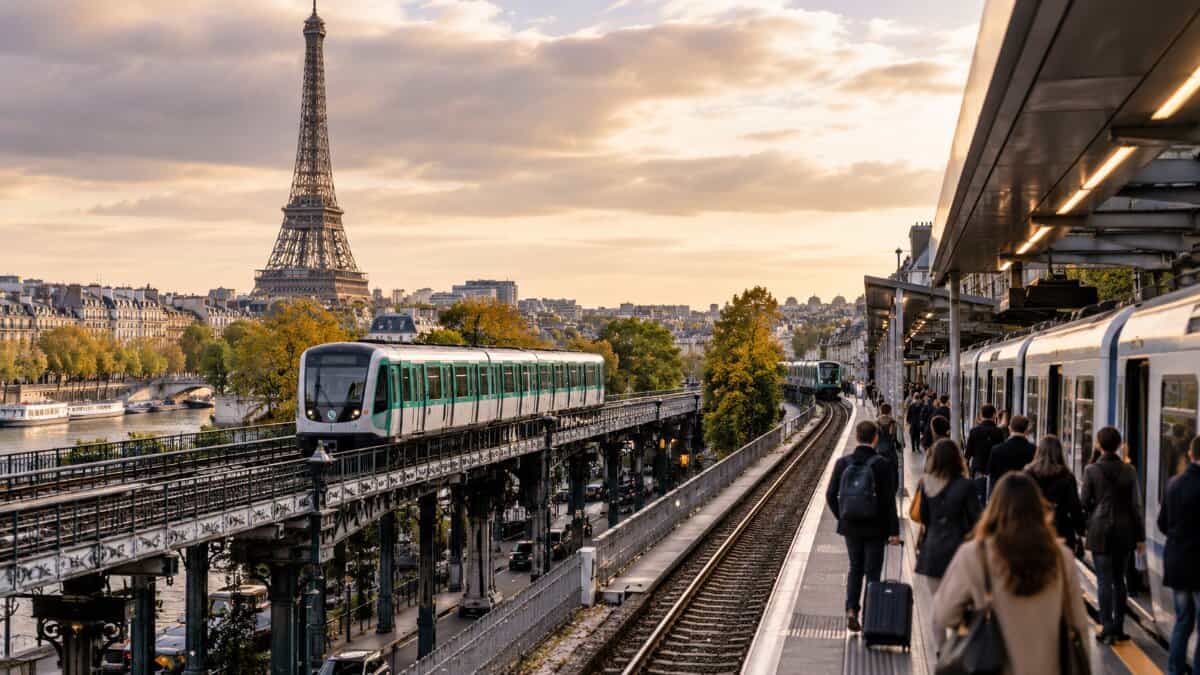
Image generated with Ai
Travellers across Paris and Île-de-France face a changing transport picture today rather than one simple closure. Metro Line 6 is shut for the entire day, as is Transilien Line V between Versailles-Chantiers and Massy-Palaiseau. Key RER C services towards Dourdan and Saint-Martin-d’Étampes regain their Paris link from 17:00, while the Paris–Massy corridor remains constrained. Later, evening cut-offs return on southern RER C branches. Monday then introduces another Paris–Versailles evening disruption pattern.
Paris transport disruption changes character during 4 October
The critical point for travellers today is timing.
Paris transport conditions on Sunday, 4 October, are not static. A journey planned during the morning cannot automatically be treated in the same way after 17:00 or late tonight.
According to RATP’s official Metro Line 6 works notice, the entire route between Charles de Gaulle–Étoile and Nation is closed throughout 4 October for modernisation. The same notice confirms further full Sunday closures on 11 October, 18 October, 8 November and 22 November, meaning today’s shutdown is not the end of the autumn works programme.
Advertisement
Advertisement
Replacement buses operate only between Charles de Gaulle–Étoile and La Motte-Picquet–Grenelle. RATP is also reinforcing bus route 71. That detail matters because travellers should not assume a single replacement bus reproduces the complete Line 6 journey from the western end of Paris to Nation.
The line normally connects several important visitor and transport districts, including Charles de Gaulle–Étoile, Trocadéro, Bir-Hakeim, Montparnasse-Bienvenüe, Bercy and Nation. RATP identifies Montparnasse-Bienvenüe as an interchange for Metro lines 4, 6, 12 and 13, while Bercy connects lines 6 and 14.
Advertisement
Advertisement
For international visitors, that turns today’s Line 6 closure into more than a local commuter issue. It changes familiar cross-city interchange patterns around major rail terminals, tourist districts and hotel zones.
The 17:00 RER C change is the detail travellers could easily miss
The most important operational shift occurs at 17:00.
Before that point, RER C trains serving Dourdan and Saint-Martin-d’Étampes operate only as far as Juvisy. Travellers continuing towards central Paris must change at Juvisy and use RER D. Passengers travelling out from Paris towards those southern branches must make the reverse connection.
From 17:00, RER C trains again run between Paris and Dourdan and between Paris and Saint-Martin-d’Étampes. Official Transilien information also specifies the return of service through central stations including Musée d’Orsay, Saint-Michel Notre-Dame, Paris Austerlitz and Bibliothèque François Mitterrand.
That does not mean every southern RER C problem ends at 17:00.
The Paris–Massy-Palaiseau branch remains disrupted throughout Sunday. SNCF Transilien states that stations between Bibliothèque François Mitterrand and Massy-Palaiseau remain unserved on that branch even after central Paris RER C service begins returning. A replacement bus operates between Pont de Rungis and Massy-Palaiseau for intermediate stops.
Advertisement
Advertisement
This distinction is particularly important for travellers using journey-planning information prepared earlier in the day.
What actually changes across the day
| Time on 4 October | Network | Operational position | Principal traveller implication |
|---|---|---|---|
| All day | Metro 6 | Entire Charles de Gaulle–Étoile–Nation line closed | Cross-Paris trips require other Metro lines, buses or alternative interchanges |
| Until 17:00 | RER C towards Dourdan | Trains operate only between Dourdan and Juvisy | Paris passengers must transfer through RER D at Juvisy |
| Until 17:00 | RER C towards Saint-Martin-d’Étampes | Trains operate only between Saint-Martin-d’Étampes and Juvisy | Central Paris is reached via an additional Juvisy interchange |
| From 17:00 | RER C southern branches | Paris–Dourdan and Paris–Saint-Martin-d’Étampes links resume | Some earlier detours cease to be necessary |
| All day | Paris–Massy RER C corridor | Direct branch remains interrupted | Several intermediate stations remain inaccessible by normal RER C service |
| From 21:07 | Dourdan branch | Evening closure sequence begins; last Dourdan departure is 21:07 | Late-return itineraries need replacement transport |
| Late evening | Saint-Martin-d’Étampes branch | Last departure from Saint-Martin-d’Étampes is 21:41; Paris Austerlitz last departure is 22:45 | Tour operators should not schedule ordinary RER C assumptions into late-night programmes |
| From 23:00 | Transilien V | Versailles-Chantiers–Massy-Palaiseau service interrupted | Late Versailles–Massy transfers move to replacement buses |
The timetable information above comes from the SNCF Transilien RER C and Line V works calendar updated for 4 October.
Massy becomes a critical interchange risk for rail and airport journeys
Massy-Palaiseau deserves particular attention because it is not simply a suburban stop.
SNCF Transilien identifies Massy-Palaiseau as an interchange for RER C, RER B, T12 and TGV services. The official Line V information also identifies RER B connections from Massy towards both Charles de Gaulle and Orly airports.
That creates a more complex risk for travellers combining regional rail, high-speed rail and airport transfers.
The RER C stations affected on the Paris–Massy corridor include Orly Ville, Pont de Rungis–Aéroport d’Orly, Rungis La Fraternelle, Chemin d’Antony and Massy Verrières. SNCF’s official RER C route information identifies Pont de Rungis as the RER C airport station and Massy-Palaiseau as a TGV and RER B interchange.
Advertisement
Advertisement
For passengers whose actual destination is Orly Airport rather than an intermediate RER C station, Metro 14 provides a separate airport corridor. Île-de-France Mobilités confirms that Metro 14 serves Orly Airport and that the Paris Region Airports ticket costs €14 for eligible airport journeys across the regional Metro, train, RER and Orlyval network.
That distinction should be reflected in travel-agent instructions. A passenger travelling to Orly Airport has different options from a passenger heading specifically to Orly Ville, Pont de Rungis or another station on the disrupted RER C corridor.
Versailles faces a second disruption phase late tonight
Versailles enters today’s disruption picture later.
According to the official Transilien Line V works calendar, trains between Versailles-Chantiers and Massy-Palaiseau stop running from 23:00 tonight. Replacement buses serve the intermediate stations.
Line V links seven stations between the two major interchange points. Versailles-Chantiers provides connections with RER C, Transilien N and U and TER services, while Massy-Palaiseau connects with RER C, RER B, T12 and TGV services.
For leisure groups returning from Versailles, rail passengers continuing through Massy, and customers with late hotel or airport transfers, the operational risk therefore increases again at the end of the day.
Advertisement
Advertisement
This is why describing 4 October simply as the final day of weekend disruption would understate the traveller issue. The more accurate interpretation is that different parts of the network become available or unavailable at different times.
Monday brings another Paris and Versailles rail change
The disruption also rolls directly into Monday, 5 October.
Official SNCF Transilien information shows that evening interruptions begin tomorrow between Javel and Versailles Château Rive Gauche. They are scheduled on weekdays from 5 to 30 October, excluding weekends and public holidays, with additional periods planned in November and December.
For the October phase, the last listed departure from Versailles Château Rive Gauche is 22:25, while the last departure from Javel is 23:11. Transilien identifies Line N, Metro, tram services and local bus routes 169 and 171 as alternatives.
This creates a Sunday-to-Monday handover that matters for escorted tours, independent travellers staying in Versailles, business travellers with evening programmes and operators issuing multi-day transport instructions.
A travel document prepared solely around today’s shutdowns could already be incomplete tomorrow night.
Advertisement
Advertisement
Why the overlapping works matter to the travel trade
The deeper issue is network dependency.
Paris tourism relies heavily on travellers being able to move between airports, high-speed rail stations, central accommodation districts and major attractions using simple interchange instructions.
Today’s works remove several of those simple assumptions at the same time.
Metro Line 6 loses its through service for the whole day. Southern RER C operations alter at 17:00. Massy remains constrained. Dourdan and Étampes face later evening cut-offs. Versailles–Massy Line V then closes at 23:00.
The operational lesson is that disruption notices should be attached to the actual travel time, not merely to the date.
A morning airport-transfer briefing, an afternoon sightseeing itinerary and a late-night hotel return can require three different routing strategies on the same Sunday.
Advertisement
Advertisement
For travel management companies, destination management companies and tour operators, that affects transfer margins, group-meeting times, coach contingency requirements, guide deployment and minimum connection buffers. It also increases the value of checking the live route planner immediately before departure rather than relying on static itinerary notes prepared several days earlier.
France is spending billions to modernise Île-de-France transport
Today’s disruption sits within a much larger infrastructure programme.
According to Île-de-France Mobilités, approximately €3.8 billion is being invested during 2026 to regenerate and modernise the regional transport network. The programme covers new rolling stock, infrastructure renewal, preparations for additional Metro lines and work intended to improve reliability, safety and passenger comfort.
RER C is one of the strategic priorities.
Île-de-France Mobilités has separately detailed a €4 billion RER C modernisation programme based on three pillars: rolling-stock renewal, infrastructure improvement and adaptation of the service offer. The authority plans to replace the line’s trains by 2033 after the infrastructure has been prepared for new rolling stock.
Separate 2026 RER C works have included up to four kilometres of track renewal, 215 metres of catenary renewal, flood-protection measures in the Invalides tunnel and the installation of a 1,400-tonne structure at Les Grésillons for a future Grand Paris Express interchange. Those projects illustrate the scale of renewal underway, although they should not be treated as the stated cause of every individual closure occurring today.
Advertisement
Advertisement
Critical operational takeaways for travel agents and tour operators
- Recheck every Paris itinerary scheduled for 4 October rather than treating the disruption as one uniform all-day condition.
- Do not route passengers onto Metro Line 6 today; the entire line is closed.
- Do not assume the Line 6 replacement bus covers Charles de Gaulle–Étoile to Nation because RATP specifies replacement service only as far as La Motte-Picquet–Grenelle.
- Before 17:00, build Juvisy interchange time into Dourdan and Saint-Martin-d’Étampes journeys involving Paris.
- After 17:00, verify the restored RER C service before retaining an earlier RER D diversion.
- Treat the Paris–Massy corridor separately because intermediate RER C stations remain affected despite the 17:00 reopening on other southern branches.
- Distinguish passengers travelling directly to Orly Airport from those needing RER C stations around Orly and Rungis.
- Protect late-night Versailles–Massy itineraries before Line V stops from 23:00.
- Reissue instructions for Monday, 5 October, because recurring evening works begin on the Javel–Versailles Château Rive Gauche corridor.
- Use live RATP, Transilien and Île-de-France Mobilités journey information before dispatching groups or confirming tight rail-air connections.
Paris transport disruption is becoming an itinerary-management issue
The significance of 4 October lies less in the existence of engineering works than in how the network changes hour by hour.
France is investing heavily in the long-term reliability and resilience of transport across Paris and Île-de-France. Yet the immediate consequence for travellers is a temporary increase in journey complexity.
Today’s Line 6 shutdown, the 17:00 RER C transition, later southern-branch cut-offs and the 23:00 Versailles–Massy suspension demonstrate why transport disruption increasingly needs to be managed as a timed itinerary issue rather than a simple closure alert.
That pressure will continue beyond tonight. Metro Line 6 has further Sunday closures scheduled, while new RER C evening works affecting the Paris–Versailles corridor begin on 5 October.
For the international travel trade, the safest strategy is therefore dynamic journey management: matching each traveller’s actual departure time, interchange point, airport, rail station and destination against the live official network position. In a city where one itinerary may combine Metro, RER, Transilien, TGV and airport services, that level of detail is now essential to protecting the passenger journey.
Advertisement
