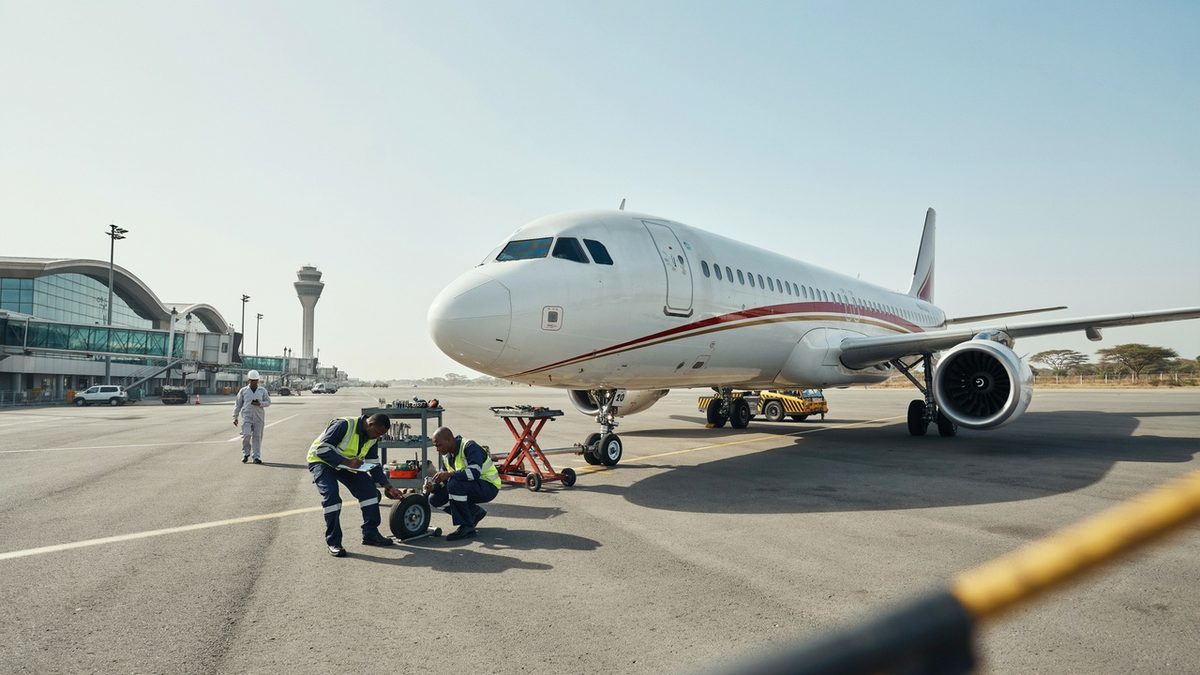
Image generated with Ai
Ghana has delivered a major boost to aircraft spare parts tax relief for domestic airlines after President John Dramani Mahama assented to the new Ghana Customs Act, 2026. The measure removes duties and taxes on aircraft spare parts imported by domestic carriers, with the government linking the change directly to safer aircraft maintenance. The announcement matters because Ghana’s domestic aviation market carried 903,227 passengers to and from Accra in 2025, according to official Ghana Civil Aviation Authority figures. The relief comes as Ghana works to expand airport capacity, improve connectivity and strengthen its position as a leading West African aviation hub.
The central development is clear. Ghana has introduced a new customs measure that removes duties and taxes on aircraft spare parts imported by domestic airlines.
President John Dramani Mahama announced the policy on 27 August 2026 during the groundbreaking ceremony for a new multi-tiered, multi-purpose car park and airport hotels complex at Accra International Airport.
According to the Ghana News Agency, Mahama said he had recently assented to the new Ghana Customs Act. He specifically stated that the law removes duties and taxes on aircraft spare parts imported by domestic airlines.
Advertisement
Advertisement
The President connected the measure with aviation safety.
He said the government wants domestic airlines to be safer and that spare parts required to maintain their aircraft would come into Ghana duty-free and tax-free.
This is an important distinction.
The announcement does not describe a blanket removal of every aviation-related tax or import charge. The relief announced by the President specifically concerns aircraft spare parts imported by domestic airlines.
That means the measure is targeted.
It is designed to address one part of the cost structure facing local carriers: the expense of obtaining components needed to keep aircraft maintained and operational.
The policy also comes through a new customs law rather than through a temporary administrative concession.
The Presidency separately confirmed that President Mahama signed ten major bills into law on 26 August 2026. Among them was the Customs Act, 2026, which the government described as a consolidation of existing customs laws into one statute intended to improve administration and reduce revenue leakages.
The aircraft-parts provision therefore sits within a much wider customs reform programme.
The Customs Act, 2026 is broader than the aircraft spare-parts measure.
The Presidency says the Act brings existing customs laws and amendments together into a single statute. President Mahama said the consolidation should make customs administration simpler and more efficient while closing loopholes associated with the previous scattered legal framework.
For aviation, the targeted spare-parts relief gives that wider customs reform a direct industry application.
Airlines depend on continuous maintenance.
Aircraft cannot simply remain in service without scheduled inspections, component replacement and repairs. Parts may need to be sourced from international suppliers because aircraft systems and components are often tied to specific manufacturers, models and approved maintenance requirements.
The cost of bringing those parts into the country can therefore affect the economics of aircraft maintenance.
Removing duties and taxes can reduce the landed cost of eligible components.
However, the policy should not be interpreted as a reduction in safety requirements.
The Ghana Civil Aviation Authority remains the country’s aviation regulator. Its stated mandate covers the regulation of air transportation in Ghana, while its regulatory framework includes safety, security, economic and operational requirements.
In other words, cheaper access to parts does not mean cheaper safety standards.
Airlines still have to comply with applicable maintenance and operational requirements.
The financial relief and the regulatory obligation work in parallel.
That distinction is vital for passengers.
The government’s stated reason for the measure is not simply to make airlines cheaper to operate. President Mahama explicitly linked the duty-free treatment to aircraft maintenance and safety.
President Mahama specifically named Africa World Airlines and PassionAir when announcing the measure.
His comments indicate that the government expects Ghana’s two established domestic passenger carriers to benefit from the new treatment.
The Ghana Civil Aviation Authority had already brought local airlines into sector discussions before the customs reform.
At a June 2025 stakeholders’ meeting, GCAA said representatives from Africa World Airlines and PassionAir were among those attending discussions on Ghana’s aviation industry. The meeting focused on safety, operational excellence, regulatory development and the future direction of the sector.
That provides useful context.
The spare-parts measure is not happening in isolation. It arrives within a wider government effort to improve aviation infrastructure, strengthen regulation and expand Ghana’s position as an aviation hub.
Africa World Airlines has a particularly important domestic footprint.
The airline’s official website says it operates in five Ghanaian cities: Accra, Kumasi, Tamale, Takoradi and Wa. It also serves regional destinations in Nigeria, Liberia and Sierra Leone.
That domestic network gives the policy wider relevance than a single route.
When an airline maintains aircraft used across multiple domestic markets, maintenance decisions can influence connectivity between Ghanaian cities.
A reduction in eligible import costs can potentially ease part of the financial burden associated with keeping those aircraft available for service.
The precise financial saving for each airline will depend on the type, value and volume of eligible spare parts imported.
No official government source reviewed for this article provides a projected annual monetary saving for Africa World Airlines or PassionAir.
It would therefore be incorrect to claim a specific savings figure.
The verified point is simpler: duties and taxes on aircraft spare parts imported by domestic airlines have been removed under the new customs legislation, according to the President’s announcement.
The policy arrives against a substantial domestic passenger market.
Official GCAA statistics show that passengers travelling to and from Accra on domestic services reached 903,227 in 2025.
That was higher than the 862,727 recorded in 2024.
The 2025 total also exceeded the 852,101 recorded in 2022.
The figures show that domestic aviation remains an important part of Ghana’s transport system.
Kumasi accounted for the largest component of the 2025 total, with 486,859 passengers travelling to or from Accra.
Tamale recorded 217,899.
Takoradi recorded 133,069.
Sunyani recorded 36,163.
Wa recorded 24,970.
Charter movements included in the GCAA table accounted for 4,267 passengers.
The total was therefore spread across several domestic markets rather than concentrated entirely on one city.
The growth is also visible over the longer term.
GCAA data show that domestic passengers travelling to or from Accra totalled 690,314 in 2019. The figure fell sharply during the pandemic period, reaching 389,252 in 2020.
Passenger numbers recovered to 722,721 in 2021 and rose to 852,101 in 2022.
After falling to 775,662 in 2023, domestic passenger traffic increased again to 862,727 in 2024 and 903,227 in 2025.
That recovery matters for airlines.
More passengers create opportunities, but they also increase the need for reliable aircraft availability.
If aircraft are unavailable for maintenance reasons, airlines may face pressure on schedules and capacity.
The government’s new approach to spare parts therefore addresses a cost issue at a time when the domestic market is showing sustained demand.
Passenger numbers alone do not determine airline performance.
Aircraft utilisation, maintenance planning, availability, crew, airport capacity and operating costs all influence the ability of an airline to provide regular service.
Ghana’s official aviation statistics show a domestic network with significant passenger movement between Accra and regional centres.
Kumasi alone generated almost 487,000 passenger movements to and from Accra in 2025.
Tamale generated almost 218,000.
Takoradi exceeded 133,000.
Together, these routes represent a substantial share of domestic passenger activity.
This makes aircraft reliability important for the wider economy.
When a route is disrupted, the impact can reach beyond passengers who have a flight ticket.
Business travellers can lose valuable time.
Tourists can face changes to their itineraries.
Hotels, restaurants, tour operators and local businesses can also be affected when travel between regions becomes less predictable.
The new customs measure does not guarantee that flights will become cheaper or more frequent.
It does, however, remove one identified financial barrier associated with imported aircraft components for eligible domestic operators.
That creates a potentially more favourable operating environment.
The spare-parts relief is arriving alongside a major programme of airport investment.
On 27 August, President Mahama also broke ground for a new multi-tiered, multi-purpose car park and airport hotels complex at Accra International Airport.
The project is expected to take 24 months to complete.
It will include a seven-storey car park, two hotels, a pedestrian connection to Terminal Three and more than 2,000 parking bays.
The President said the completed complex would provide about 2,030 covered parking bays.
The development reflects a wider strategy.
Ghana is trying to prepare airport infrastructure before passenger congestion becomes more severe.
According to the Ghana News Agency report, passenger traffic through Accra International Airport increased from 1.8 million in 2022 to 2.5 million in 2025. The government sees this increase as evidence of expanding connectivity and Ghana’s attractiveness for business, tourism and investment.
That growth creates pressure on more than aircraft.
Airport roads, parking areas, security operations, passenger processing and terminal capacity all need to keep pace.
The new airport complex is therefore part of a broader aviation development strategy.
The customs reform complements that strategy from the airline side.
Infrastructure supports the airport environment.
Aircraft maintenance supports the carrier operating within that environment.
Both are necessary for a functioning aviation system.
Ghana Airports Company Limited has separately been working to repurposed Terminal 2 at Accra International Airport.
GACL said the project is intended to facilitate both domestic and international operations and ease pressure on Terminal 3.
The company said the work would maximise unused terminal space and support Ghana’s ambition to establish the airport as a preferred aviation hub in West Africa.
The project was being developed with airline engagement.
GACL said airline representatives took part in a walkthrough of the project in March 2025 and provided feedback on operational readiness, activation and transition.
The repurposed terminal is expected to help accommodate increasing passenger traffic and reduce pressure during peak periods.
This is important when considering the new aircraft spare parts tax relief.
An airline’s operating environment includes both the aircraft and the airport.
Ghana is addressing both sides.
The country is investing in terminal and airport infrastructure while also providing targeted customs relief to domestic carriers.
That combination could support a stronger domestic aviation market if the measures are implemented effectively.
The government’s ambitions extend beyond domestic travel.
At the 2025 GCAA stakeholders’ meeting, Transport Minister Joseph Bukari Nikpe said Ghana wanted to position itself at the top of the aviation sector.
He highlighted infrastructure development and said Ghana was working towards becoming a hub for aviation in West Africa.
The government has also been working on airport infrastructure outside Accra.
At the August 2026 groundbreaking ceremony, President Mahama said preparations were under way for airports in Bolgatanga, Wa and Nsoatre near Sunyani.
This points to a national rather than purely Accra-focused aviation strategy.
Domestic air travel can help connect different regions with the country’s economic centre.
Regional airports can also support local tourism, business and investment when adequate air services are available.
But airports alone cannot create connectivity.
Airlines need viable aircraft.
They need maintenance support.
They need predictable operating conditions.
The new customs measure addresses one part of that equation.
The government’s justification for the tax relief is particularly notable because it is explicitly tied to safety.
President Mahama said the purpose was to make domestic airlines safer by allowing aircraft spare parts required for maintenance to enter duty-free and tax-free.
The GCAA’s own policy position reinforces the importance of safety.
The Authority describes itself as Ghana’s regulatory agency for air transportation and maintains a regulatory framework covering areas including flight standards, safety management, air navigation, aviation security, aerodromes and economic regulation.
Its certification framework also sets requirements for operators seeking approval to conduct commercial air transport.
For example, GCAA states that an airline applicant must be a Ghanaian registered company, hold an Air Carriers Licence and have an aircraft registered in its name in Ghana, among other requirements.
The Authority also publishes flight-standards guidance covering areas such as Air Operator Certificate applications, maintenance control by reliability methods, minimum equipment lists and adding aircraft types to an operator’s certificate.
This regulatory structure matters because the customs change should not be confused with a relaxation of technical requirements.
The government is reducing the fiscal cost of obtaining eligible parts.
It is not removing the obligation to maintain aircraft properly.
Passengers are unlikely to see the customs reform as a direct change at the ticket counter.
The measure is aimed at airlines and imported aircraft spare parts.
It does not announce a specific reduction in domestic airfares.
The potential passenger benefit is more indirect.
If domestic airlines face lower eligible maintenance-related import costs, they may have greater room to manage their fleets.
Better access to required components can support maintenance planning.
More predictable maintenance can contribute to aircraft availability.
Aircraft availability can, in turn, support schedule reliability.
These links are logical industry effects, but they should not be presented as guaranteed outcomes.
No official government source reviewed for this report states that the measure will automatically reduce ticket prices or increase flight frequencies.
The immediate confirmed outcome is the removal of duties and taxes on aircraft spare parts imported by domestic airlines.
The longer-term effects will depend on how carriers use the relief and how the policy is administered.
The reform also has a potential competitive dimension.
Domestic airlines operate in a market where operating costs can influence network decisions.
If maintenance-related import costs fall, carriers may have more flexibility to allocate resources elsewhere.
That could include fleet upkeep, training, operational systems or network development.
But again, these are potential uses rather than government-confirmed commitments.
Ghana’s aviation sector has already been moving towards wider connectivity.
GACL has highlighted regional route development involving Ghanaian and international carriers.
In April 2025, the company welcomed the launch of direct connectivity between Accra and Ouagadougou involving Africa World Airlines and Uganda Airlines, describing the route as an important development for business and leisure travellers.
This regional orientation is important.
A stronger domestic airline sector can support the broader aviation ecosystem by feeding traffic into regional and international services.
It can also help Ghana connect its major cities more effectively.
Aviation has effects well beyond the airline balance sheet.
When domestic air services connect Accra with Kumasi, Tamale, Takoradi and other cities, they support movement between different economic centres.
Business travellers can reach meetings faster.
Tourists can move between regions more easily.
Government officials and professionals can travel for work.
Families can maintain links across the country.
The GCAA’s 2025 statistics demonstrate the scale of this movement, with more than 903,000 domestic passenger movements to and from Accra.
That passenger activity supports airport operations and a wider chain of services.
These include ground handling, security, catering, transport, accommodation and other airport-related businesses.
The government is also investing in airport commercial infrastructure.
The new Accra airport complex will include hotels, retail and office space, a food court, a sky lounge and a sky observatory, alongside its parking facilities.
That demonstrates how aviation infrastructure is increasingly being viewed as part of a broader commercial ecosystem.
Ghana is also a major destination for cultural, heritage and business travel.
Domestic aviation can make it easier for international visitors to combine Accra with other parts of the country.
The value is particularly relevant when a traveller has limited time.
A visitor arriving in Accra may want to experience more than the capital.
Efficient domestic services can make multi-destination itineraries more practical.
This can support hotels, attractions, restaurants, tour operators and other tourism businesses in regional destinations.
However, the aircraft-spare-parts measure should not be presented as a tourism policy by itself.
The government has described it as a measure aimed at domestic airlines and aircraft maintenance.
The tourism connection is a potential secondary effect arising from stronger domestic connectivity.
The same principle applies to business travel.
A reliable domestic network can reduce the time and logistical cost involved in travelling between Ghana’s major commercial centres.
The customs change forms part of a broader period of aviation reform in Ghana.
GCAA has been pursuing regulatory and operational improvements.
In 2025, the Authority highlighted plans involving a modern Air Traffic Control Centre, Advance Passenger Information and Passenger Name Record systems, digitalisation of regulatory functions and expansion of Performance-Based Navigation protocols.
The Authority has also continued work in sustainability.
In June 2026, GCAA announced completion of a Business Implementation Study for sustainable aviation fuel following stakeholder engagement. The Authority said the study would support development of a sustainable aviation fuel industry in Ghana and help reduce aviation-related emissions.
This matters because Ghana’s aviation strategy is not focused on one issue.
The country is simultaneously addressing infrastructure, safety, digital regulation, sustainability, connectivity and airline operating conditions.
The customs reform adds another piece.
It is important not to overstate the scope of the policy.
The government has announced relief on aircraft spare parts imported by domestic airlines.
That does not mean every aviation expense in Ghana has disappeared.
Airlines continue to face other costs.
These include aircraft financing or leasing, fuel, staff, insurance, airport charges, navigation services, ground handling, training, regulatory compliance and other operating expenses.
The new customs measure targets only the duties and taxes covered by the new legal provision for eligible aircraft spare parts.
There is also no official statement establishing a universal percentage reduction in airline operating costs.
The financial impact will vary between carriers.
It will also depend on their fleet composition, maintenance requirements and import patterns.
Therefore, the strongest verified conclusion is that Ghana has removed a specific fiscal burden on aircraft spare parts imported by domestic airlines.
The next stage will be implementation.
A policy announcement becomes commercially meaningful when airlines can use it effectively.
The Ghana Revenue Authority remains responsible for customs administration.
Its public customs guidance states that goods are generally subject to customs duties unless specifically exempted by law. It also explains that duty assessment normally depends on customs valuation and applicable tariff classifications.
That framework makes the new legal exemption particularly important.
The new Customs Act provides the legal basis for the relief announced by the President.
Practical implementation will determine how eligible aircraft spare parts are identified, documented and processed.
The government has not publicly provided, in the sources reviewed for this article, a detailed list of every aircraft component covered by the exemption.
It would therefore be premature to claim that every item used in aircraft maintenance will automatically receive the same treatment without qualification.
The legal and customs administration details will matter.
Africa World Airlines is particularly relevant because it is one of Ghana’s principal domestic carriers and operates across several Ghanaian cities.
Its official corporate information states that the airline operates in Accra, Kumasi, Tamale, Takoradi and Wa, alongside regional destinations.
That network places the carrier directly within the domestic connectivity system that the government is seeking to strengthen.
The airline’s operating environment also reflects the importance of fleet availability.
A domestic network covering multiple cities requires aircraft to be maintained and scheduled effectively.
The customs relief therefore addresses a practical part of airline operations.
The President’s direct reference to Africa World Airlines and PassionAir shows that the government sees local carriers as important beneficiaries of the reform.
The supplied ch-aviation report says Africa World Airlines welcomed the change. However, because the editorial brief requires official sources only, this article does not treat that secondary report as independent confirmation of an AWA corporate statement.
The verified government record is that President Mahama explicitly said the two domestic airlines would be happy with the measure.
The timing of the reform is significant because domestic passenger traffic has recovered strongly from the pandemic shock.
In 2020, passenger movements to and from Accra on domestic services dropped to 389,252.
By 2025, the number had risen to 903,227.
That represents a major recovery over five years.
The 2025 figure was also above the pre-pandemic 2019 total of 690,314 in the same GCAA series.
This creates a different operating environment for Ghanaian airlines.
The market is no longer simply rebuilding.
Passenger activity has moved beyond the 2019 level in the official Accra domestic passenger series.
That makes fleet reliability and capacity increasingly important.
The government is therefore attempting to reduce selected airline costs while simultaneously expanding airport infrastructure.
The new airport complex at Accra International Airport is another visible part of the strategy.
The project will create more than 2,000 parking bays and connect the car park with Terminal Three through a pedestrian connector.
It will also introduce hotels and commercial facilities.
President Mahama said the project is intended to respond to growing passenger and airport activity and improve passenger experience.
GACL’s earlier Terminal 2 project has a similar strategic objective.
The company said re purposing Terminal 2 would help manage growing passenger traffic and congestion while making better use of existing infrastructure.
Together, these projects show that Ghana is treating airport capacity as a long-term issue.
The aircraft-spare-parts relief tackles a different bottleneck.
It targets the cost of maintaining the aircraft that provide the services.
The next few years will show whether the new policy delivers the intended benefits.
Several factors will matter.
First, airlines must be able to access the exemption efficiently.
Second, eligible spare parts must be processed under the new customs framework.
Third, carriers must continue meeting GCAA safety and maintenance requirements.
Fourth, passenger demand must remain strong enough to support domestic routes.
Fifth, airport infrastructure must expand alongside airline capacity.
Ghana has already recorded strong domestic passenger activity.
It is also developing airport infrastructure and regulatory systems.
The customs reform adds another tool to the government’s aviation strategy.
The policy is therefore best understood as part of a wider effort rather than a standalone solution.
It cannot solve every challenge facing domestic airlines.
But it can remove one clearly identified fiscal burden.
That could become increasingly relevant as Ghana seeks to expand connectivity between its regions and strengthen Accra’s role as a West African gateway.
For travellers, the most important point is that the reform is designed to support domestic airline operations rather than directly change passenger visa, ticketing or airport entry rules.
There is no government announcement stating that domestic airfares will immediately fall because of the exemption.
There is also no official promise that airlines will automatically add routes because of the change.
Instead, the government is reducing the fiscal burden attached to aircraft spare parts for domestic airlines.
The stated goal is closely linked to aircraft maintenance and safety.
That could help create better conditions for local carriers.
The wider passenger benefit will depend on how airlines respond and how the aviation market develops.
For now, the policy represents a clear change in Ghana’s customs treatment of eligible aircraft spare parts imported by domestic airlines.
The strongest feature of Ghana’s current aviation policy is its breadth.
The country is not relying on one reform.
It is expanding airport facilities.
It is examining sustainable aviation fuel.
And now it has removed duties and taxes on aircraft spare parts imported by domestic airlines.
The individual measures address different parts of the aviation ecosystem.
Infrastructure supports passengers.
Regulation supports safety.
Technology supports efficiency.
Maintenance supports aircraft availability.
Airline connectivity supports tourism, business and regional mobility.
That integrated approach is important as Ghana seeks to strengthen its position in West African aviation.
Ghana has taken a significant step to support domestic aviation by removing duties and taxes on aircraft spare parts imported by local airlines under the Customs Act, 2026. President John Dramani Mahama linked the measure directly to safer aircraft maintenance, while official GCAA data show domestic passenger movements to and from Accra reached 903,227 in 2025. The reform comes alongside airport expansion, terminal improvements and wider aviation initiatives. For Africa World Airlines, PassionAir and Ghanaian travellers, the immediate change is lower fiscal pressure on eligible imported maintenance parts. Its wider benefits will depend on effective implementation, airline investment and continued growth in domestic connectivity.
[Source:- ch- aviation]
Advertisement
Tags: Africa World Airlines, aviation tax relief, domestic airlines, Ghana aviation, Ghana Customs Act 2026
Advertisement
Advertisement












Wednesday, September 2, 2026

Wednesday, September 2, 2026

Wednesday, September 2, 2026

Wednesday, September 2, 2026

Wednesday, September 2, 2026

Tuesday, September 1, 2026
Wednesday, September 2, 2026

Wednesday, September 2, 2026



